Exact2Pass

We have coached hundreds of principal network architects, infrastructure directors, and senior solutions engineers through this elite expert-tier infrastructure milestone. Let's be completely transparent about this advanced validation process. The candidates who fall short on this intense conceptual evaluation are almost always those who relied on low-tier, unverified test pools—those flat, context-stripped answer repositories floating around public community forums. Those static, superficial memorization shortcuts simply cannot prepare you for the complex business scenario mapping or the high-level design (HLD) trade-offs tested on the real exam. At Ex1eact2Pass, our framework targets the underlying structural logic and technological design lifecycles of the enterprise network framework instead. Our 400-007 CCDE exam prep delivers comprehensive structural and discovery breakdowns for every multi-region plane routing and business alignment query. You will master actual core architectural engineering instead of leaning on short-sighted memorization shortcuts. We map out end-to-end IP traffic patterns, software-defined SD-WAN underlays, cross-border data sovereignty parameters, and complex cloud service placement strategies step by step.
Our learning material is built from the ground up by active network expert design authorities who orchestrate global corporate architectures daily. Because of that, we completely avoid mindless, repetitive question lists. Instead, our platform acts as a dynamic workspace that forces you to evaluate infrastructure scaling, regulatory compliance, and protocol dependencies like a principal systems architect. You will learn the exact reason why a specific control plane architecture or security enforcement mechanism succeeds or breaks under heavy corporate business requirements. That is how you build real confidence before logging into the official Pearson VUE and OnVUE testing environment. Our adaptive testing engine develops deep architectural skills that transfer perfectly to live data center deployments, helping you pass on your very first try.
Two enterprise networks must be connected together. Both networks are using the same private IP addresses. The client requests from both sides should be translated using hide NAT (dynamic NAT) with the overload feature to save IP addresses from the NAT pools. Which design addresses this requirement using only one Cisco IOS NAT router for both directions?
: 473
A network consists of multiple planes where each plane represents a different area of network operations and cames different types of network traffic Which two statements describe the concepts of assurance in the context of control planes? (Choose two.)
Sometimes SDN leverages various overlay networking technologies to create layer(s) of network abstraction. What describes an overlay network?
A global e-commerce company is expanding its operations and planning to migrate its entire infrastructure to a hybrid cloud solution. They are concerned about data governance and want to ensure that their customers ' data is treated with utmost respect to sovereignty and privacy. What is an appropriate approach?
Which relationship between IBGP and the underlying physical topology is true?
Company XYZ network runs IPv4 and IPv6 and they want to introduce a multidomain, multicast-based network. The new design should use a flavor of PIM that forwards traffic using SPT. Which technology meets this requirement?
Refer to the exhibit.
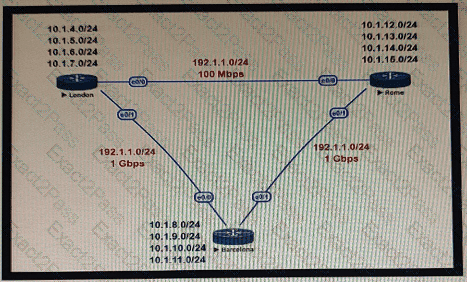
This network is running OSPF as the routing protocol. The internal networks are being advertised in OSPF. London and Rome are using the direct link to reach each other although the transfer rates are better via Barcelona. Which OSPF design change allows OSPF to calculate the proper costs?
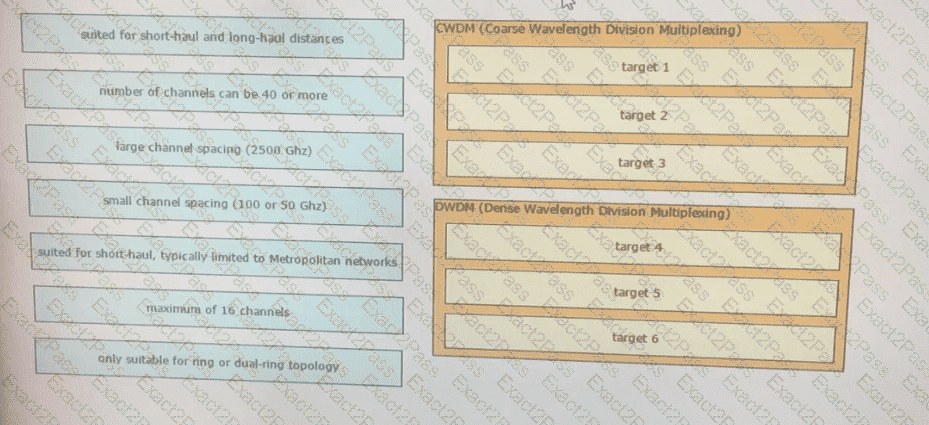
Drag and drop the optical technology design characteristics on the left to the correct optical technologies on the right. Not all options are used
Company XYZ needs advice in redesigning their legacy Layer 2 infrastructure. Which technology should be included in the design to minimize or avoid convergence delays due to STP or FHRP and provide a loop-free topology?
Which two mechanisms avoid suboptimal routing in a network with dynamic mutual redistribution between multiple OSPFv2 and EIGRP boundaries? (Choose two.)


