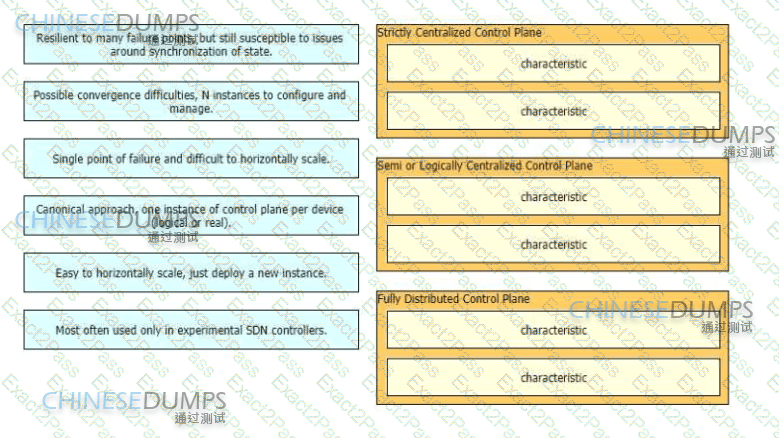
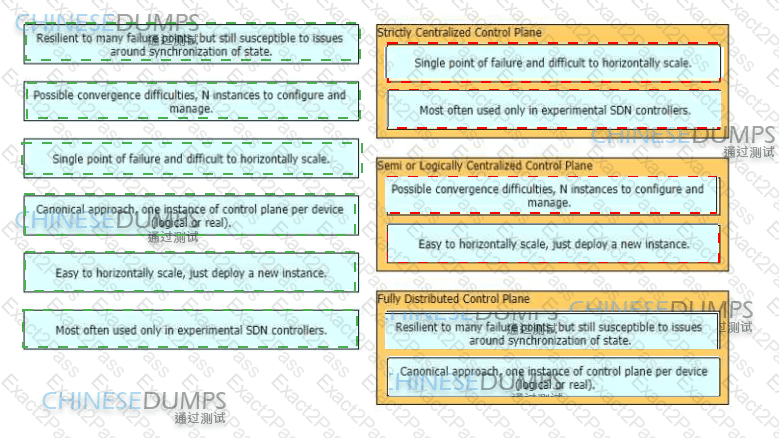
Comprehensive and Detailed Explanation:
B: Fate sharing refers to a situation where multiple logical or virtual paths depend on a single physical component. If that physical link fails, all virtual tunnels or services carried over it are simultaneously affected—reducing fault isolation and increasing failure impact.
Other options:
A: Tunneling is often needed for overlays; not inherently a drawback.
C: Bandwidth utilization is an efficiency metric, not a drawback in this context.
D: Serialization delay is more relevant to low-speed links or voice/real-time traffic, not virtualized path concerns.
???? QUESTION NO: 338 [Protocol Design Implications]
An engineer must redesign the QoS strategy due to oversubscription and excessive packet drops. What QoS technique should be used to manage traffic leaving the edge router and reduce packet drops?
A. LLQ
B. Traffic shaping
C. Rate-limiting
D. Policing
Answer:B
???? Explanation:
B: Traffic shaping buffers excess traffic and releases it gradually to match the configured rate, preventing congestion and dropped packets on outbound interfaces. It’s ideal for controlling egress traffic to match the service provider ' s rate.
Other options:
A: LLQ (Low Latency Queueing) provides strict priority queuing but doesn’t control overall rate or prevent oversubscription.
C: Rate-limiting enforces a cap and drops packets exceeding the threshold.
D: Policing drops excess traffic immediately and is more aggressive than shaping.
==========
???? QUESTION NO: 339 [Scenario-Based Design Strategy Guidance]
Refer to the exhibit. The network experiences Stuck-in-Active (SIA) problems due to resource contention. An acquisition will further increase routing demands via R3 and R4.
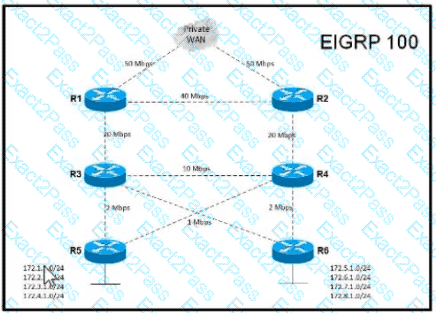
Which solution best mitigates the SIA issue?
A. Utilize EIGRP unequal cost load-balancing on R5 and R6
B. Implement EIGRP Route Flap Dampening
C. Deploy EIGRP stub on R5 and R6 with connected and summary options
D. Advertise only a default route to R5 and R6
Answer:C
???? Explanation:
C: Configuring R5 and R6 as EIGRP stub routers reduces query scope and prevents SIA conditions. EIGRP stub routers do not forward queries and are ideal for spoke or edge routers.
Other options:
A: Load balancing doesn’t reduce control-plane query overhead.
B: Route Flap Dampening isn’t applicable to EIGRP and won’t solve SIA.
D: Default route advertisement helps simplify routing, but stub configuration is purpose-built to prevent SIA issues.
==========
???? QUESTION NO: 340 [Security, Automation, and Policy Integration in Design]
Which are two benefits of using Layer 2 access control lists (ACLs) for segmentation? (Choose two)
A. Traffic filtering
B. Contextual filtering
C. Containing lateral attacks
D. Reduced load at Layer 2
E. VLAN intercept
Answer:A, C
???? Explanation:
A: Layer 2 ACLs can block or allow specific MAC or IP traffic right at the switchport.
C: Containing lateral attacks—Layer 2 ACLs help block unauthorized east-west traffic between hosts within the same VLAN.
Incorrect options:
B: Contextual filtering is associated with next-gen firewalls or Layer 7 inspection.
D: ACLs add processing load, not reduce it.
E: VLAN intercept is not a valid Cisco term for ACL application.
==========
???? QUESTION NO: 341 [Business-Driven Design Approaches / Agile Frameworks]
In the Scrum Agile framework, who acts as the interface between the business/customers and the team?
A. Product Owner
B. Product Manager
C. Scrum Master
D. Program Manager
Answer:A
???? Explanation:
A: The Product Owner is responsible for defining user stories, maintaining the product backlog, and representing the customer ' s voice to the development team.
B: Product Manager may define broader strategy but doesn’t manage the backlog directly.
C: Scrum Master ensures the process is followed but doesn’t interface with the business side.
D: Program Manager oversees multiple projects; not Scrum-specific.
==========
???? QUESTION NO: 342 [Security, Automation, and Policy Integration in Design]
Company XYZ must isolate and encrypt production traffic to meet HIPAA compliance. The current WAN includes MPLS and P2P links.
What is the fastest deployment option?
A. IPsec P2P tunnels over MPLS and links
B. GETVPN over MPLS
C. Centralized firewall
D. VRF-Lite with IPsec tunnels
Answer:A
???? Explanation:
A: IPsec point-to-point tunnels provide immediate, well-supported encryption across both MPLS and P2P transports. Quick to implement and doesn’t rely on service provider support.
Other options:
B: GETVPN requires coordination and is more complex to deploy.
C: Central firewalls don’t encrypt traffic over the WAN.
D: VRF-Lite with IPsec is viable but more complex than direct IPsec tunnels.
==========
???? QUESTION NO: 343 [Technology Comparisons and Use Cases]
One of the approaches used in cloud bursting is distributed load-balancing, where workloads operate between a public cloud and a data center.
How can the characteristics of distributed load-balancing be described?
A. Simultaneously provisions cloud resources
B. Usually uses cloud APIs for communication
C. Useful for testing and proof-of-concept projects
D. Useful for large but temporary cloud deployments
Answer:A
???? Explanation:
A: Distributed load-balancing in cloud bursting allows workloads to run simultaneously across on-premises infrastructure and public cloud. Resources are provisioned concurrently to manage increased load or optimize application performance.
Other options:
B: Cloud APIs are widely used, but this is a general trait of cloud integration—not specific to distributed load-balancing.
C: Proof-of-concept projects are more aligned with basic cloud testing or DevOps, not distributed production workloads.
D: Temporary deployments describe elastic scaling, not the permanent load-balancing between environments.
==========
???? QUESTION NO: 344 [Business-Driven Design Approaches]
Which two factors must be considered while calculating the Recovery Time Objective (RTO)? (Choose two)
A. Importance and priority of individual systems
B. Maximum tolerable amount of data loss that the organization can sustain
C. Cost of lost data and operations
D. How often backups are taken and how quickly these can be restored
E. Steps needed to mitigate or recover from a disaster
Answer: A, C
???? Explanation:
A: RTO depends on how critical the system is. More critical systems require shorter recovery times.
C: The business impact of downtime (cost of operational loss) drives the acceptable RTO for systems.
Incorrect options:
B: This refers to Recovery Point Objective (RPO), not RTO.
D: Backup frequency aligns with RPO; restore speed can influence RTO but isn ' t a direct calculation input.
E: Mitigation steps are part of disaster recovery planning—not direct RTO calculation.
==========
???? QUESTION NO: 345 [Network Architecture Principles]
As more links are added to a network, the control plane slows down due to more data to process. As redundancy increases, MTTR also increases. Which risk increases along with the higher MTTR?
A. Management visibility
B. Slower data plane convergence
C. Overlapping outages
D. Topology change detection
Answer:C
???? Explanation:
C: As MTTR (Mean Time to Repair) increases due to complex topologies and control plane delays, the likelihood of experiencing overlapping outages (i.e., a second failure occurring before the first is resolved) also increases. This can cascade into a wider outage.
Other options:
A: Management visibility isn’t directly affected by MTTR.
B: Data plane convergence is generally fast and not as affected as control plane convergence.
D: Topology changes may still be detected quickly, but the reaction time (recovery) is delayed.
==========
???? QUESTION NO: 346 [Security, Automation, and Policy Integration in Design]
Which layer of the SDN architecture orchestrates how applications receive available network resources?
A. Orchestration layer
B. Southbound API
C. Northbound API
D. Control layer
Answer:A
???? Explanation:
A: The orchestration layer manages global resource allocation, service policies, and end-to-end workflows. It ensures that applications receive the necessary resources through coordination between the control and application layers.
Other options:
B: Southbound APIs connect the control layer to the infrastructure layer.
C: Northbound APIs connect the control layer to applications but don’t handle orchestration.
???? QUESTION NO: 347 [Security, Automation, and Policy Integration in Design]
Company XYZ wants to detect and block known attacks by inspecting every forwarded packet with minimal performance impact. What is the recommended design?
A. Deploy an IPS behind the firewall in promiscuous mode
B. Deploy an IPS in front of the firewall in promiscuous mode
C. Deploy an IPS behind the firewall in in-line mode
D. Deploy an IPS in front of the firewall in in-line mode
Answer: C
???? Explanation:
C: Deploying the IPS behind the firewall in in-line mode ensures that only filtered and relevant traffic is inspected, minimizing performance impact while still allowing the IPS to block malicious packets. Inline mode allows for active blocking based on signature detection.
A and B: Promiscuous mode only detects but does not block traffic.
D: Placing IPS in front of the firewall increases the processing load by exposing it to all traffic, including unwanted or already-blocked connections.
==========
???? QUESTION NO: 348 [Technology Comparisons and Use Cases]
In an SDN architecture, what is present on the switches but not on the centralized controller?
A. Control plane functions
B. A southbound interface
C. Data plane functions
D. A northbound interface
Answer: C
???? Explanation:
C: In SDN, switches retain the data plane functionality—they forward packets based on flow rules received from the controller.
A: Control plane functions are moved to the centralized controller in SDN.
B: Southbound interfaces are present on both controllers and switches for communication.
D: Northbound interfaces exist on controllers to interact with applications—not switches.
==========
???? QUESTION NO: 349 [Technology Comparisons and Use Cases]
What is a connection service that provides direct connectivity to a cloud provider from a data center?
A. Cloud OnRamp
B. Cloud Gateway
C. Cloud Direct Connect
D. Carrier-neutral facility
Answer: C
???? Explanation:
C: Cloud Direct Connect (or equivalent, e.g., AWS Direct Connect, Azure ExpressRoute) provides private, low-latency connectivity between on-prem data centers and public cloud providers.
A: Cloud OnRamp is part of Cisco SD-WAN solutions that optimize SaaS and IaaS access.
B: Cloud Gateway typically refers to a device or service that connects on-prem to cloud, but not necessarily direct, private circuits.
D: Carrier-neutral facilities are physical data centers used for interconnection but not themselves the service.
==========
???? QUESTION NO: 350 [Scenario-Based Design Strategy Guidance]
A customer is designing a network to support video applications with centralized and distributed deployments. The team has reviewed bandwidth, cost, and usage patterns. What additional key information is missing?
A. Video traffic jitter and delay
B. Type of video resources
C. Transport protocol and traffic engineering
D. Network management and monitoring
Answer: B
???? Explanation:
B: The type of video resources (e.g., MCUs, call agents, conferencing servers) significantly affects whether a centralized or distributed deployment is more efficient. This decision impacts call setup, bridging, and media flow.
A: While jitter/delay are QoS concerns, they don’t dictate the resource allocation model by themselves.
C and D: Important for operations and engineering but not the missing business-critical input for resource placement.