Ticking Clock Black Friday Special: 75% Off! Apply coupon code below to save on all exam bundles! - Ends in 0d 00h 00m 00s - Coupon code: 75epass

Exact2Pass Menu

Cisco AI Technical Practitioner (810-110 AITECH)

Last Update 55 minutes ago Total Questions : 98

The Cisco AI Technical Practitioner (810-110 AITECH) content is now fully updated, with all current exam questions added 55 minutes ago. Deciding to include 810-110 practice exam questions in your study plan goes far beyond basic test preparation.

You'll find that our 810-110 exam questions frequently feature detailed scenarios and practical problem-solving exercises that directly mirror industry challenges. Engaging with these 810-110 sample sets allows you to effectively manage your time and pace yourself, giving you the ability to finish any Cisco AI Technical Practitioner (810-110 AITECH) practice test comfortably within the allotted time.

Question # 1

Which design principle helps stop an autonomous agent from getting stuck in an infinite loop and wasting tokens?

A.

Removing system prompts

B.

Implementing constraints

C.

Using known patterns

D.

Using smaller contexts

Question # 2

Which activity is being performed when a developer prompts an AI tool to produce an entire Python class for a new API client, working only from a high-level description of what it should do?

A.

Providing inline co-pilot assistance

B.

Performing code scaffolding

C.

Implementing predictive function logic

D.

Executing legacy code refactoring

Question # 3

A practitioner is examining a production failure in which an autonomous agent repeatedly invoked the same tool using different parameters, consuming thousands of tokens without progressing. Which artifact explains why the agent made those decisions?

A.

The system dashboard showing aggregate CPU and memory usage.

B.

The cumulative token consumption report generated for the entire execution period.

C.

The final output generated by the agent after the timeout limit was reached.

D.

The reasoning trace showing the chain-of-thought and the sequence of tool calls.

Question # 4

When preparing a comprehensive proposal from multiple AI-synthesized research documents, which workflow is most effective at ensuring the AI preserves context and consistency throughout the entire document?

A.

Draft each section in a separate chat session to prevent the AI from becoming confused.

B.

Create a "Master Briefing Document" and provide it as context for each drafting prompt.

C.

Rely on the AI's built-in long-term memory to recall all previous research documents.

D.

Instruct the AI to generate the entire proposal in a single prompt to ensure flow.

Question # 5

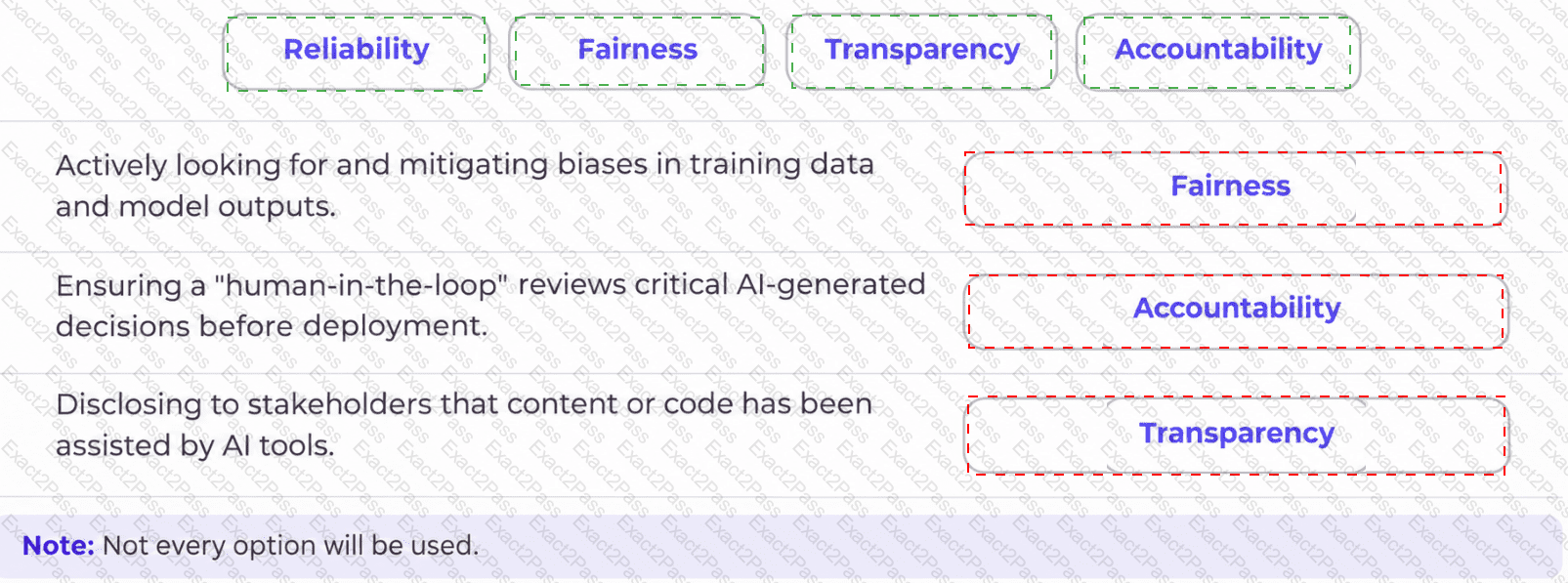
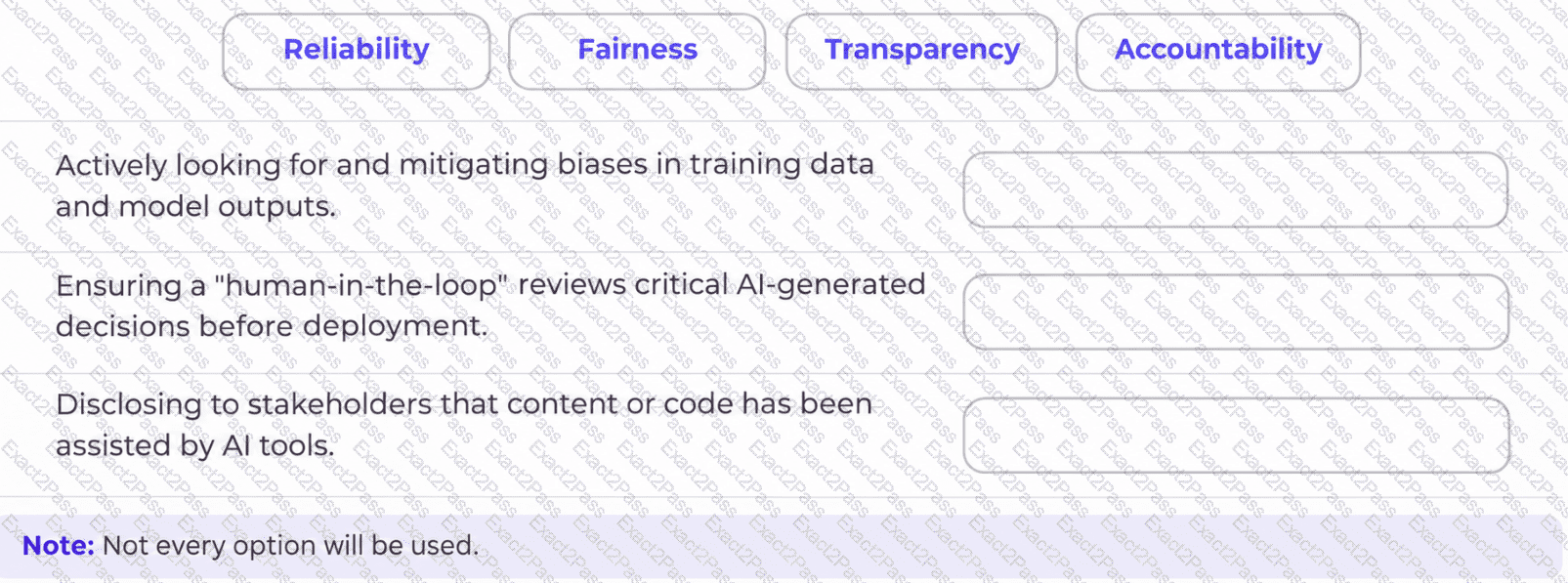
Drag the responsible AI principle on the left to its corresponding action on the right. Not every option will be used.
Question # 6

In the context of AI-assisted data analysis, what does the term "aggregation bias" refer to?

A.

When data is omitted due to incompatible formats

B.

When AI uses summary statistics instead of raw data

C.

When a summary masks subpatterns

D.

When AI fails to combine conflicting patterns

Question # 7

In the MCP (Model Context Protocol) open standard, what function does an MCP server perform?

A.

To host the LLM and perform token inference

B.

To provide the GUI for the end-user interaction

C.

To route requests between different AI providers

D.

To expose tools and resources to an AI model

Question # 8

When using AI to collect external information for a technical report, what professional practice is required for attributing sources?

A.

Enable the AI web search tool to automatically filter out all unverified external sources.

B.

Trust the AI's internal knowledge base, as it is trained on vast amounts of data.

C.

Request a URL for every claim, then verify the existence and accuracy of the source.

D.

Utilize only the specific sources that the AI identifies as highly reliable in the chat.

Question # 9

A practitioner applies the self-consistency technique by running the same prompt three separate times and comparing the resulting outputs. What is the purpose of this approach?

A.

To increase the response speed

B.

To verify the output reliability

C.

To bypass the context window

D.

To increase the model creativity

Question # 10

An analyst needs to use a model capable of simultaneously analyzing a network topology diagram along with a set of configuration logs. Which type of model should be chosen for this task?


A.

Multimodal model

B.

Diffusion model

C.

Embedding model

D.

Generative adversarial network

Go to page: