Exact2Pass

Last Update 55 minutes ago Total Questions : 105
The Implementing Cisco Wireless Advanced Solutions (300-120 WLSI) v1.2 content is now fully updated, with all current exam questions added 55 minutes ago. Deciding to include 300-120 practice exam questions in your study plan goes far beyond basic test preparation.
You'll find that our 300-120 exam questions frequently feature detailed scenarios and practical problem-solving exercises that directly mirror industry challenges. Engaging with these 300-120 sample sets allows you to effectively manage your time and pace yourself, giving you the ability to finish any Implementing Cisco Wireless Advanced Solutions (300-120 WLSI) v1.2 practice test comfortably within the allotted time.
The security policy mandates that only controller web management traffic is allowed from the IT subnet. In testing, an engineer is trying to connect to a WLAN with Web Authentication for guest users, but the page is timing out on the wireless client browser. What is the cause of the issue?
A retail chain is deploying a wireless network across multiple branch stores using Cisco Catalyst 9800 Series controllers and access points in FlexConnect mode. The employee WLAN uses WPA2-PSK and must remain available during WAN outages while still being centrally managed when WAN connectivity is available.
Which two actions should the network administrator implement to support this design? (Choose two.)
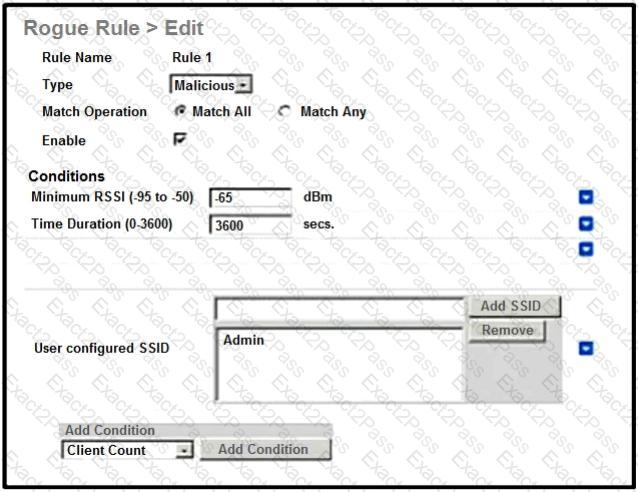
Refer to the exhibit.
An engineer tries to manage the rogues on the Cisco WLC. Based on the configuration, which AP is marked as malicious by the controller?
A wireless engineer deployed all remote sites as FlexConnect. The client VLAN assignment on these sites is configured manually mapped by WLAN and using local switching. Dynamic VLAN assignment is provided by the newly deployed Cisco ISE. Which IETF attribute must be configured on the AAA server to send that VLAN ID?
A customer must provide remote users with secure wireless access through a Cisco Catalyst 9800 Series Wireless Controller and Cisco APs. The corporate WLAN must be extended over the Internet to specific locations and support a locally installed IP phone.
Which two actions accomplish this configuration? (Choose two.)
A customer uses a Cisco Catalyst 9800 Series Wireless Controller and Cisco 802.11axAPs. The management has requested the ability to see what type of devices are on the wireless network. Which two types of local device profiling must be used? (Choose two)
When the Cisco FlexConnect AP Image Upgrade feature is used, APs must communicate with each other to distribute the image. Which two elements are required for this feature to work when the APs are on different subnets? (Choose two.)
Which three properties are used for client profiling of wireless clients? (Choose three.)
A corporation has a wireless network in which all APs are configured in FlexConnect mode. The WLC has a data WLAN and a VoWiFi WLAN, and both SSIDs are centrally switched. Which QoS configuration must be implemented so that wireless packets maintain their markings across the wired and wireless networks?
A network engineer created a new wireless network that will be used for guest access. The corporate network must utilize all rates. The guest network must use only lower rates instead of 802.11n data rates. To what must the WMM policy of the WLAN be set to accomplish this task?