Exact2Pass

Last Update 9 hours ago Total Questions : 215
The Health Plan Finance and Risk Management content is now fully updated, with all current exam questions added 9 hours ago. Deciding to include AHM-520 practice exam questions in your study plan goes far beyond basic test preparation.
You'll find that our AHM-520 exam questions frequently feature detailed scenarios and practical problem-solving exercises that directly mirror industry challenges. Engaging with these AHM-520 sample sets allows you to effectively manage your time and pace yourself, giving you the ability to finish any Health Plan Finance and Risk Management practice test comfortably within the allotted time.
In order to print all of its forms in-house, the Prism health plan is considering the purchase of 10 new printers at a total cost of $30,000. Prism estimates that the proposed printers have a useful life of 5 years. Under its current system, Prism spends $10,000 a year to have forms printed by a local printing company. Assume that Prism selects a 15% discount rate based on its weighted-average costs of capital. The cash inflows for each year, discounted to their present value, are shown in the following chart:
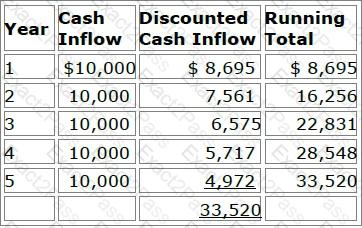
Prism will use both the payback method and the discounted payback method to analyze the worthiness of this potential capital investment. Prism's decision rule is to accept all proposed capital projects that have payback periods of four years or less.
Now assume that Prism decides to use the net present value (NPV) method to evaluate this potential investment's worthiness and that Prism will accept the project if the project's NPV is greater than $4,000. Using the NPV method, Prism would correctly conclude that this project should be
The Essential Health Plan markets a product for which it assumed total expenses to equal 92% of premiums. Actual data relating to this product indicate that expenses equal 89% of premiums. This information indicates that the expense margin for this product has:
The risk-based capital formula for health plans defines a number of risks that can impact a health plan’s solvency. These categories reflect the fact that the level of risk faced by health plans is significantly impacted by provider reimbursement methods that shift utilization risk to providers. The following statements are about the effect of a health plan transferring utilization risk to providers. Select the answer choice containing the correct statement:
The following information was presented on one of the financial statements prepared by the Rouge health plan as of December 31, 1998:
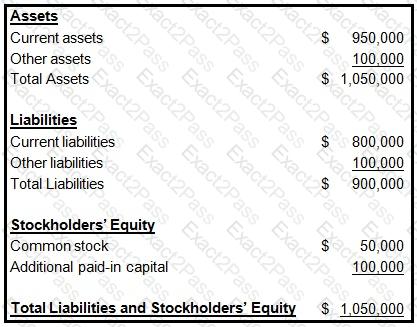
When calculating its cash-to-claims payable ratio, Rouge would correctly divide its:
A health plan most likely would use benchmarking in order to
The Fairway health plan is a for-profit health plan that issues stock. The following data was taken from Fairway's financial statements:
Current assets.....$5,000,000
Total assets.....6,000,000
Current liabilities.....2,500,000
Total liabilities.....3,600,000
Stockholders' equity.....2,400,000
Fairway's total revenues for the previous financial period were $7,200,000, and its net income for that period was $180,000.
For the previous financial period, Fairway's net profit margin was
Residual trend is the difference between total trend and the portion of the total trend caused by changes in provider reimbursement levels.
Consider the following events that could affect an health plan’s provider reimbursement levels:
Event 1 — The disenrollment of a large group with unusually high utilization rates
Event 2 — The introduction of a new treatment for infertility
Event 3 — A serious flu epidemic
Event 4 — A shift in inpatient medical services from obstetrical care to neonatal intensive care
One cause of residual trend is change in intensity, which would be represented by:
Correct statements about the financial risks associated with benefits that health plans provide to the Medicare and Medicaid markets include:
The Arista Health Plan is evaluating the following four groups that have applied for group healthcare coverage:
The Blaise Company, a large private employer
The Colton County Department of Human Services (DHS)
A multiple-employer group comprised of four companies
The Professional Society of Daycare Providers
With respect to the relative degree of risk to Arista represented by these four companies, the company that would most likely expose Arista to the lowest risk is the:
A health plan can use a SWOT (strengths, weaknesses, opportunities, and threats) analysis to analyze its relationships with the major providers in each market in which it conducts business.

