Exact2Pass

Last Update 16 hours ago Total Questions : 572
The MEDICAL LABORATORY TECHNICIAN - MLT(ASCP) content is now fully updated, with all current exam questions added 16 hours ago. Deciding to include ASCP-MLT practice exam questions in your study plan goes far beyond basic test preparation.
You'll find that our ASCP-MLT exam questions frequently feature detailed scenarios and practical problem-solving exercises that directly mirror industry challenges. Engaging with these ASCP-MLT sample sets allows you to effectively manage your time and pace yourself, giving you the ability to finish any MEDICAL LABORATORY TECHNICIAN - MLT(ASCP) practice test comfortably within the allotted time.
The coagulation department tests samples for:
On the red cell membrane, there is a bicarbonate / chloride exchanger. This exchanger allows for bicarbonate to leave the red cells while chloride is allowed inside.
In blood, bicarbonate leaves the red blood cell and enters the plasma through an exchange mechanism with:
Provide the equivalent measurement for one pint.
Post-hepatic obstruction is characterized by a marked increase in alkaline phosphatase, GGT, conjugated bilirubin, as well as other hepatic enzymes. The slight rise of ALT suggests that the issue is not hepatitis. Renal and cardiovascular failure do not match the symptom of jaundice or the abnormal laboratory values.
Chem
Which of the following conditions would be suggested by a jaundiced patient experiencing a marked rise in alkaline phosphatase, conjugated bilirubin, and a slight rise in ALT:
Certain recipients have increased risk for developing TA-GVHD. They are:
Neonates less than 4 months of age
Fetuses
Recipients with a congenital or acquired immunodeficiency, such as bone marrow or stem cell recipients, and patients receiving chemotherapy
recipients of donor units from a blood relative
Which of the following patients are at risk for transfusion-associated graft versus host disease (TA-GVHD) and require irradiated cellular blood products? (Choose all that apply)
CAMP is the correct answer because the case is typical of Streptococcus agalactiae(Group B strep). The main presumptive identification test is CAMP. Bile solubility is positive for Streptococcus pneumonia. Coagulase would be positive for Staphylococcus aureus. PYR is positive for Streptococcus pyogenes (Group A strep) which is ruled out by the resistance to bacitracin.
Microbiology
Spinal fluid cultures on a 3-day-old infant revealed beta-hemolytic, Gram-positive cocci occurring in pairs and chains. The organism was catalase-negative and bile esculin-negative. Resistance to 0.04 U disk of bacitracin was noted. The other test necessary to identify this organism is a positive test by:
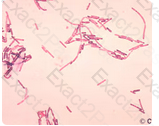
The organisms in this image are demonstrating a gram-variable phenomenon. For the most part, the organisms are staining primarily gram-negative, however, on the tips of some of the rods, there is a gram-positive staining morphology. This can be defined as gram-variable.
Which of the following best describes the organisms seen in this illustration:
Albumin is a " negative " acute phase protein since it is found in decreased levels during acute phase response. Alpha-1-antitrypsin, fibrinogen, and ceruloplasmin are all " positive " acute phase proteins that are found in increased levels during acute phase response.
Which one of the following usually shows a decrease during an acute phase response?
What is the best description of the purpose of the Commission on Office Laboratory Accreditation (COLA) pertaining to the clinical laboratory?
The structures involved in the production of semen include the prostate, the seminal vesicles, and the bulbourethral gland, along with the testes and epididymis.
Semen is produced as a combination of secretions from the different regions of the male reproductive tract. Each fraction differs in chemical composition and function.
Spermatozoa are produced in the testes. They mature in the epididymis. The testes also produce testosterone and inhibin.
Fluid from the seminal vesicles accounts for approximately 70% of semen volume. The seminal vesicles are the source of fructose in semen. Fructose is used by the spermatozoa as an energy source.
The prostate gland supplies about 20% of the volume of semen. Its fluids include acid phosphatase and proteolytic enzymes that lead to coagulation and subsequent liquefaction of semen. The prostate also contains most of the IgA found in semen.
The bulbourethral gland produces mucoproteins that make up about 5% of the volume of semen.
The pituitary gland is not directly involved in the production of semen; instead hormones are released which stimulate the production of sperm. The urethra is not involved in the production of semen.
Which of the following are directly involved in the production of semen?
The laboratory employee with an 2-year associate degree who performs clinical testing is the:
Elevation in conjugated bilirubin is most likely to be found in which of the following conditions:
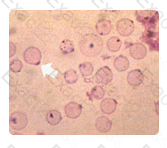
Heinz bodies occur as the result of denaturation and precipitation of hemoglobin, and are often attached to the red cell membrane. They require staining with crystal violet or methyl violet to be visible. They may be seen in thalassemia, with unstable hemoglobins, or during a hemolytic episode in G6PD deficiency.
Hematology
The intracellular precipitates seen in the RBCs in this illustration is termed:
When an antigen comes in contact with the skin, the antigen is processed by cells in the epidermis and come in contact with T lymphocytes. T lymphocytes recognize the antigen as foreign and circulate through the bloodstream back to the epidermis and produce an inflammatory response to eliminate the antigen, but this immune response can produce a characteristic rash in the skin called contact dermititis.
Contact dermatitis is mediated by:
Antidiuretic hormone, or ADH, has the important role of conserving body water by reducing the loss of water in urine by changing the water permeability of the distal tubule and collecting duct. An increase in ADH causes a concentrated urine since the water is retained and absorbed through the permeable membrane. An decrease in ADH causes the collecting ducts to retain very little water, instead it is excreted as urine.
Chemistry
Which of the following action describes the MAJOR property of antidiuretic hormone?

