Exact2Pass

Last Update 16 hours ago Total Questions : 572
The MEDICAL LABORATORY TECHNICIAN - MLT(ASCP) content is now fully updated, with all current exam questions added 16 hours ago. Deciding to include ASCP-MLT practice exam questions in your study plan goes far beyond basic test preparation.
You'll find that our ASCP-MLT exam questions frequently feature detailed scenarios and practical problem-solving exercises that directly mirror industry challenges. Engaging with these ASCP-MLT sample sets allows you to effectively manage your time and pace yourself, giving you the ability to finish any MEDICAL LABORATORY TECHNICIAN - MLT(ASCP) practice test comfortably within the allotted time.
The DAT, or direct antiglobulin test, is used to detect antibodies coating RBC ' s in vivo.
The Direct Antiglobulin Test (DAT) is usually used to detect:
Nucleated RBCs may be seen in the peripheral blood in cases of beta thalassemia major. Nucleated RBCs are usually not found in peripheral blood in cases of beta thalassemia minor and beta thalassemia intermedia, and would not be a finding in beta thalassemia minima.
Nucleated RBCs are most likely to be seen in the peripheral blood of which of these beta thalassemias?
Epidemiology studies only infectious diseases that impact humans
The results of this PT and aPTT are in normal range. These results can be reported and are not indicative of the need to: order a mixing study or request a redraw.
You have just performed stat PT and aPTT tests on your coagulation instrument. Your results are as follows:
PT = 12 seconds (normal range 10-13 seconds)
aPTT = 24 seconds (normal range 21-34 seconds)
What would be your next step?
Sally is seeing her new primary care provider for the first time. When she signs in, she is asked to sign papers for the release of medical records, including her laboratory results. According to the Health Insurance Portability and Accountability Act (HIPAA), she must authorize release of records before _______________would be permitted to receive and review her records.
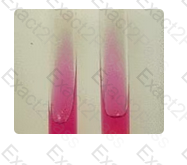
Conversion of only the slant to a pink color in a Christensen ' s urea agar slant is produced by bacterial species that have weak urease activity. The reaction in the slant to the right is often produced by Klebsiella species, as an example. Strong urease activity is indicated by conversion of the slant and the butt of the tube to a pink color, as seen in the tube to the left. The slant only reaction in the right tube may be seen early on if only the slant had been inoculated; however, with a strong urease producer, both the slant and the butt would turn. Therefore, the reaction is dependent on the strength of urease activity. If the media had outdated for a prolonged period, either there would be no reaction or the appearance of only a faint pink tinge, either in the slant, the butt or both, again depending on the strength of urease production by the unknown organism.
The urease reaction seen in the Christensen ' s urea agar slant on the far right indicates:
The microscopic features shown here represent Scopulariopsis species. In most instances, particularly if a patient does not have underlying immunologic or hematologic disease, Scopulariopsis species should be considered a contaminant when recovered from a sputum specimen. However, if there is clinical or X-ray evidence of mycotic pulmonary infection, additional daily induced sputum specimens should be obtained.
If Scopulariopsis species or any other hyaline mold is recovered from two or more successive specimens, its potential as a pathogenic agent should be considered. Scopulariopsis species have been reported as the agents of pulmonary fungus ball infections in patients with preexistent cavities and as a cause of pneumonia in patients with leukemia.
Invasive pulmonary disease by this agent has not been reported.
The fungus illustrated in this photomicrograph was recovered from an induced sputum specimen from a 74 year old man with chronic obstructive pulmonary disease. This isolate is most likely:

Which of the following cardiac biomarkers rises within 30 minutes - 4 hours after chest pain, peaks in 2 - 12 hours, and is usually normal within 24 - 36 hours.
Plasma concentrations of creatinine are used to assess renal function. Creatinine clearance is based on the serum creatinine level and is used to measure glomerular filtration rate, or GFR.
An increased serum level of which of the following analytes is MOST commonly associated with decreased glomerular filtration?
The laboratory uses flammable chemicals for processing and staining patient specimens. One type of chemical used is ethanol. What is the proper way to store this chemical in the laboratory?
Enterobius vermicularis infection occurs through swallowing ova. Pinworm infections including those caused by Enterobius vermicularis, usually occur due to a fecal-oral route of transmission. According to the CDC, " Eggs are deposited on perianal folds. Self-infection occurs by transferring infective eggs to the mouth with hands that have scratched the perianal area. Person-to-person transmission can also occur through handling of contaminated clothes or bed linens. Enterobiasis may also be acquired through surfaces in the environment that are contaminated with pinworm eggs (e.g. , curtains, carpeting). Some small number of eggs may become airborne and inhaled. These would be swallowed and follow the same development as ingested eggs. Following ingestion of infective eggs, the larvae hatch in the small intestine and the adults establish themselves in the colon. The time interval from ingestion of infective eggs to oviposition by the adult females is about one month. The life span of the adults is about two months. Gravid females migrate nocturnally outside the anus and oviposit while crawling on the skin of the perianal area. The larvae contained inside the eggs develop (the eggs become infective) in 4 to 6 hours under optimal conditions . Retroinfection, or the migration of newly hatched larvae from the anal skin back into the rectum, may occur but the frequency with which this happens is unknown. "
Enterobius vermicularis infection occurs through:
A test with high specificity accurately detects the absence of disease. The more specific a test is, the fewer false-positive results will occur. A test with high sensitivity accurately identifies the presence of disease. The more sensitive a test, the fewer false-negative results it produces. In the case stated in this question, the immunoassay has high specificity, so it has few false-positives and will accurately detect those individuals who do not have the disease or condition that is being tested for. However, the test has low sensitivity, so it may not identify all individuals who actually have the disease; it may produce many false-negative results.
The accuracy of an immunoassay is its ability to discriminate between results that are true positives and results that are true negatives. Two parameters of test accuracy are specificity and sensitivity. Which of these statements apply to an immunoassay with high specificity, but low sensitivity?
Type I hyperlipoproteinemia is a form of hyperlipoproteinemia associated with deficiencies of lipoprotein lipase. Hyperlipoproteinemia type II is the most common form and is classified into type IIa and type IIb, depending on whether there is elevation in the triglyceride level in addition to LDL cholesterol. Hyperlipoproteinemia type III is associated with high chylomicrons and IDL. Hyperlipoproteinemia type IV is assoicated with high triglycerides. It is also known as hypertriglyceridemia. Hyperlipoproteinemia type V is similar to type I, but with high VLDL in addition to chylomicrons.
An obese adult with premature arteriosclerosis is seen in the clinic. When her serum is tested no chylomicrons are present, LDL are normal and VLDL are increased. There is an increase in triglycerides and slight increase in cholesterol. Lipoprotein electrophoresis reveals a heavy pre-beta band. She has no skin rash and uric acid is increased. This patient has a hyperlipoproteinemia with the MOST likely type of:
An antithetical relationship exists between the antigens M and N. Antithetical relationships occur in situations where for a given locus, only one of two genes may be inherited, the alleles are termed antithetical alleles.
In immunohematology, an antithetical relationship exists between M antigen and which of these antigens?
The activities conducted in a laboratory with a certificate of registration include:

