Exact2Pass

Last Update 1 day ago Total Questions : 295
The Configuring Windows Server Hybrid Advanced Services content is now fully updated, with all current exam questions added 1 day ago. Deciding to include AZ-801 practice exam questions in your study plan goes far beyond basic test preparation.
You'll find that our AZ-801 exam questions frequently feature detailed scenarios and practical problem-solving exercises that directly mirror industry challenges. Engaging with these AZ-801 sample sets allows you to effectively manage your time and pace yourself, giving you the ability to finish any Configuring Windows Server Hybrid Advanced Services practice test comfortably within the allotted time.
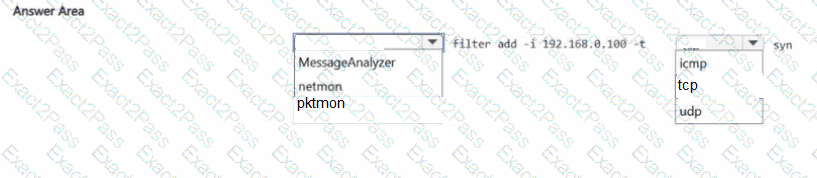
You have a server named Server1 that runs Windows Server.
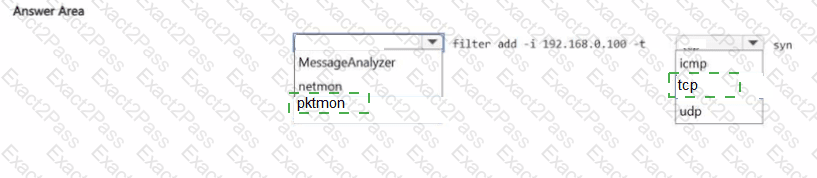
You need to capture the SYN packets exchanged between Server1 and an IP address of 192.168.0.100. How should you complete the command? To answer, select the appropriate options in the answer area.
NOTE: Each correct selection is worth one point.
You have 50 on-premises servers that run Windows Server.
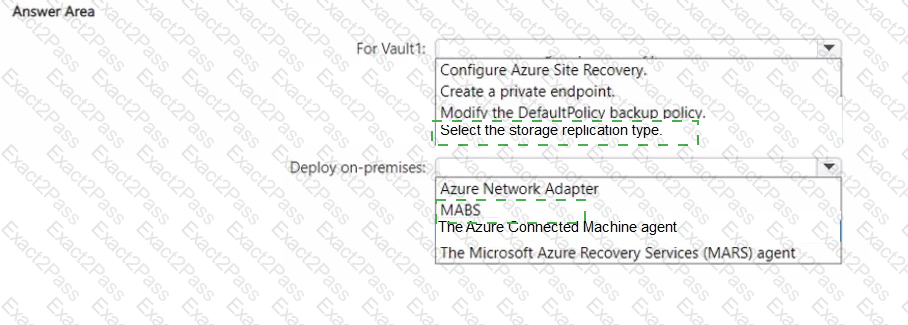
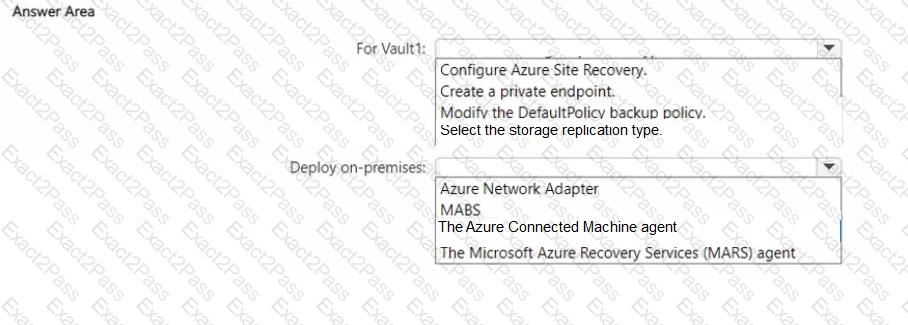
You have an Azure subscription that contains a Recovery Services vault named Vaultl.
You plan to back up the on-premises servers to Vault1 by using Microsoft Azure Backup Server (MABS).
You need to configure prerequisites to support MABS. The solution must minimize costs.
What should you do for Vault1, and what should you deploy on-premises? To answer, select the appropriate options in the answer area.
NOTE: Each correct selection is worth one point.
You have two servers named Server1 and Server2 that run Windows Server. Both servers have the Hyper-V server role installed.
Server1 hosts three virtual machines named VM1, VM2, and VM3. The virtual machines replicate to Server2.
Server1 experiences a hardware failure.
You need to bring VM1, VM2, and VM3 back online as soon as possible.
From the Hyper-V Manager console on Server2, what should you run for each virtual machine?
You have two servers named Host1 and Host2 that run Windows Server and have the Hyper-V server role installed. Host2 is configured as a replica server.
Host1 contains a virtual machine named VM1.
You plan to use Hyper-V Replica to replicate VM1 to Host2.
You need to ensure that you can restore a replica of VM1 to a specific state from the past eight hours.
What should you do?
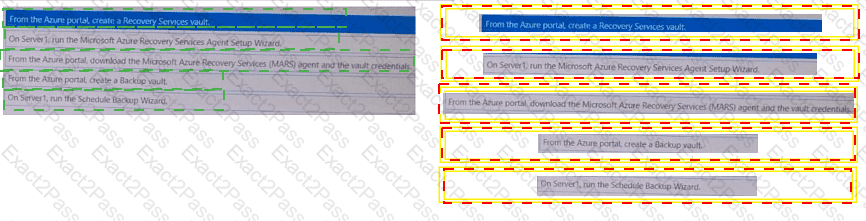
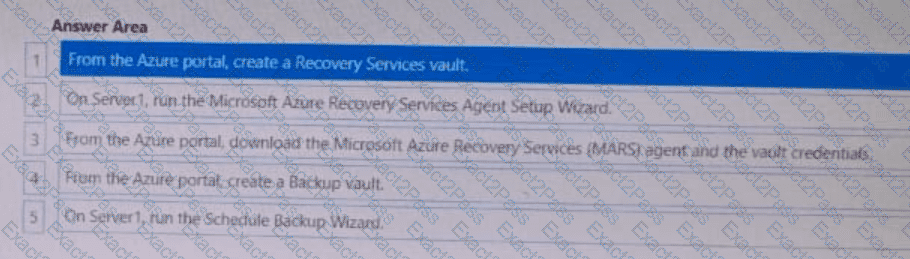
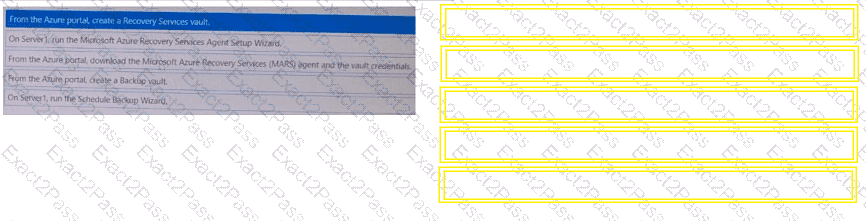
You have an on-premises server named Server1 that runs Windows Server. You need to perform an on-demand backup of the files on Server 1 by using Azure Backup.
Which five actions should you perform in sequence? To answer, move the appropriate actions actions from the list of actions to the answer are and arrange them in the correct order.
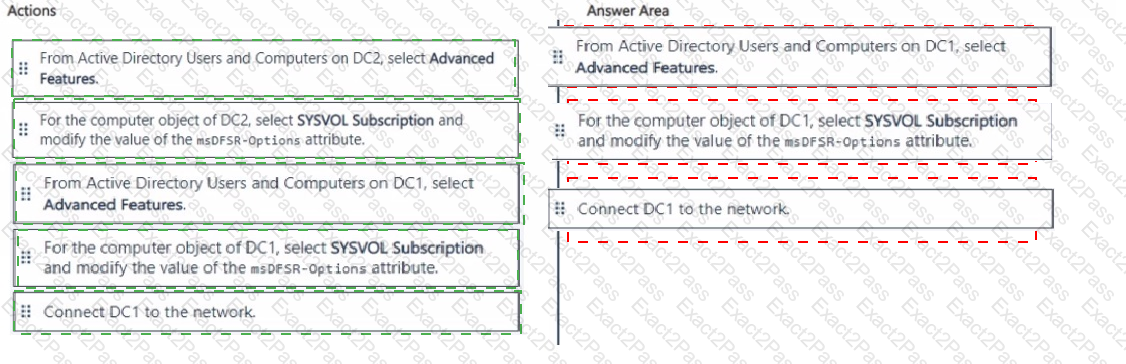
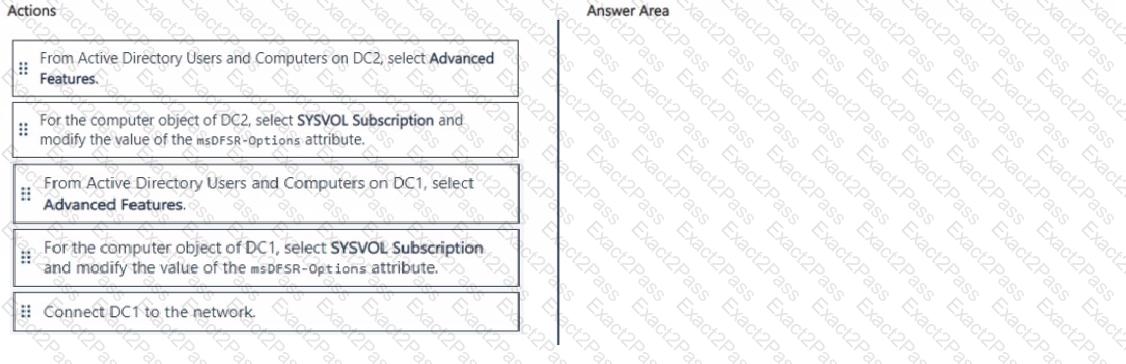
You have a single-domain Active Directory Domain Services (AD DS) forest named contoso.com that contains two domain controllers named DC1 and DC2. DC1 and DC2 run Windows Server.
You plan to perform an authoritative restore of SYSVOL on DC1.
You isolate DC1 and restore DC1 from a backup.
You need to ensure that SYSVOL on DC1 replicates to DC2.
Which three actions should you perform in sequence? To answer, move the appropriate actions from the list of actions to the answer area and arrange them in the correct order.
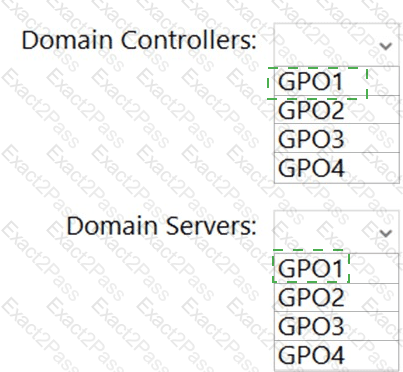
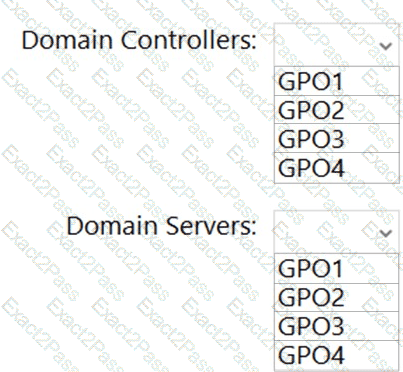
Your network contains an Active Directory Domain Services (AD DS) domain named contoso.com. The domain contains the organizational units (OUs) shown in the following table.
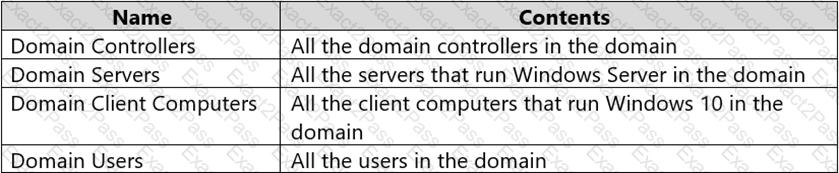
In the domain, you create the Group Policy Objects (GPOs) shown in the following table.

You need to implement IPsec authentication to ensure that only authenticated computer accounts can connect to the members in the domain. The solution must minimize administrative effort.
Which GPOs should you apply to the Domain Controllers OU and the Domain Servers OU? To answer, select the appropriate options in the answer area.
NOTE: Each correct selection is worth one point.
Your network contains an Active Directory Domain Services (AD DS) domain that has a Windows Server 2012 R2 forest and domain functional level. The domain contains the domain controllers shown in the following table.
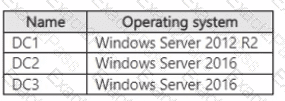
You need to ensure that you can deploy a new domain controller that runs Windows Server 2025. The solution must minimize administrative effort.
Which two actions should you perform? Each correct answer presents part of the solution.
NOTE: Each correct selection is worth one point.
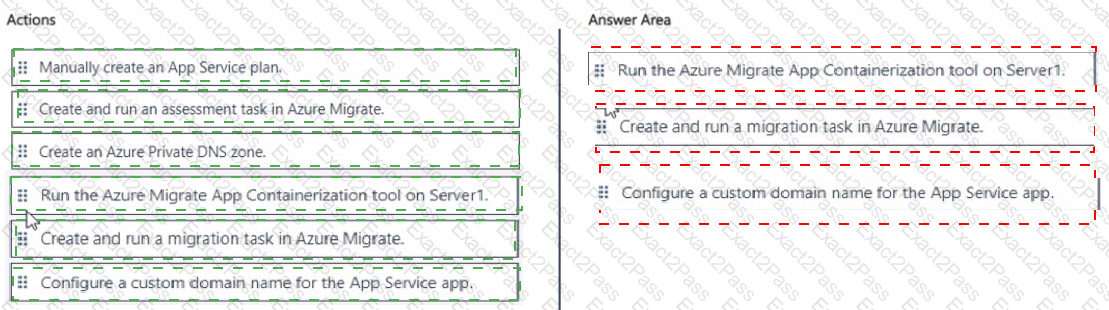
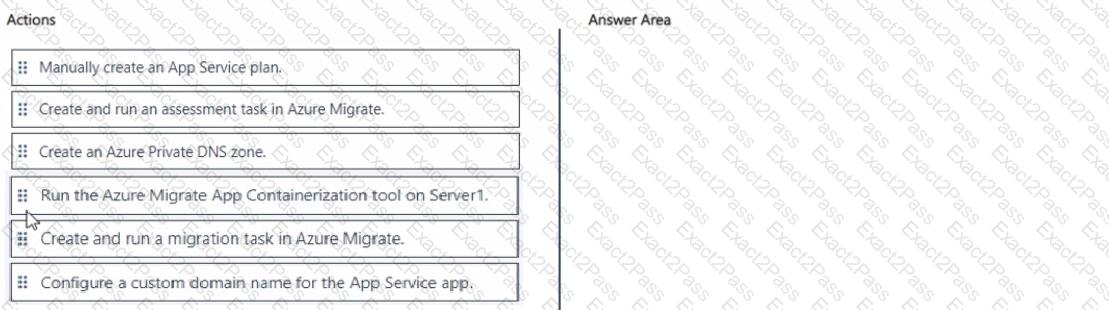
You have a server named Server1 that runs Windows Server and is hosted in a VMWare environment. Server1 contains an ASP.NET application named Appl. Users access App1 by using the following URL: https://app1.contoso.com.
You need to use the integrated flow in Azure Migrate to migrate App1 to Azure App Service. After the migration, users must be able to access App1 by using the same URL.
Which three actions should you perform in sequence? To answer, move the appropriate actions from the list of actions to the answer area and arrange them in the correct order.
Note: This question is part of a series of questions that present the same scenario. Each question in the series contains a unique solution that might meet the stated goals. Some question sets might have more than one correct solution, while others might not have a correct solution.
After you answer a question in this section, you will NOT be able to return to it. As a result, these questions will not appear in the review screen.
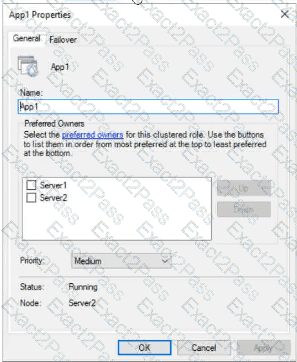
You have a failover cluster named Cluster1 that hosts an application named App1.
The General tab in App1 Properties is shown in the General exhibit. (Click the General tab.)
The Failover tab in App1 Properties is shown in the Failover exhibit. (Click the Failover tab.)
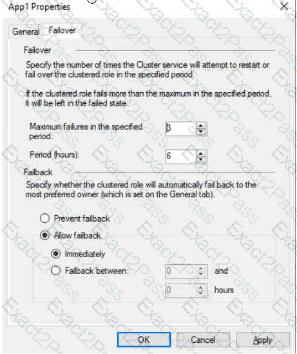
Server1 shuts down unexpectedly.
You need to ensure that when you start Server1, App1 continues to run on Server2.
Solution: From the General settings, you move Server2 up.
Does this meet the goal?