Exact2Pass

Last Update 12 hours ago Total Questions : 638
The Certification of Capability in Business Analysis (CCBA) content is now fully updated, with all current exam questions added 12 hours ago. Deciding to include CCBA practice exam questions in your study plan goes far beyond basic test preparation.
You'll find that our CCBA exam questions frequently feature detailed scenarios and practical problem-solving exercises that directly mirror industry challenges. Engaging with these CCBA sample sets allows you to effectively manage your time and pace yourself, giving you the ability to finish any Certification of Capability in Business Analysis (CCBA) practice test comfortably within the allotted time.
There are three business analysis planning techniques that a business analyst can use to help plan business analysis processes. Which one of the following is not one of the three techniques?
As a business analyst, you must identify activities in your business analysis approach. Which one of the following is useful for identifying activities?
As a candidate for the CCBA exam, you should be able to recognize the activities associated with each knowledge area. All of the following are the business analysis planning & monitoring activities except for which one?
In order to plan the business analysis approach, the business analyst must understand the organizational process needs and what other thing?
The creative thinking process has three values to determine the effectiveness of the process. Which one of the following is not a measurement of effective creative thinking?
A business analyst (BA) is managing stakeholder collaboration to ensure positive reactions are capitalized upon. There is uncertainty as to whether the correct stakeholders have been identified. Which technique can be used to correct this situation?
A senior manager wants to know at what stage the business analyst (BA) is with the requirements management process. The BA immediately sends a 600-page document with models and business rules to all stakeholders. Which best practice did the BA violate in this situation?
The product backlog refinement meeting for a project is complete, but two stakeholders do not agree on the priority of several product backlog items. What should the business analyst (BA) do to help move the project forward?
A business analyst (BA) is reviewing the elicitation results of several workshops in order to decide which technique to use to model the requirements. The elicitation identified user roles needed in a future solution, the functionality needed by each of these roles, and how the desired interaction with the solution should look.
Which technique allows the BA to model this type of information?
The business analyst (BA) has documented the requirements for a new system and is preparing the requirements for approval. Which of the following helps ensure that requirements are fully understood and traceable?
A business analyst (BA) is determining the current state as part of a new project. What is an internal enterprise asset that the BA must include in the analysis?
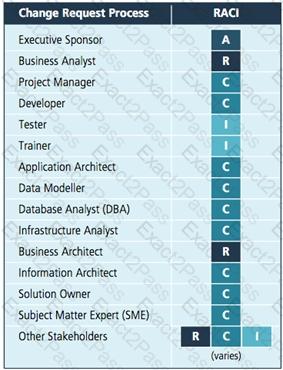
A business analyst (BA) has identified the impacts and resolution for a proposed change. Based on the Responsible, Accountable, Consulted, informed (RACI) matrix, who must approve the change before it is implemented?
Requirements have been prioritized in the product backlog for inclusion in the upcoming release. One of the project team members fears that at least one requirement from the prioritization list is not finalized and still requires further analysis. Which of the following factors describe the affected requirement?
A business analyst (BA) identifies a design option that enhances the performance of the business by automating repetitive tasks that require multiple staff touchpoints to complete a single task. Which type of improvement opportunity is identified by the BA?
What can be considered the only input to the task of defining assumptions and constraints?


 Table
Description automatically generated
Table
Description automatically generated