Summer Sale Special Limited Time 70% Discount Offer - Ends in 0d 00h 00m 00s - Coupon code: buysanta

Exact2Pass Menu

SnowPro Core Certification 2026 Exam

Last Update 9 hours ago Total Questions : 1102

The SnowPro Core Certification 2026 Exam content is now fully updated, with all current exam questions added 9 hours ago. Deciding to include COF-C03 practice exam questions in your study plan goes far beyond basic test preparation.

You'll find that our COF-C03 exam questions frequently feature detailed scenarios and practical problem-solving exercises that directly mirror industry challenges. Engaging with these COF-C03 sample sets allows you to effectively manage your time and pace yourself, giving you the ability to finish any SnowPro Core Certification 2026 Exam practice test comfortably within the allotted time.

Question # 101

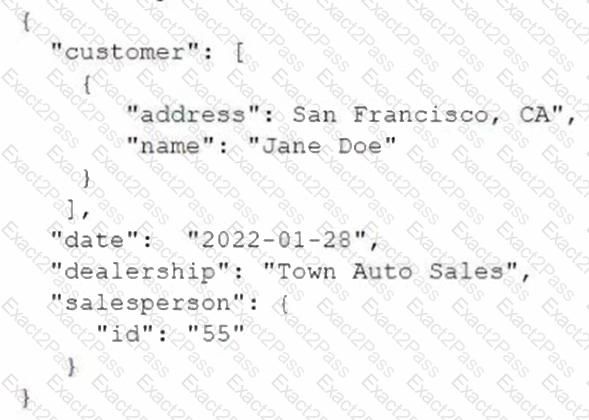
A JSON document is stored in the source_colum of type VARIANT. The document has an array called elements. The array contains the name key that has a string value How can a Snowflake user extract the name from the first element?

A.

Source_column.element[1]:name

B.

Source_column.element[0]:name

C.

Source_column.element[1].name

D.

Source_column.element[0]:name

Question # 102

What costs are associated with sharing Snowflake data with a reader account ?

A.

The data provider incurs costs for the data storage costs, and the data consumer incurs compute costs.

B.

The data provider incurs costs for compute, and the data consumer incurs costs for data storage.

C.

The data provider does not incur costs when sharing data; the data consumer incurs costs for data storage and compute.

D.

The data consumer does not incur costs when accessing shared data; the data provider incurs costs for data storage and compute.

Question # 103

What Multi-Factor Authentication, or MFA, service is provided by Snowflake?

A.

Microsoft Entra ID

B.

Google Authenticator

C.

Duo Security

D.

Microsoft Authenticator

Question # 104

How are micro-partitions enabled on Snowflake tables?

A.

Micro-partitioning requires a cluster key on a table.

B.

Micro-partitioning is automatically performed on a table.

C.

Micro-partitioning requires the use of the search optimization service.

D.

Micro-partitioning is defined by the user when a table is created.

Question # 105

What are characteristics of Secure Data Sharing? Select TWO.

A.

Allows regular views to be shared.

B.

Sensitive data is automatically masked.

C.

Data is not transferred between accounts.

D.

Consumer account will incur compute costs.

E.

Source data can be edited by users with reader accounts.

Question # 106

Which Snowflake data governance feature can support auditing when a user query reads column data?

A.

Access History

B.

Data classification

C.

Column-level security

D.

Object dependencies

Question # 107

Which Snowflake data governance feature supports the tracking of sensitive data for compliance, discovery, protection, and resource usage?

A.

Row access policies

B.

Data classification

C.

Object dependencies

D.

Object tagging

Question # 108

Which components make up the Snowflake Cortex AI suite? Select TWO.

A.

Document AI

B.

Snowpipe

C.

Streams

D.

Secure views

E.

Cortex Analyst

Question # 109

The Snowflake VARIANT data type imposes a 16 MB size limit on what?

A.

An individual row

B.

An individual column

C.

A view

D.

A file in a stage

Question # 110

In addition to performing all the standard steps to share data, which privilege must be granted on each database referenced by a secure view in order to be shared?

A.

READ

B.

REFERENCES

C.

REFERENCEJJSAGE

D.

USAGE

Question # 111

Which URL type permits temporary access to a staged file without granting privileges to the stage?

A.

Pre-signed URL

B.

Scoped URL

C.

File URL

D.

Build_Stage_File_URL

Question # 112

Which commands extract the value for a key, key_1, from an object column? Select TWO.

A.

SELECT column:key_1 FROM my_table;

B.

SELECT column.key_1 FROM my_table;

C.

SELECT column[ ' key_1 ' ] FROM my_table;

D.

SELECT column( ' key_1 ' ) FROM my_table;

E.

SELECT key_1 FROM column::string AS key_1;

Question # 113

Which action will scale-out a Snowflake virtual warehouse?

A.

Removing 1 cluster from a multi-cluster warehouse

B.

Adding 2 additional clusters to a multi-cluster warehouse

C.

Resizing a warehouse from size Small to X-Large

D.

Resizing a warehouse from size Large to Medium

Question # 114

What takes the highest precedence in Snowflake file format options, when specified in multiple locations during data loading?

A.

The stage definition

B.

The table definition

C.

The use of a copy into < table > statement

D.

The use of a copy INTO < location > statement

Question # 115

What is the data lineage feature used for in Snowflake?

A.

To track how records are read by a user

B.

To track dependencies at the object level

C.

To track how data has been transformed among columns

D.

To track how transformation processes have impacted individual records

Question # 116

Which Snowflake tasks will take advantage of underlying micro-partition metadata? Select TWO.

A.

Query pruning

B.

Queries using a result cache

C.

Queries using a local disk cache

D.

Queries using a remote disk cache

E.

Operations using Data Manipulation Language, or DML

Question # 117

How does Snowflake handle the data retention period for a table if a stream has not been consumed?

A.

The data retention period is reduced to a minimum of 14 days.

B.

The data retention period is permanently extended for the table.

C.

The data retention period is temporarily extended to the stream ' s offset.

D.

The data retention period is not affected by the stream consumption.

Question # 118

Which function can be used to convert semi-structured data into rows and columns?

A.

TABLE

B.

FLATTEN

C.

PARSE_JSON

D.

JSON EXTRACT PATH TEXT

Question # 119

When using the COPY INTO < location > command to unload table data into a CSV file, which option would compress the file using the default algorithm?

A.

SNAPPY

B.

DEFLATE

C.

NONE

D.

AUTO

Question # 120

When do Snowflake object owners lose their ability to make grant decisions?

A.

When the object owner has been granted a database role

B.

When the object owner has been granted an account role

C.

When the object is part of a managed access schema

D.

When the object is part of a regular schema

Go to page: