
Summer Sale Special Limited Time 70% Discount Offer - Ends in 0d 00h 00m 00s - Coupon code: buysanta

Exact2Pass Menu

SnowPro Core Certification 2026 Exam

Last Update 9 hours ago Total Questions : 1102

The SnowPro Core Certification 2026 Exam content is now fully updated, with all current exam questions added 9 hours ago. Deciding to include COF-C03 practice exam questions in your study plan goes far beyond basic test preparation.

You'll find that our COF-C03 exam questions frequently feature detailed scenarios and practical problem-solving exercises that directly mirror industry challenges. Engaging with these COF-C03 sample sets allows you to effectively manage your time and pace yourself, giving you the ability to finish any SnowPro Core Certification 2026 Exam practice test comfortably within the allotted time.

Question # 121

Which command can be used to load data files into a Snowflake stage?

A.

JOIN

B.

COPY INTO

C.

PUT

D.

GET

Question # 122

What is the minimum Snowflake edition that has column-level security enabled?

A.

Standard

B.

Enterprise

C.

Business Critical

D.

Virtual Private Snowflake

Question # 123

Which command should be used to download files from a Snowflake stage to a local folder on a client ' s machine?

A.

PUT

B.

GET

C.

COPY

D.

SELECT

Question # 124

What is the default file size when unloading data from Snowflake using the COPY command?

A.

5 MB

B.

8 GB

C.

16 MB

D.

32 MB

Question # 125

What is the minimum Snowflake edition required for row level security?

A.

Standard

B.

Enterprise

C.

Business Critical

D.

Virtual Private Snowflake

Question # 126

What versions of Snowflake should be used to manage compliance with Personal Identifiable Information (PII) requirements? (Choose two.)

A.

Custom Edition

B.

Virtual Private Snowflake

C.

Business Critical Edition

D.

Standard Edition

E.

Enterprise Edition

Question # 127

Which methods can be used to delete staged files from a Snowflake stage? (Choose two.)

A.

Use the DROP < file > command after the load completes.

B.

Specify the TEMPORARY option when creating the file format.

C.

Specify the PURGE copy option in the COPY INTO < table > command.

D.

Use the REMOVE command after the load completes.

E.

Use the DELETE LOAD HISTORY command after the load completes.

Question # 128

What is the maximum total Continuous Data Protection (CDP) charges incurred for a temporary table?

A.

30 days

B.

7 days

C.

48 hours

D.

24 hours

Question # 129

Which command sets the Virtual Warehouse for a session?

A.

COPY WAREHOUSE FROM < < config file > > ;

B.

SET WAREHOUSE = < < warehouse name > > ;

C.

USE WAREHOUSE < < warehouse name > > ;

D.

USE VIRTUAL_WAREHOUSE < < warehouse name > > ;

Question # 130

Which statements are true concerning Snowflake ' s underlying cloud infrastructure? (Select THREE),

A.

Snowflake data and services are deployed in a single availability zone within a cloud provider ' s region.

B.

Snowflake data and services are available in a single cloud provider and a single region, the use of multiple cloud providers is not supported.

C.

Snowflake can be deployed in a customer ' s private cloud using the customer ' s own compute and storage resources for Snowflake compute and storage

D.

Snowflake uses the core compute and storage services of each cloud provider for its own compute and storage

E.

All three layers of Snowflake ' s architecture (storage, compute, and cloud services) are deployed and managed entirely on a selected cloud platform

F.

Snowflake data and services are deployed in at least three availability zones within a cloud provider ' s region

Question # 131

A virtual warehouse is created using the following command:

Create warehouse my_WH with

warehouse_size = MEDIUM

min_cluster_count = 1

max_cluster_count = 1

auto_suspend = 60

auto_resume = true;

The image below is a graphical representation of the warehouse utilization across two days.
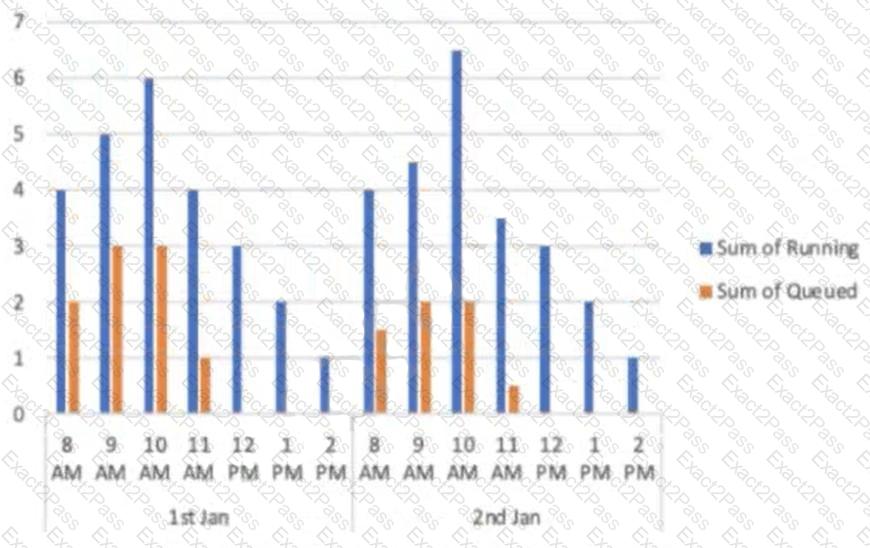
What action should be taken to address this situation?

A.

Increase the warehouse size from Medium to 2XL.

B.

Increase the value for the parameter MAX_CONCURRENCY_LEVEL.

C.

Configure the warehouse to a multi-cluster warehouse.

D.

Lower the value of the parameter STATEMENT_QUEUED_TIMEOUT_IN_SECONDS.

Question # 132

How many days is load history for Snowpipe retained?

A.

1 day

B.

7 days

C.

14 days

D.

64 days

Question # 133

By default, which Snowflake role is required to create a share?

A.

ORGADMIN

B.

SECURITYADMIN

C.

SHAREADMIN

D.

ACCOUNTADMIN

Question # 134

Which columns are part of the result set of the Snowflake LATERAL FLATTEN command? (Choose two.)

A.

CONTENT

B.

PATH

C.

BYTE_SIZE

D.

INDEX

E.

DATATYPE

Question # 135

Which of the following are characteristics of Snowflake virtual warehouses? (Choose two.)

A.

Auto-resume applies only to the last warehouse that was started in a multi-cluster warehouse.

B.

The ability to auto-suspend a warehouse is only available in the Enterprise edition or above.

C.

SnowSQL supports both a configuration file and a command line option for specifying a default warehouse.

D.

A user cannot specify a default warehouse when using the ODBC driver.

E.

The default virtual warehouse size can be changed at any time.

Question # 136

What are supported file formats for unloading data from Snowflake? (Choose three.)

A.

XML

B.

JSON

C.

Parquet

D.

ORC

E.

AVRO

F.

CSV

Question # 137

In the Snowflake access control model, which entity owns an object by default?

A.

The user who created the object

B.

The SYSADMIN role

C.

Ownership depends on the type of object

D.

The role used to create the object

Question # 138

How can a row access policy be applied to a table or a view? (Choose two.)

A.

Within the policy DDL

B.

Within the create table or create view DDL

C.

By future APPLY for all objects in a schema

D.

Within a control table

E.

Using the command ALTER < object > ADD ROW ACCESS POLICY < policy > ;

Question # 139

The Snowflake Search Optimization Services supports improved performance of which kind of query?

A.

Queries against large tables where frequent DML occurs

B.

Queries against tables larger than 1 TB

C.

Selective point lookup queries

D.

Queries against a subset of columns in a table

Question # 140

What happens to historical data when the retention period for an object ends?

A.

The data is cloned into a historical object.

B.

The data moves to Fail-safe

C.

Time Travel on the historical data is dropped.

D.

The object containing the historical data is dropped.

Go to page:

