Exact2Pass

Last Update 3 hours ago Total Questions : 180
The IREB Certified Professional for Requirements Engineering Foundation Level content is now fully updated, with all current exam questions added 3 hours ago. Deciding to include CPRE-FL_Syll_3.0 practice exam questions in your study plan goes far beyond basic test preparation.
You'll find that our CPRE-FL_Syll_3.0 exam questions frequently feature detailed scenarios and practical problem-solving exercises that directly mirror industry challenges. Engaging with these CPRE-FL_Syll_3.0 sample sets allows you to effectively manage your time and pace yourself, giving you the ability to finish any IREB Certified Professional for Requirements Engineering Foundation Level practice test comfortably within the allotted time.
In regard to configurations and baselines in RE, it is INCORRECT to say that:
Choose the right options regarding tools to support Requirements Engineering.
To get maximum value from validation activities, which practices should be followed? (Select 2 answers.)
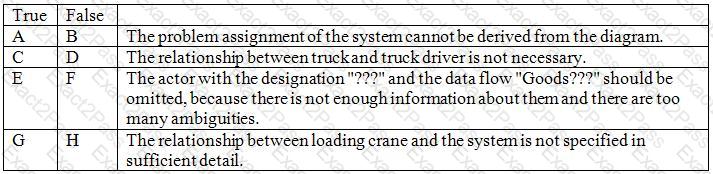
You are employed as a requirements engineer in a company in the logistics sector and are involved in a project that aims to replace a legacy application for distribution and shipment of goods with a new system. A colleague has already created a context diagram. You are assigned to check this. What are your thoughts about this? Indicate for each statement whether it is true or false. (3 Points)
You are assigned to carry out and document a system and context delimitation for a software system that is to be developed. What diagram is least suited for the representation of the delimitation? (1 Point)
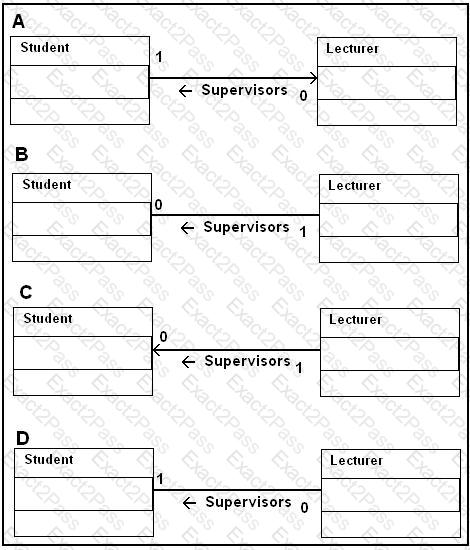
At a technical college, each student is supervised by a lecturer. Some lecturers supervise several students, some none. Which of the following class diagrams best shows this student-lecturer relationship? (2 Points)
Which of the following are considered to be enablers of shared understanding?
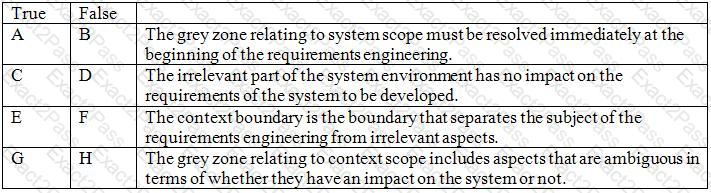
In requirements engineering, a differentiation is made between system scope and context scope. In both cases it is possible that so-called grey zones may appear. For each statement, indicate if it is true or false. (2 Points)
In a linear approach, the decision on a change proposal about a commissioned system is made by the:
Which of the following measures should be taken when changing a requirement that is in a draft state?

