
Spring Sale Special Limited Time 70% Discount Offer - Ends in 0d 00h 00m 00s - Coupon code: buysanta

Exact2Pass Menu

IREB Certified Professional for Requirements Engineering Foundation Level

Last Update 17 hours ago Total Questions : 180

The IREB Certified Professional for Requirements Engineering Foundation Level content is now fully updated, with all current exam questions added 17 hours ago. Deciding to include CPRE-FL_Syll_3.0 practice exam questions in your study plan goes far beyond basic test preparation.

You'll find that our CPRE-FL_Syll_3.0 exam questions frequently feature detailed scenarios and practical problem-solving exercises that directly mirror industry challenges. Engaging with these CPRE-FL_Syll_3.0 sample sets allows you to effectively manage your time and pace yourself, giving you the ability to finish any IREB Certified Professional for Requirements Engineering Foundation Level practice test comfortably within the allotted time.

Question # 41

The range of things that can be shaped/designed while developing a system is called:

A.

System context

B.

System boundary

C.

System environment

D.

Scope of a system

Question # 42

Which of the following sentences is correct?

A.

The utmost goal of Requirements Engineering is to satisfy users’ desires and needs.

B.

“Technical” is one of the three kinds of requirements.

C.

“Non-functional” is one of the three kinds of requirements.

D.

A requirement may be understood as a representation of a stakeholder’s need.

Question # 43

Which view represented in a figure with three different highlighted views of a set of requirements is considered a selective view?

A.

View C

B.

View A

C.

View B

D.

There is no selective view represented in the figure.

Question # 44

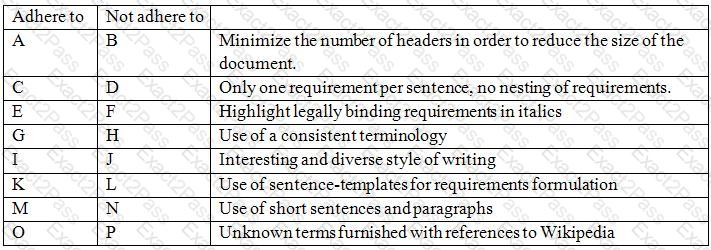
Evaluate the following guidelines as to whether they should or should not be adhered to when writing a requirements specification: (2 Points)
Question # 45

Choose the WRONG sentences:

A.

There is an optimum RE practice that works well in every situation.

B.

Work products should be chosen to best fit the situation at hand.

C.

Application of RE should be systematic.

D.

Processes and practices from past successful RE applications should never be reused.

Question # 46

Which of the following is a major task in Requirements Engineering?

A.

Tool support

B.

Validation of requirements

C.

Verification of requirements

D.

Requirements writing

Question # 47

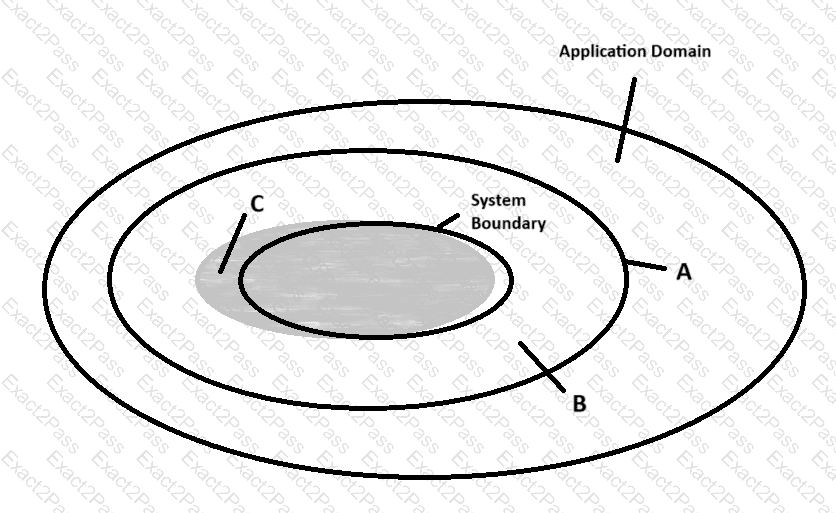
Look at the figure of nested ovals labeled A, B and C (context and scope diagram). Which option best matches these labels?
A.

A – Context boundary; B – Context; C – Scope of the system

B.

A – Context boundary; B – Context; C – System

C.

A – Environment; B – Context boundary; C – Scope of the system

D.

A – Environment; B – Context boundary; C – System scope

Question # 48

Which of the following statements best characterizes the relationship between a requirements engineer and a stakeholder in the role of a tester? (1 Point)

A.

The requirements engineer delivers input for the work of the stakeholder.

B.

The output from the requirements engineer is managed by the stakeholder.

C.

The stakeholder delivers input for the requirements engineer.

D.

The stakeholder monitors the work of the requirements engineer.

E.

The work of the requirements engineer is not related to the role of the stakeholder.

Question # 49

Which of the following perspectives is the most important when selecting a tool to support the RE process?

A.

Process perspective

B.

User perspective

C.

All the other options are wrong

D.

Project perspective

Question # 50

Regarding the influencing factors to consider when configuring an RE process, it is correct to say that:


A.

A tight budget requires a robust RE process to compensate.

B.

Complexity requires a more loose, informal RE process to be dealt with.

C.

Experienced requirements engineers do better with a lightweight RE process.

D.

All the other options are wrong.

Go to page: