Exact2Pass

Last Update 3 hours ago Total Questions : 180
The IREB Certified Professional for Requirements Engineering Foundation Level content is now fully updated, with all current exam questions added 3 hours ago. Deciding to include CPRE-FL_Syll_3.0 practice exam questions in your study plan goes far beyond basic test preparation.
You'll find that our CPRE-FL_Syll_3.0 exam questions frequently feature detailed scenarios and practical problem-solving exercises that directly mirror industry challenges. Engaging with these CPRE-FL_Syll_3.0 sample sets allows you to effectively manage your time and pace yourself, giving you the ability to finish any IREB Certified Professional for Requirements Engineering Foundation Level practice test comfortably within the allotted time.
Consider the following figure (diagram of actors and use cases).
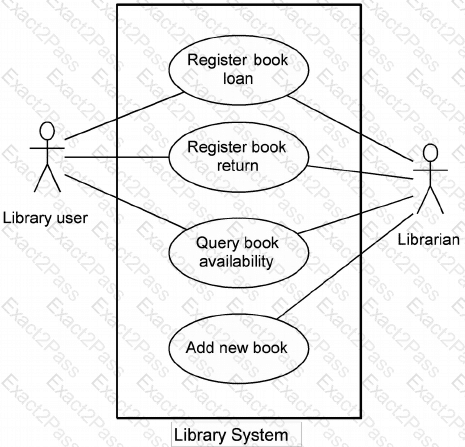
This is an example of a:
Choose the right sentence regarding the types of views:
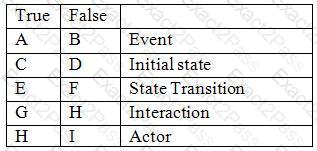
Which of the following elements are elements of a state diagram and which are not? Please indicate true or false. (1 Point)
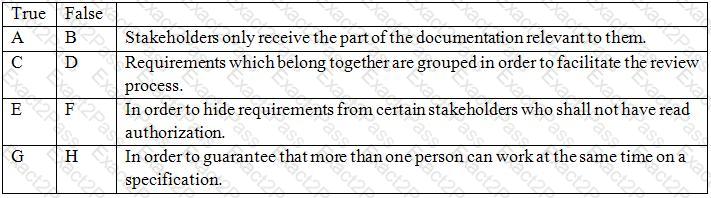
Listed below you will find four reasons why different views of individual components of the requirements are used instead of a single view displaying all the requirements and attributes. Which of the following reasons are true and which are false? (2 Points)
A company needs to select a tool to support its Requirements Engineering process. Which statements do NOT apply to this selection process? (Select 3 answers.)
In regard to configurations and baselines in RE, it is INCORRECT to say that:
According to the Kano model, there is a particular category of system attributes that has an almost linear relationship between satisfaction and degree of compliance.
For which category is this so? (1 Point)
The customer imposes several requirements on the contractor delivering a maintenance management system. Which of the following are system requirements ? (Select all that apply.)
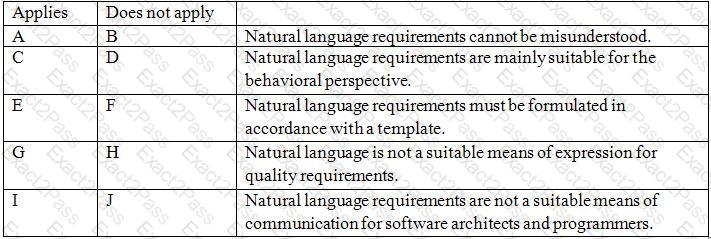
Assess the following statements about the natural language documentation of requirements in terms of being applicable or not applicable. (2 Points)
Consider a context diagram of a system. The context diagram of the figure was done using:

