Exact2Pass

Last Update 20 hours ago Total Questions : 130
The ISTQB® Certified Tester Advanced Level - Test Manager [Syllabus 2012] content is now fully updated, with all current exam questions added 20 hours ago. Deciding to include CTAL-TM_Syll2012 practice exam questions in your study plan goes far beyond basic test preparation.
You'll find that our CTAL-TM_Syll2012 exam questions frequently feature detailed scenarios and practical problem-solving exercises that directly mirror industry challenges. Engaging with these CTAL-TM_Syll2012 sample sets allows you to effectively manage your time and pace yourself, giving you the ability to finish any ISTQB® Certified Tester Advanced Level - Test Manager [Syllabus 2012] practice test comfortably within the allotted time.
The main objectives the senior management team wants to achieve are:
- to reduce the costs associated with dynamic testing
- to use reviews to ensure that the project is on course for success and following the plan
- to use reviews as a well-documented and effective bug-removal activity following a formal process with well-defined roles
- to determine the effectiveness of reviews in terms of phase containment
- to improve phase containment effectiveness
Which of the following answers would you expect to describe the best way to achieve these objectives?
Number of correct responses: 1
K4 3 credits
Reviews
Which of the following factors could negatively influence a review?
Number of correct responses: 1
K2 1 credit
Test Tools and Automation
Assume you are a Test Manager involved in system testing of a CRM application for a Pay-TV company. Currently the application is able to support a proper number of users assuring the required responsiveness. Since the business is expected to grow, you have been asked to evaluate the ability of the application to grow to support more users while maintaining the same responsiveness.
Which of the following tools would you expect to be the most useful at performing this evaluation?
Number of correct responses: 1
K2 1 credit
Test Tools and Automation
Assume you are managing a test automation project for a mission-critical system.
Because vendor provided tools and open source solutions don't meet the needs of this project, you ask your test team to develop a custom automation framework.
Which of the following management issues associated to the development of this custom automation framework is least likely to manage?
Number of correct responses: 1
K2 1 credit
Test Tools and Automation
Assume you are the Test Manager in charge of independent testing for avionics applications.
You are in charge of testing for a project to implement three different CSCI (Computer Software Configuration Item):
- a BOOT-X CSCI that must be certified at level B of the DO-178B standard
- a DIAG-X CSCI that must be certified at level C of the DO-178B standard
- a DRIV-X CSCI that must be certified at level A of the DO-178B standard
These are three different software modules written in C language to run on a specific hardware platform.
You have been asked to select a single code coverage tool to perform the mandatory code coverage measurements, in order to meet the structural coverage criteria prescribed by the DO-178B standard. This tool must be qualified as a verification tool under DO-178B.
Since there are significant budget constraints to purchase this tool, you are evaluating an open-source tool that is able to provide different types of code coverage. This tool meets perfectly your technical needs in terms of the programming language and the specific hardware platform (it supports also the specific C-compiler).
The source code of the tool is available.
Your team could easily customize the tool to meet the project needs. This tool is not qualified as a verification tool under the DO-178B.
Which of the following are the three main concerns related to that open-source tool selection?
Number of correct responses: 3
K4 3 credits (2 credits out of 3 credits correct, 1 credit point)
Testing Process
Consider an information system of a Pay-Tv company based on a SOA architecture.
The integrated system currently consists of three core systems:
- a CRM (Customer Relationship Management) system
- a BRM (Billing and Revenue Management) system
- a CAS (Conditional Access System) system
all of them communicating with SOA Middleware.
You have been asked to manage the testing activities for the integration of two additional off-the-shelf systems from two different vendors: a SMS (Short Message Service) server and an IVR (Interactive Voice Response) system.
Assume that there is a high likelihood that the two off-the-shelf systems will be low-quality and that you have a clear proof that the testing performed by the two vendors on their systems has been unsystematic and unprofessional. This obviously leads to higher quality risk for the overall integrated system.
You are the Test Manager of this project. Your main goal is to plan for testing activities to mitigate this risk.
Which of the following answers best describes the test activities (assuming it is possible to perform all of them) you should plan for?
Number of correct responses: 1
K4 3 credits
Improving the Testing Process
Which of the following statements about the STEP test process improvement model is true?
Number of correct responses: 1
K2 1 credit
Defect Management
Consider a defect report and assume that a part of its lifecycle includes the following states:
New: Is the initial state
Working: Means that the developers are addressing the defect in order to produce a fix for the defect
Clarification: Means that the developers need more information from the tester to address the defect and produce a fix for the defect and the tester is working to provide this information to the developers
Verification: Means that a fix for the defect has been produced and the tester is running the adequate tests to verify whether the fix solves the defect
Closed: is the final state
Which of the following answers represents an invalid sequence of states that can’t lead the bug report to the “Closed” state?
Number of correct responses: 1
K2 1 credit
Defect Management
Assume you are working on a defect management process to be used by a software organization to track the current status of the defects reports for several projects.
When a defect is found for investigation a defect report is created in “Opened” state that is the unique initial state. The defect report status has also a unique finale state that is the “Closed” state.
The following state transition diagram describes the states of this defect management process:
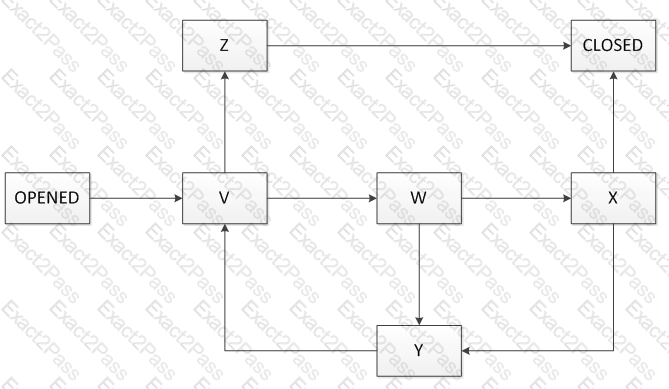
where only the initial (“Opened”) and final (“Closed”) states are indicated while the remaining states (V, W, X, Y, Z) have yet to be named.
Which of the following assignments would you expect to best complete the defect management process?
Number of correct responses: 1
K3 2 credits
Defect Management
Which of the following information would you expect to be the most useful to perform a defect clustering analysis?
Number of correct responses: 1
K2 1 credit

