Exact2Pass

Last Update 20 hours ago Total Questions : 130
The ISTQB® Certified Tester Advanced Level - Test Manager [Syllabus 2012] content is now fully updated, with all current exam questions added 20 hours ago. Deciding to include CTAL-TM_Syll2012 practice exam questions in your study plan goes far beyond basic test preparation.
You'll find that our CTAL-TM_Syll2012 exam questions frequently feature detailed scenarios and practical problem-solving exercises that directly mirror industry challenges. Engaging with these CTAL-TM_Syll2012 sample sets allows you to effectively manage your time and pace yourself, giving you the ability to finish any ISTQB® Certified Tester Advanced Level - Test Manager [Syllabus 2012] practice test comfortably within the allotted time.
When scheduling performance testing, which of the following approaches would be most advisable? [1]
Assume that no additional product risks have been identified during the first week of test execution.
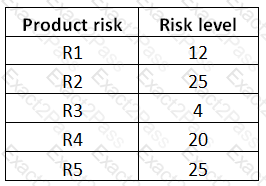
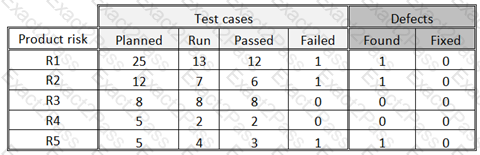
Which of the following answers would you expect to best describe the residual risks associated with the identified product risks, at the end of the first week of test execution?
Number of correct responses: 1
K3 2 credits
Test Management
Assume you have some data related to confirmation testing during system testing of a past project.
In that project 240 bug reports have been opened once, 80 were opened twice, 10 were opened three times and no bug reports have been opened more than three times.
You estimate that a bug report, which has failed its confirmation test, costs, on average, 3 person-hours.
Which of the following statements correctly describe the value of these confirmatory testing activities based on cost of quality?
Number of correct responses: 1
K3 2 credits
Test Management
You are performing a quality risk analysis for a CSCI (Computer Software Configuration Item) used to implement a CBIT (Continuous Built-In Test) module of a safety-critical system.
During the quality risk analysis you are trying to identify the ways in which failures of the CBIT module can occur, for each of them trying to determine the potential causes and likely effects, and the risk level (calculated as the product of three factors: severity, occurrence and detection).
Which of the following risk analysis techniques are you working with?
Number of correct responses: 1
K2 1 credit
Test Management
In the next two months some new features will be constantly added to new releases of a project you are working on as Test Manager.
You have identified as one of the main project risks, that the requirements specification will still be incomplete when your team starts the test design and implementation phase.
Some requirements will most likely be completed too late to allow a proper test preparation.
You and your test team have already worked on several similar past projects in the same organization.
Which one of the following options would you expect to be the most effective at mitigating this risk?
Number of correct responses: 1
K4 3 credits
Reviews
You are the Test Manager of a project that adopts a V-model with four formal levels of testing: unit, integration, system and acceptance testing.
On this project reviews have been conducted for each development phase prior to testing, which is to say that reviews of requirements, functional specification, high-level design, low-level design and code have been performed prior to testing.
Assume that no requirements defects have been reported after the release of the product.
Which TWO of the following metrics do you need in order to evaluate the requirements reviews in terms of phase containment effectiveness?
Number of correct responses: 2
K3 2 credits
Which classification information would be most useful to capture for newly identified defects? [2]
Your test team has created a custom automation tool that will be used for an upcoming release. Now that the tool has been coded, what
should be the next step? [1]
During the follow-up phase the following conditions are checked:
X1. The code has been completely reviewed
X2. All the identified defects have been correctly fixed and the modified code has been compiled successfully and run through all the static analyzers used by the project without warnings and errors
X3. The modified code is available under the configuration management system with a new version number for the specified CI
If these conditions are fulfilled then the review process terminates.
Which of the following characteristics of a formal review is missing in this description?
Number of correct responses: 1
K2 1 credit
Reviews
You are a Test Manager working for a software organization where reviews have never been applied. After a meeting with your managers examining a business case for reviews, (including their costs, benefits, and potential issues), the management finally decides to adopt formal reviews for future projects.
You have been given a budget that you have spent to provide training in the review process and to introduce the review process on a pilot project.
On that pilot project the introduction of reviews has been very positive in terms of positive involvement from all the participants. All the reviews applied to different documents have been very effective for their purposes (especially at revealing defects).
Which of the following answers describes an important success factor for the introduction of formal reviews which is missing in this scenario?
Number of correct responses: 1
K4 3 credits

