Exact2Pass

Last Update 20 hours ago Total Questions : 130
The ISTQB® Certified Tester Advanced Level - Test Manager [Syllabus 2012] content is now fully updated, with all current exam questions added 20 hours ago. Deciding to include CTAL-TM_Syll2012 practice exam questions in your study plan goes far beyond basic test preparation.
You'll find that our CTAL-TM_Syll2012 exam questions frequently feature detailed scenarios and practical problem-solving exercises that directly mirror industry challenges. Engaging with these CTAL-TM_Syll2012 sample sets allows you to effectively manage your time and pace yourself, giving you the ability to finish any ISTQB® Certified Tester Advanced Level - Test Manager [Syllabus 2012] practice test comfortably within the allotted time.
Defect Management
During the system testing phase a tester from your test team observes a failure in the system under test and he/she decides to create an incident report. The incident report is currently in a “new” state, indicating it needs to be investigated.
Which THREE of the following information items can’t yet be present in the incident report?
Number of correct responses: 3
K3 2 credits (2 credits out of 3 credits correct, 1 credit point)
Which of the following statements represents the most effective contribution of the stakeholders to the completion of the failure mode analysis table?
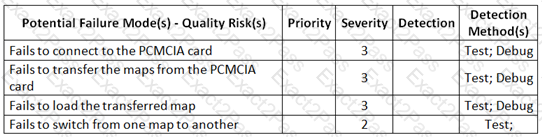
Number of correct responses: 1
K4 3 credits
Test Management
In the test strategy document your organization declares:
- to adopt a V-model development lifecycle, with three formal levels of testing: unit, integration and system testing
- to use a blended risk-based and regression-averse testing strategy for each level of testing
The following is an excerpt of the “approach” section for the system test plan document of a new project:
“Testing will only use manual tests. Due to the short period of time for test execution, the following activities will be performed in parallel with test execution: Test planning, test analysis and test design.
Basic metrics will be taken for test effort (i.e. person-hours), test cases executed (passed/failed), and incidents (no more metrics, such as code coverage, will be collected).”
In the system test plan, no deviations from the test strategy are described.
Based only on the given information, which of the following statements is true?
Number of correct responses: 1
K4 3 credits
Test Tools and Automation
In your organization the following tools of the same vendor are currently in use: a requirements management tool, a test management tool and a bug tracking tool.
You are the Test Manager.
You are currently evaluating a test automation tool of the same vendor (to complete the vendor's tool suite) against an interesting open-source test automation tool under the GNU GPL (General Public License).
There are no initial costs associated to that open-source tool.
Which of the following statements associated to the selection of the open-source tool is correct in this scenario?
Number of correct responses: 1
K2 1 credit
Test Tools and Automation
After a selection process you have selected a test management tool that is going be introduced in your organization and used by your test team in a pilot project.
You have already identified the member of your test team who will be the administrator of the tool, since he/she has a significant experience with the administration of test management tools and so he/she is able to make effective and efficient up-front decisions about "how" the tool will be used. You have also developed a training plan for the other members of your test team.
In collaboration with the administrator of the tool you have also devised standard ways of managing, storing and maintaining the tool and its assets including backup/restore procedures.
You have also analyzed standard formats supported by the tool (CSV, XLS, XML, etc.) to export, import and archive all the information managed by the tool itself (requirements, test case specifications, test plans etc.) for compliance with the most important test management tools, in order to minimize the impacts of migrating this information to a new tool that could replace the existing one in the future.
Which of the following phases in the lifecycle of the new tool has NOT been adequately considered in this description?
Number of correct responses: 1
K2 1 credit

