Exact2Pass

Last Update 8 hours ago Total Questions : 94
The FCSS - SD-WAN 7.6 Architect content is now fully updated, with all current exam questions added 8 hours ago. Deciding to include FCSS_SDW_AR-7.6 practice exam questions in your study plan goes far beyond basic test preparation.
You'll find that our FCSS_SDW_AR-7.6 exam questions frequently feature detailed scenarios and practical problem-solving exercises that directly mirror industry challenges. Engaging with these FCSS_SDW_AR-7.6 sample sets allows you to effectively manage your time and pace yourself, giving you the ability to finish any FCSS - SD-WAN 7.6 Architect practice test comfortably within the allotted time.
Exhibit.

For your ZTP deployment, you review the CSV file shown in exhibit and note that it is missing important information. Which two elements must you change before you can import it into FortiManager? (Choose two.)
(Refer to the exhibit.
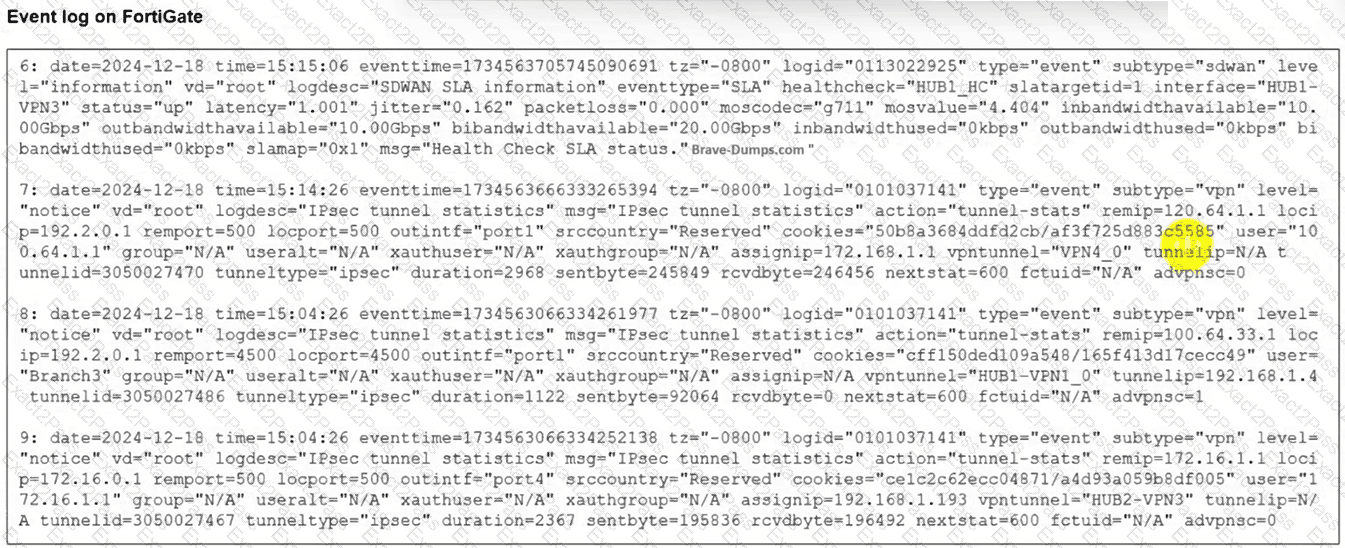
The event log on a FortiGate device is shown.
Based on the output shown in the exhibit, what can you conclude about the tunnels on this device? (Choose one answer))
(You want to configure two static routes: one that references an SD-WAN zone and a second one that references an SD-WAN member that belongs to that zone.
Which statement about this scenario is true? Choose one answer.)
(Refer to the exhibits.
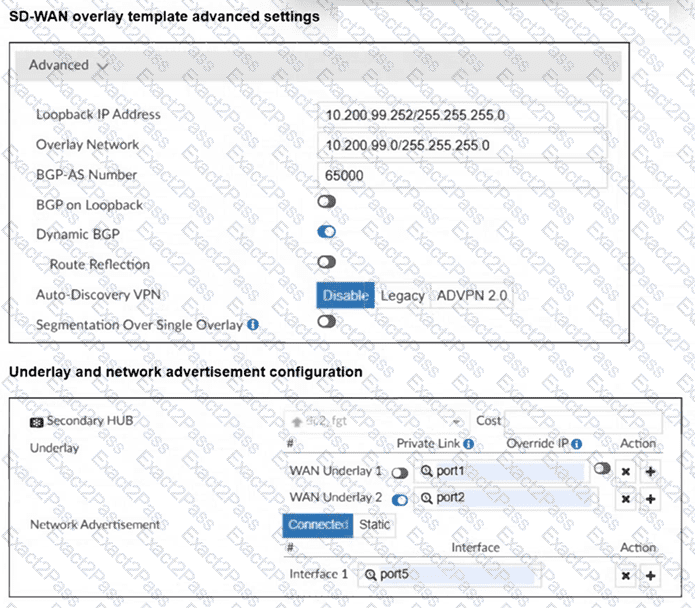
The SD-WAN overlay template advanced settings and the underlay and network advertisement settings are shown. These are the configurations for the secondary hub of a dual-hub SD-WAN topology created with the FortiManager SD-WAN overlay orchestrator.
Which two conclusions can you draw from the information shown in the exhibits? Choose two answers.)
The administrator uses the FortiManager SD-WAN overlay template to prepare an SD-WAN deployment. Using information provided through the SD-WAN overlay template wizard, FortiManager creates templates ready to install on the spoke and hub devices.
What are the three templates created by the SD-WAN overlay template for a spoke device? (Choose three.)
Refer to the exhibit.
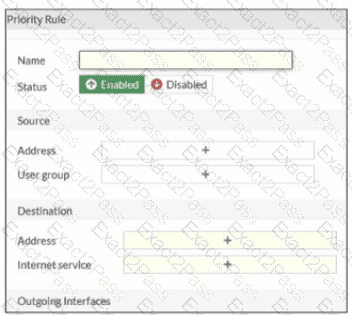
An administrator configures SD-WAN rules for a DIA setup using the FortiGate GUI. The page to configure the source and destination part of the rule looks as shown in the exhibit. The GUI page shows no option to configure an application as the destination of the SD-WAN rule Why?
You have a FortiGate configuration with three user-defined SD-WAN zones and two members in each of these zones. One SD-WAN member is no longer in use in health-check and SD-WAN rules. You want to delete it.
What happens if you delete the SD-WAN member from the FortiGate GUI?
When you use the command diagnose sys session list, how do you identify the sessions that correspond to traffic steered according to SD-WAN rules?
(Refer to the exhibit.
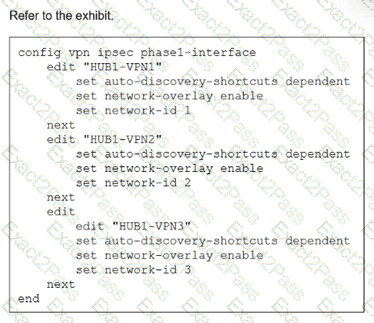
You update the spokes configuration of an existing auto-discovery VPN (ADVPN) topology by adding the parameters shown in the exhibit.
Which is a valid objective of those settings? Choose one answer.)
Refer to the exhibit, which shows the SD-WAN rule status and configuration.
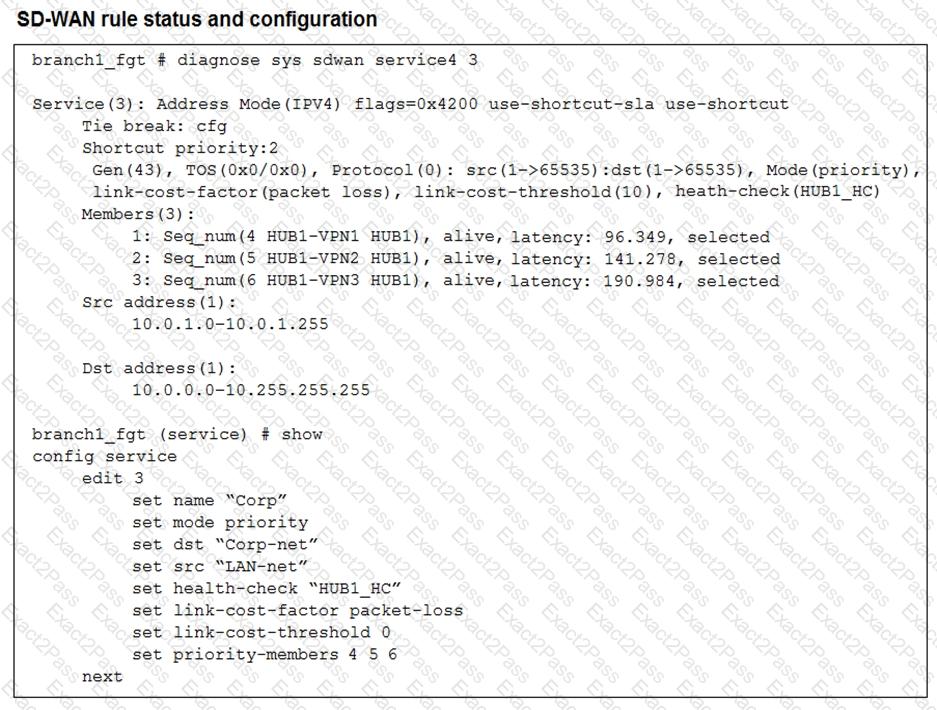
Based on the exhibit, which change in the measured latency will first make HUB1-VPN3 the new preferred member?

