
Spring Sale Special Limited Time 70% Discount Offer - Ends in 0d 00h 00m 00s - Coupon code: buysanta

Exact2Pass Menu

ISTQB Certified Tester Foundation Level (CTFL v4.0)

Last Update 3 hours ago Total Questions : 406

The ISTQB Certified Tester Foundation Level (CTFL v4.0) content is now fully updated, with all current exam questions added 3 hours ago. Deciding to include ISTQB-CTFL practice exam questions in your study plan goes far beyond basic test preparation.

You'll find that our ISTQB-CTFL exam questions frequently feature detailed scenarios and practical problem-solving exercises that directly mirror industry challenges. Engaging with these ISTQB-CTFL sample sets allows you to effectively manage your time and pace yourself, giving you the ability to finish any ISTQB Certified Tester Foundation Level (CTFL v4.0) practice test comfortably within the allotted time.

Question # 71

Which of the following statements about the shift-left approach is true?

A.

Shift-left in testing can be implemented only in Agile/DevOps frameworks, as it relies completely on automated testing activities performed within a continuous integration process

B.

Performance testing performed during component testing, is a form of shift-left in testing that avoids planning and executing costly end-to-end testing at the system test level in a production-like environment

C.

Shift-left in testing can be implemented in several ways to find functional defects early in the lifecycle, but it cannot be relied upon to find defects associated with non-functional characteristics

D.

Continuous integration supports shift-left in testing as it can reduce the time between the introduction of a defect and its detection, thereby reducing the cost to fix it

Question # 72

Which of the following statements is TRUE ' ?

A.

Unlike functional testing, non-fundional testing can only be applied to conventional systems, not artificial intelligence-based system.

B.

Functional testing focuses on what the system is supposed to do, while white-box testing focuses on how well the system does what it is supposed to do

C.

Functional testing can be applied to all test levels, while non-functional testing can be applied only to system and acceptance test levels.

D.

Black-box test techniques and experience-based test techniques may be applicable to both functional testing and non-functional testing

Question # 73

A software development company invests heavily in tools to support the entire software development lifecycle, including testing. They have a tool that allows automated creation and installation of builds and subsequent execution of various types of automated tests. Which ONE of the following is a CORRECT statement about this type of test tool?

A.

It is an example of collaboration tool

B.

It is an example of test implementation tool

C.

It is an example of DevOps related tools

D.

It is an example of automated unit testing tool

Question # 74

Which of the following statements best describes the objective of branch testing?

A.

Branch testing is used to verify the functionality of an application on all logical branches without knowledge of its internal workings.

B.

Branch testing is used to check the interactive reachable branches of the user interface of an application.

C.

Branch testing is used to verify the performance of an application on certain branches.

D.

Branch testing is used to execute some or all branches in the code of an application at least once.

Question # 75

While repotting a defect, which attribute indicates the degree of impact that the defect has on the system?

A.

Priority

B.

Severity

C.

Status

D.

Description

Question # 76

Which of the following statements is true?

A.

Experience-based test techniques rely on the experience of testers to identify the root causes of defects found by black-box test techniques

B.

Some of the most common test basis used by white-box test techniques include user stories, use cases and business processes

C.

Experience-based test techniques are often useful to detect hidden defects that have not been targeted by black-box test techniques

D.

The primary goal of experience-based test techniques is to design test cases that can be easily automated using a GUI-based test automation tool

Question # 77

Decision table testing is being performed on transactions in a bank’s ATM (Automated Teller Machine) system. Two test cases have already been generated for rules 1 and 4. which are shown below:
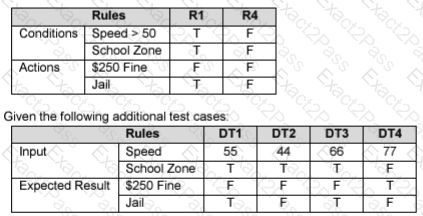
Which two of the additional test cases would achieve full coverage of the full decision table (when combined with the test cases that have already been generated for rules 1 and 4)?

A.

DT1, DT4

B.

DT3, DT4

C.

DT2, DT3

D.

DT1.DT2

Question # 78

Which of the following statements about branch coverage is true?

A.

The minimum number of test cases needed to achieve full branch coverage, is usually lower than that needed to achieve full statement coverage

B.

If full branch coverage has been achieved, then all unconditional branches within the code have surely been exercised

C.

If full branch coverage has been achieved, then all combinations of conditions in a decision table have surely been exercised

D.

Exercising at least one of the decision outcomes for all decisions within the code, ensures achieving full branch coverage

Question # 79

Which ONE of the following is a characteristic of exploratory testing?

A.

Effectiveness depends on the individual testers ' skills

B.

Usually conducted when there is sufficient time for testing

C.

Testing without defined time-boxes

D.

Test cases are written once the specifications become available

Question # 80

Which ONE of the following elements is TYPICALLY used to guide testing during exploratory testing ?


A.

A test charter that defines the testing objectives for the test session.

B.

A comprehensive specification that must be fully available before testing begins.

C.

A detailed test script that prescribes all the steps to be performed.

D.

A predefined test case that must be executed exactly as documented.

Go to page: