Exact2Pass

Last Update 3 hours ago Total Questions : 80
The MuleSoft Certified Platform Architect - Level 1 MAINTENANCE content is now fully updated, with all current exam questions added 3 hours ago. Deciding to include MCPA-Level-1-Maintenance practice exam questions in your study plan goes far beyond basic test preparation.
You'll find that our MCPA-Level-1-Maintenance exam questions frequently feature detailed scenarios and practical problem-solving exercises that directly mirror industry challenges. Engaging with these MCPA-Level-1-Maintenance sample sets allows you to effectively manage your time and pace yourself, giving you the ability to finish any MuleSoft Certified Platform Architect - Level 1 MAINTENANCE practice test comfortably within the allotted time.
An organization has created an API-led architecture that uses various API layers to integrate mobile clients with a backend system. The backend system consists of a number of specialized components and can be accessed via a REST API. The process and experience APIs share the same bounded-context model that is different from the backend data model. What additional canonical models, bounded-context models, or anti-corruption layers are best added to this architecture to help process data consumed from the backend system?
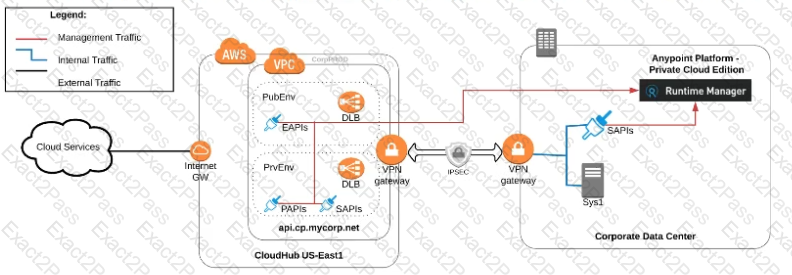
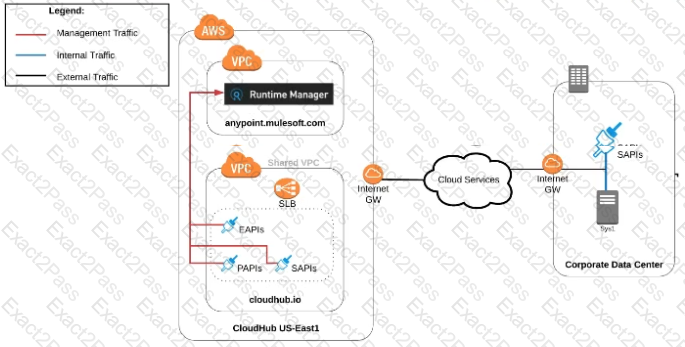
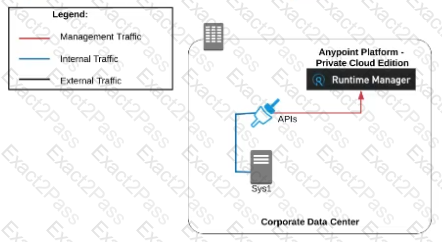
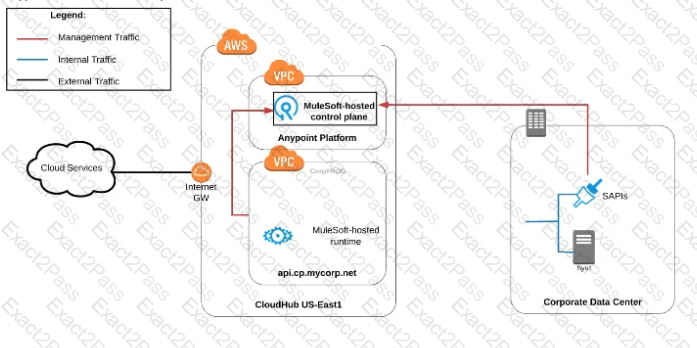
An organization uses various cloud-based SaaS systems and multiple on-premises systems. The on-premises systems are an important part of the organization ' s application network and can only be accessed from within the organization ' s intranet.
What is the best way to configure and use Anypoint Platform to support integrations with both the cloud-based SaaS systems and on-premises systems?
A) Use CloudHub-deployed Mule runtimes in an Anypoint VPC managed by Anypoint Platform Private Cloud Edition control plane
B) Use CloudHub-deployed Mule runtimes in the shared worker cloud managed by the MuleSoft-hosted Anypoint Platform control plane
C) Use an on-premises installation of Mule runtimes that are completely isolated with NO external network access, managed by the Anypoint Platform Private Cloud Edition control plane
D) Use a combination of Cloud Hub-deployed and manually provisioned on-premises Mule runtimes managed by the MuleSoft-hosted Anypoint Platform control plane
An Order API must be designed that contains significant amounts of integration logic and involves the invocation of the Product API.
The power relationship between Order API and Product API is one of " Customer/Supplier " , because the Product API is used heavily throughout the organization and is developed by a dedicated development team located in the office of the CTO.
What strategy should be used to deal with the API data model of the Product API within the Order API?
True or False. We should always make sure that the APIs being designed and developed are self-servable even if it needs more man-day effort and resources.
A retail company with thousands of stores has an API to receive data about purchases and insert it into a single database. Each individual store sends a batch of purchase data to the API about every 30 minutes. The API implementation uses a database bulk insert command to submit all the purchase data to a database using a custom JDBC driver provided by a data analytics solution provider. The API implementation is deployed to a single CloudHub worker. The JDBC driver processes the data into a set of several temporary disk files on the CloudHub worker, and then the data is sent to an analytics engine using a proprietary protocol. This process usually takes less than a few minutes. Sometimes a request fails. In this case, the logs show a message from the JDBC driver indicating an out-of-file-space message. When the request is resubmitted, it is successful. What is the best way to try to resolve this throughput issue?
What is typically NOT a function of the APIs created within the framework called API-led connectivity?
When could the API data model of a System API reasonably mimic the data model exposed by the corresponding backend system, with minimal improvements over the backend system ' s data model?
What is a typical result of using a fine-grained rather than a coarse-grained API deployment model to implement a given business process?
Once an API Implementation is ready and the API is registered on API Manager, who should request the access to the API on Anypoint Exchange?
What Mule application can have API policies applied by
Anypoint Platform to the endpoint exposed by that Mule application?
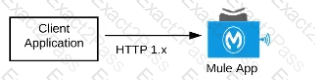
A) A Mule application that accepts requests over HTTP/1.x
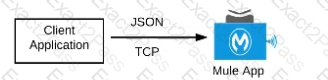
B) A Mule application that accepts JSON requests over TCP but is NOT required to provide a response
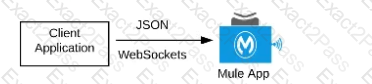
C) A Mute application that accepts JSON requests over WebSocket
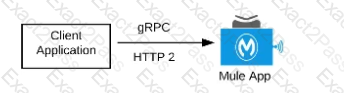
D) A Mule application that accepts gRPC requests over HTTP/2