Exact2Pass

Last Update 10 hours ago Total Questions : 91
The Fortinet NSE 7 - Security Operations 7.6 Architect content is now fully updated, with all current exam questions added 10 hours ago. Deciding to include NSE7_SOC_AR-7.6 practice exam questions in your study plan goes far beyond basic test preparation.
You'll find that our NSE7_SOC_AR-7.6 exam questions frequently feature detailed scenarios and practical problem-solving exercises that directly mirror industry challenges. Engaging with these NSE7_SOC_AR-7.6 sample sets allows you to effectively manage your time and pace yourself, giving you the ability to finish any Fortinet NSE 7 - Security Operations 7.6 Architect practice test comfortably within the allotted time.
Refer to the exhibits.
The DOS attack playbook is configured to create an incident when an event handler generates a denial-of-ser/ice (DoS) attack event.
Why did the DOS attack playbook fail to execute?
When configuring a FortiAnalyzer to act as a collector device, which two steps must you perform? (Choose two.)
Which three end user logs does FortiAnalyzer use to identify possible IOC compromised hosts? (Choose three answers)
Which three end user logs does FortiAnalyzer use to identify possible IOC compromised hosts? (Choose three.)
Refer to the exhibit.
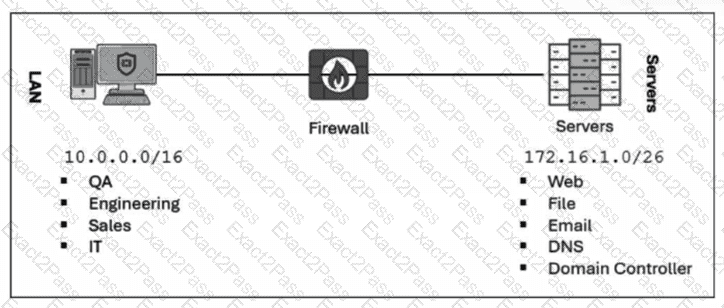
Which method most effectively reduces the attack surface of this organization? (Choose one answer)
Refer to the exhibits.
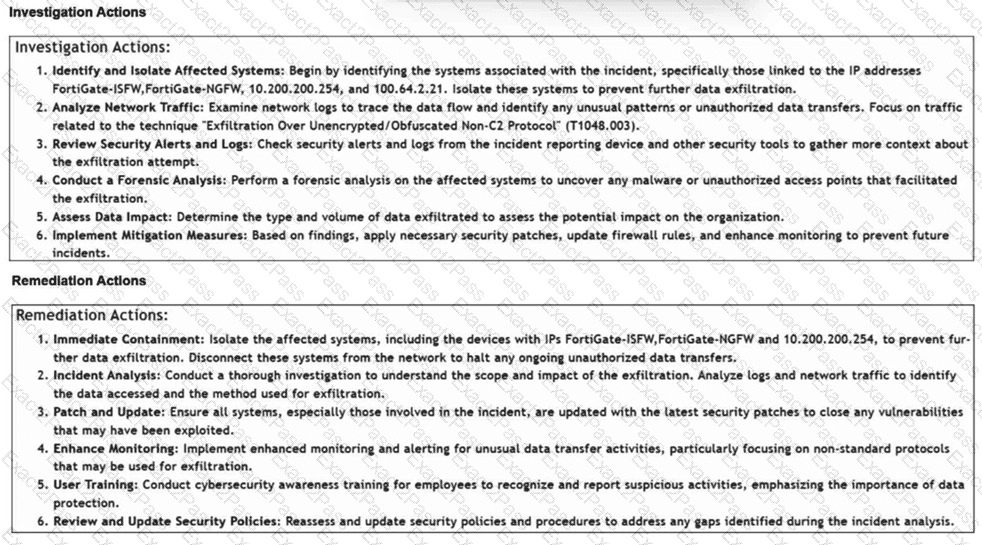
How is the investigation and remediation output generated on FortiSIEM? (Choose one answer)
Refer to Exhibits:
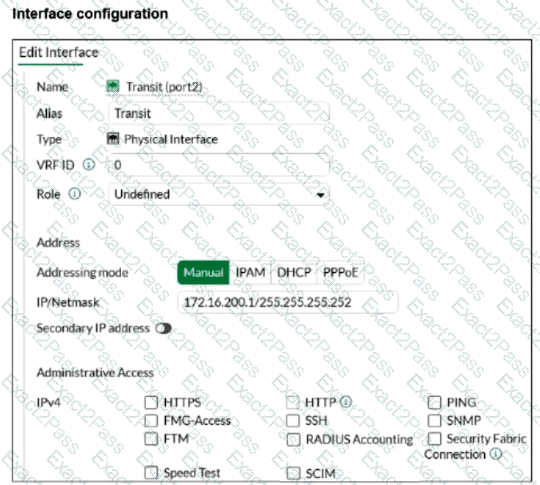
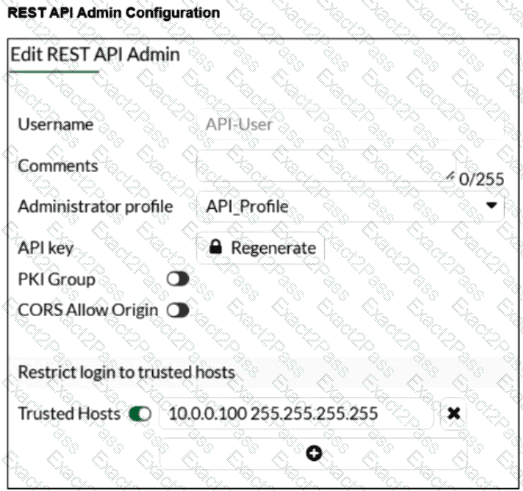
You configured the FortiGate connector on FortiSOAR. You want to allow FortiSOAR 10.200.200.160 to perform actions on FortiGate 172.16.200.1 . However, the connection attempt fails. Assume that the FortiGate connector is configured correctly on the FortiSOAR side.
Which two configurations are required on FortiGate? Choose two answers.
While monitoring your network, you discover that one FortiGate device is sending significantly more logs to FortiAnalyzer than all of the other FortiGate devices in the topology.
Additionally, the ADOM that the FortiGate devices are registered to consistently exceeds its quota.
What are two possible solutions? (Choose two.)
Which two ways can you create an incident on FortiAnalyzer? (Choose two.)
You are using FortiSIEM analytics to reference the configuration management database (CMDB) event type categories with the following requirements:
Attribute: Event Type
Value: Group: Logon Success
Which operator must you use for the analytics search? Choose one answer.

