Exact2Pass

Last Update 1 hour ago Total Questions : 110
The Fortinet NSE 7 - FortiSASE 26 Architect content is now fully updated, with all current exam questions added 1 hour ago. Deciding to include NSE7_SSE_AR-26 practice exam questions in your study plan goes far beyond basic test preparation.
You'll find that our NSE7_SSE_AR-26 exam questions frequently feature detailed scenarios and practical problem-solving exercises that directly mirror industry challenges. Engaging with these NSE7_SSE_AR-26 sample sets allows you to effectively manage your time and pace yourself, giving you the ability to finish any Fortinet NSE 7 - FortiSASE 26 Architect practice test comfortably within the allotted time.
You are tasked with configuring ADVPN 2.0 on an SD-WAN topology already configured for ADVPN. What should you do to implement ADVPN 2.0 in this scenario?
Refer to the exhibit. The administrator configured two SD-WAN rules to load balance the traffic. Which interfaces does FortiGate use to steer the traffic from 10.0.1.124 to 10.0.0.254? Choose one answer.
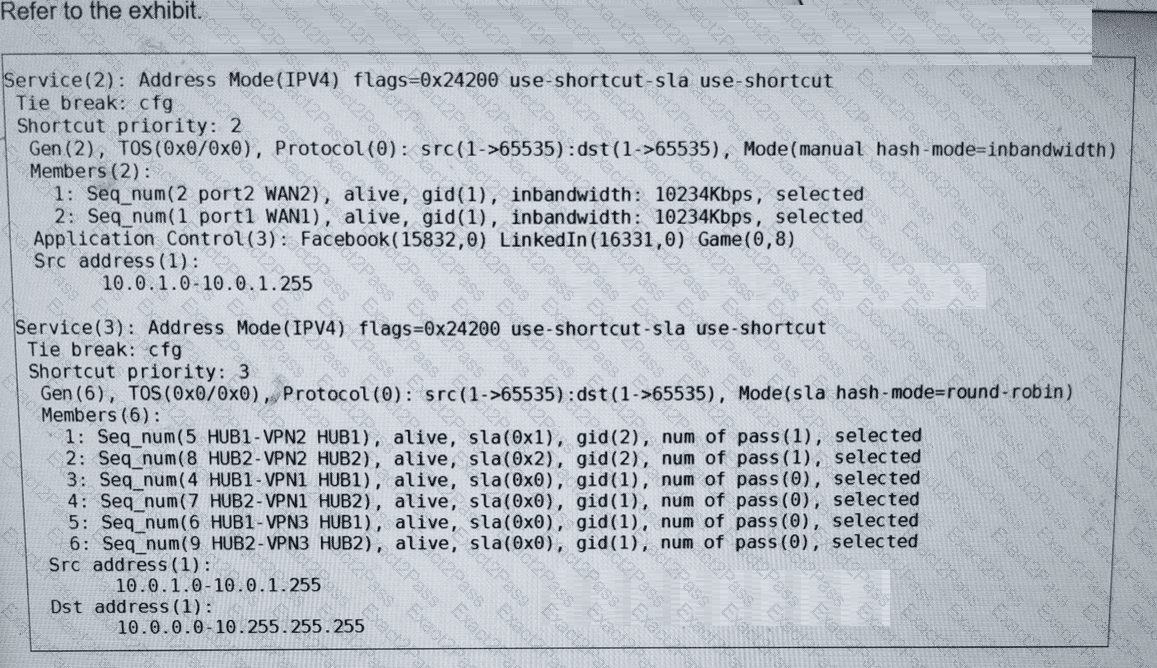
Exhibit 1
Refer to the exhibit. The administrator configured the IPsec tunnel VPN1 on a FortiGate device with the parameters shown in exhibit. Based on the configuration, which three conclusions can you draw about the characteristics and requirements of the VPN tunnel? (Choose three.)
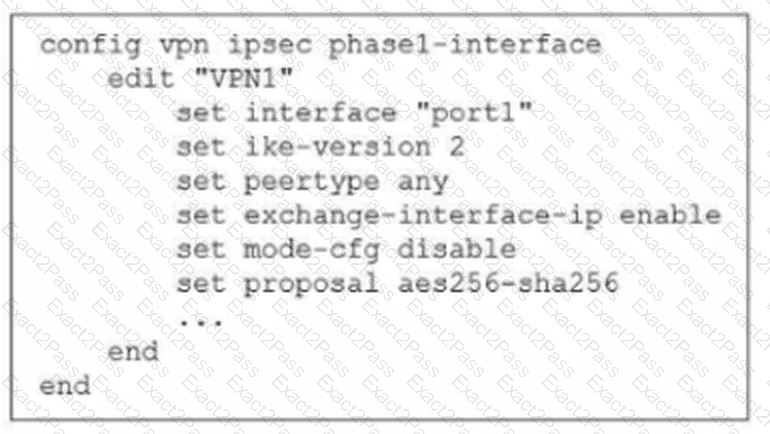
Exhibit 1
In which order does FortiGate consider the following elements during the route lookup process? Choose one answer.
Refer to the exhibit that shows an SD-WAN zone configuration on the FortiManager GUI. Based on the exhibit, how will the FortiGate device behave after it receives this configuration?
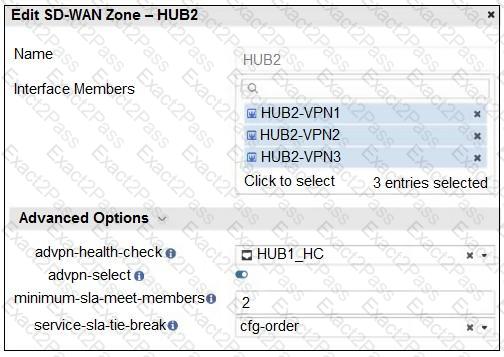
Exhibit 1
What are three characteristics of the provisioning templates available on FortiManager? (Choose three.)
The administrator uses the FortiManager SD-WAN overlay template to prepare an SD-WAN deployment. Using information provided through the SD-WAN overlay template wizard, FortiManager creates templates ready to install on the spoke and hub devices. What are the three templates created by the SD-WAN overlay template for a spoke device? (Choose three.)
Refer to the exhibit. The administrator analyzed the traffic between a branch FortiGate and the server located in the data center, and noticed the behavior shown in the diagram. When the LAN clients located behind FGT1 establish a session to a server behind DC-1, the administrator observes that, on DC-1, the reply traffic is routed overT2. even though T1 is the preferred member in the matching SD-WAN rule. What can the administrator do to instruct DC-1 to route the reply traffic through the member with the best performance?
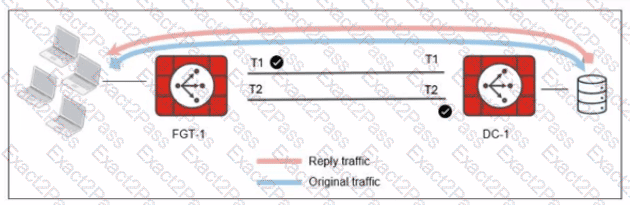
Exhibit 1
In a newly deployed FortiSASE environment using default configuration settings, an administrator provisions endpoint connectivity through FortiClient. As part of the onboarding process, specific configuration elements are automatically synchronized from FortiSASE to connected endpoints without manual intervention.
Which two settings are automatically pushed from FortiSASE to FortiClient, in this default deployment scenario? (Choose two.)
Refer to the exhibits.
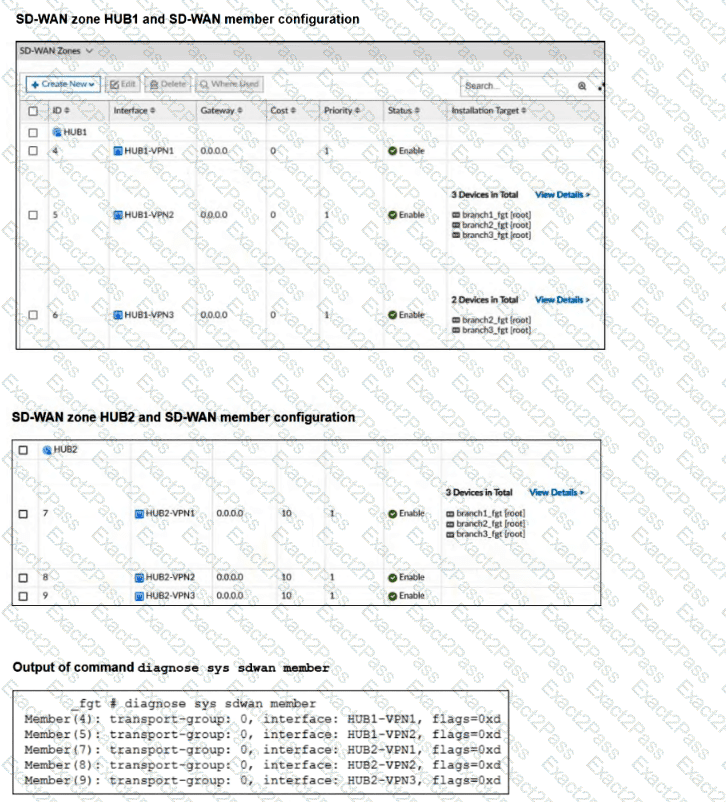
The exhibits show an SD-WAN zone HUB1 and SD-WAN member configuration from an SD-WAN template and the output of command diagnose sys sdwan member collected on a FortiGate device.
Which statement best describes what the diagnose output shows?