Exact2Pass

Last Update 1 hour ago Total Questions : 110
The Fortinet NSE 7 - FortiSASE 26 Architect content is now fully updated, with all current exam questions added 1 hour ago. Deciding to include NSE7_SSE_AR-26 practice exam questions in your study plan goes far beyond basic test preparation.
You'll find that our NSE7_SSE_AR-26 exam questions frequently feature detailed scenarios and practical problem-solving exercises that directly mirror industry challenges. Engaging with these NSE7_SSE_AR-26 sample sets allows you to effectively manage your time and pace yourself, giving you the ability to finish any Fortinet NSE 7 - FortiSASE 26 Architect practice test comfortably within the allotted time.
Refer to the exhibits. The exhibits show two IPsec templates to define Branch IPsec 1 and Branch_IPsec_2. Each template defines a VPN tunnel. The error message that FortiManager displayed when the administrator tried to assign the second template to the FortiGate device is also shown. Which statement best describes the cause of the issue?
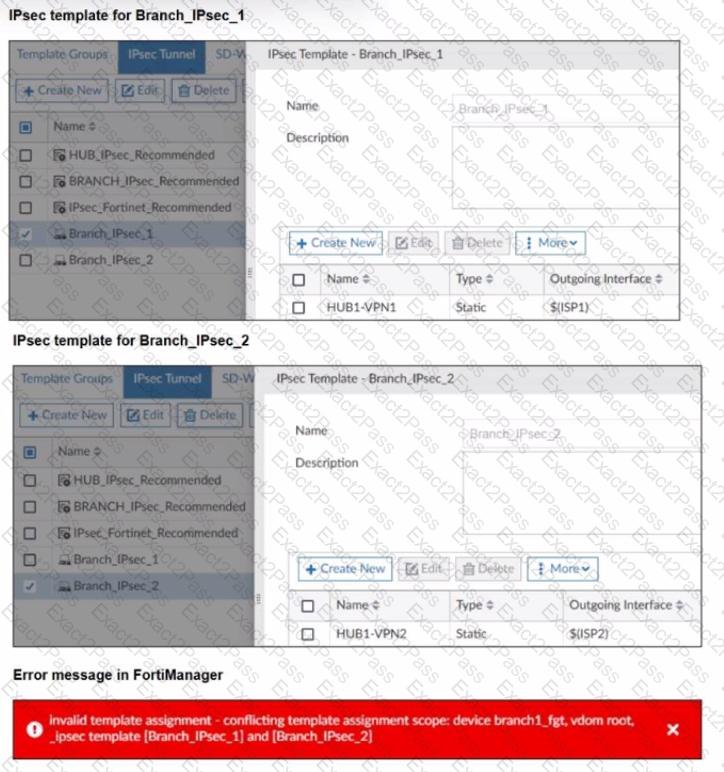
Exhibit 1
You are planning a large SD-WAN deployment with approximately 1000 spokes and want to allow ADVPN between the spokes. Some remote sites use FortiSASE to connect to the company ' s SD-WAN hub. Which overlay routing configuration should you use?
What are three key routing principles of SD-WAN? (Choose three.)
Refer to the exhibit.
An SD-WAN zone configuration on the FortiGate GUI is shown.
What can you conclude about the zone and member configuration on this device?
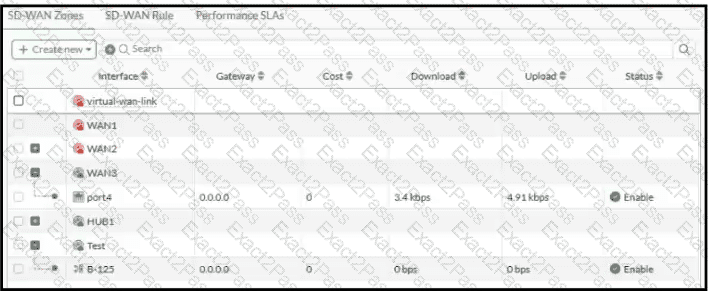
Exhibit — FortiGate SD-WAN zones
Refer to the exhibits. The exhibits show the SD-WAN zone configuration of an SD-WAN template prepared on FortiManager and the policy package configuration. When the administrator tries to install the configuration changes, FortiManager fails to commit. What should the administrator do to fix the issue?
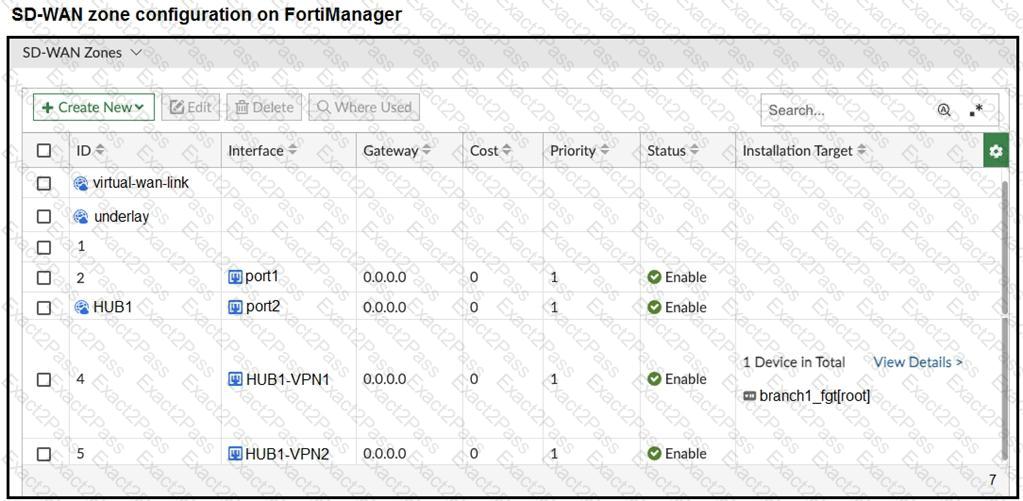
Exhibit 1
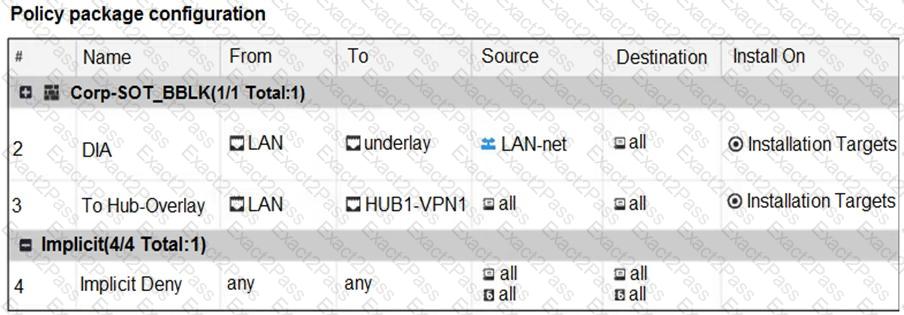
Exhibit 2
Refer to the exhibit. An administrator is troubleshooting SD-WAN on FortiGate. A device behind branch1_fgt generates traffic to the 10.0.0.0/8 network. The administrator expects the traffic to match SD-WAN rule ID 1 and be routed over HUB1-VPN1. However, the traffic is routed over HUB1-VPN3. Based on the output shown in the exhibit, which two reasons, individually or together, could explain the observed behavior? (Choose two.)
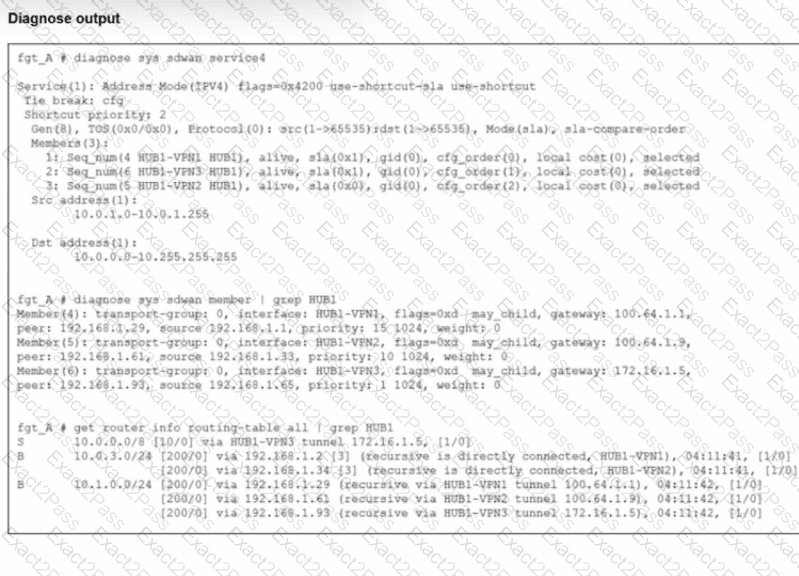
Exhibit 1
Refer to the exhibit. Which two conclusions can you draw from the output shown? (Choose two.)
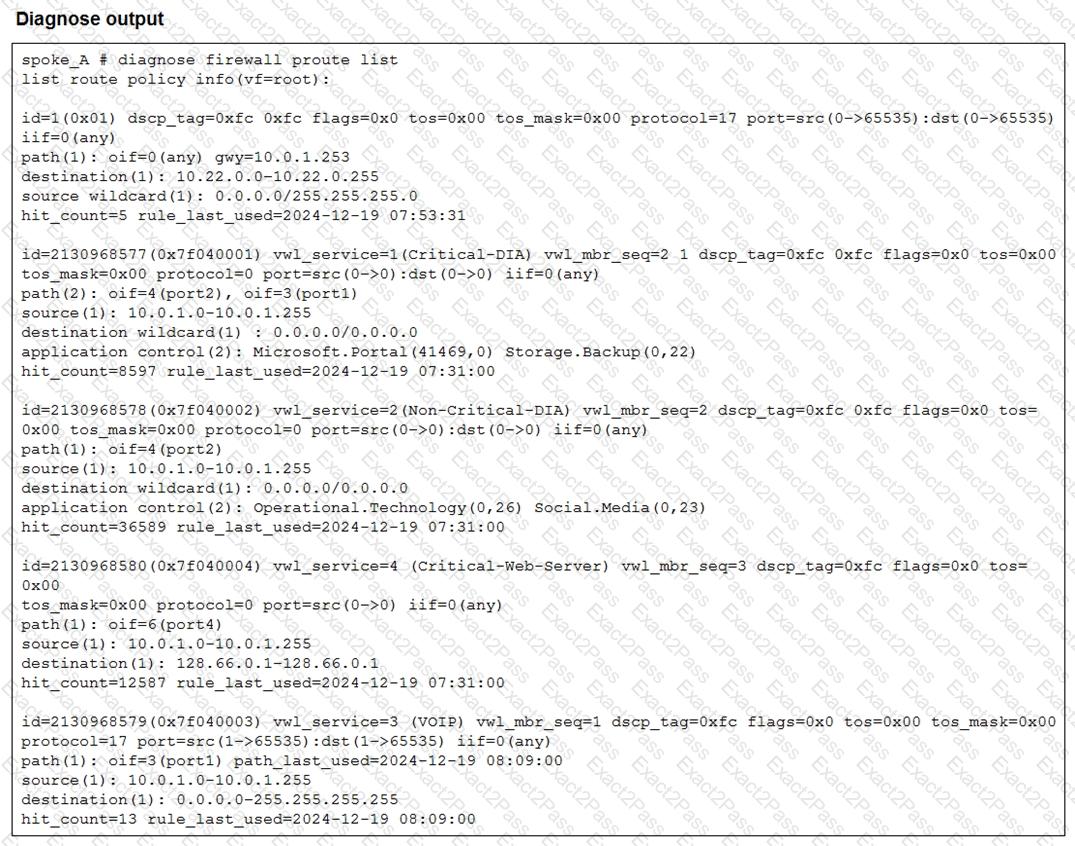
Exhibit 1
Refer to the exhibits. An administrator is testing application steering in SD-WAN. Before generating test traffic, the administrator collected the information shown in the first exhibit. After generating GoToMeeting test traffic, the administrator examined the corresponding traffic log on FortiAnalyzer, which is shown in the second exhibit. The administrator noticed that the traffic matched the implicit SD-WAN rule, but they expected the traffic to match rule ID 1. Which two reasons explain why some log messages show that the traffic matched the implicit SD-WAN rule? (Choose two.)
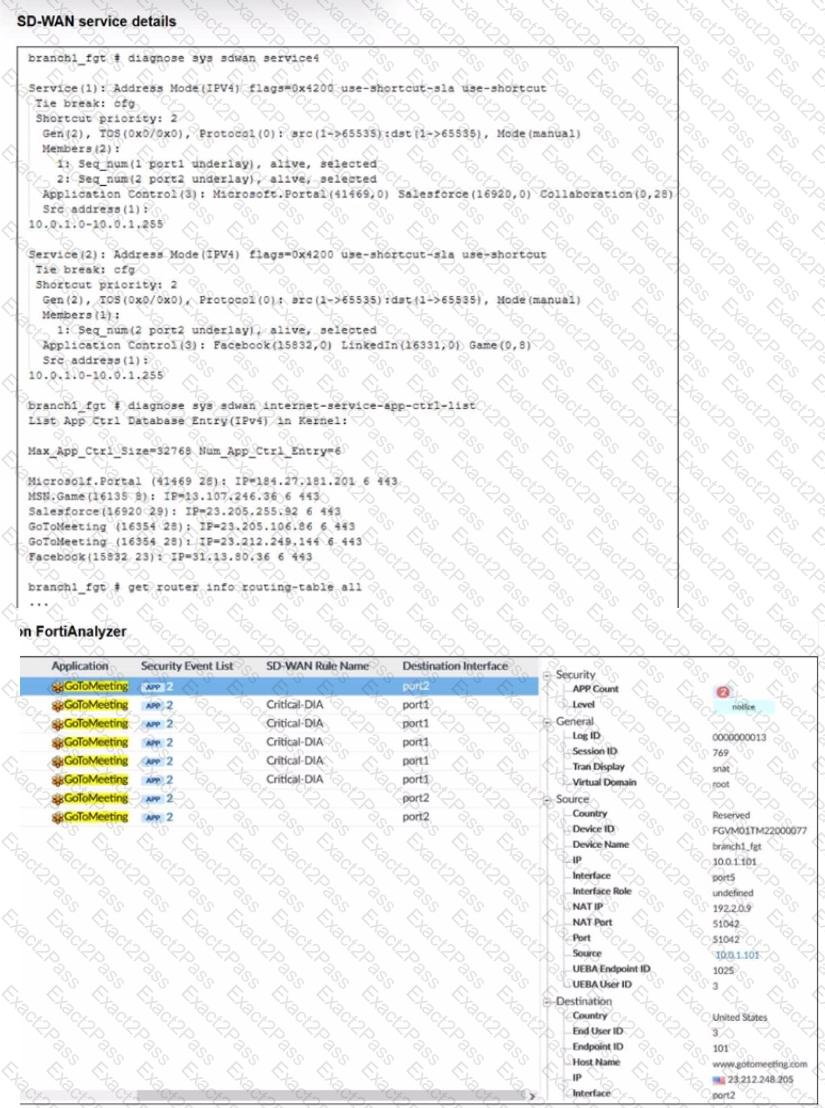
Exhibit 1
An administrator is enforcing endpoint network lockdown using FortiSASE to ensure that devices access the internet only under defined security conditions. The lockdown state must be released automatically when the endpoint meets specific trust or connectivity criteria.
Which two conditions can trigger the release of the network lockdown on an endpoint? (Choose two answers.)
Refer to the exhibit. You update the spokes configuration of an existing auto-discovery VPN (ADVPN) topology by adding the parameters shown in the exhibit. Which is a valid objective of those settings? Choose one answer.
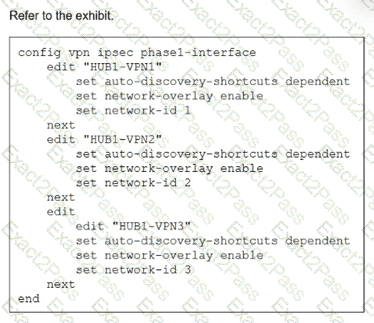
Exhibit 1