Exact2Pass

Last Update 6 hours ago Total Questions : 60
The Palo Alto Networks Certified Network Security Consultant content is now fully updated, with all current exam questions added 6 hours ago. Deciding to include PCNSC practice exam questions in your study plan goes far beyond basic test preparation.
You'll find that our PCNSC exam questions frequently feature detailed scenarios and practical problem-solving exercises that directly mirror industry challenges. Engaging with these PCNSC sample sets allows you to effectively manage your time and pace yourself, giving you the ability to finish any Palo Alto Networks Certified Network Security Consultant practice test comfortably within the allotted time.
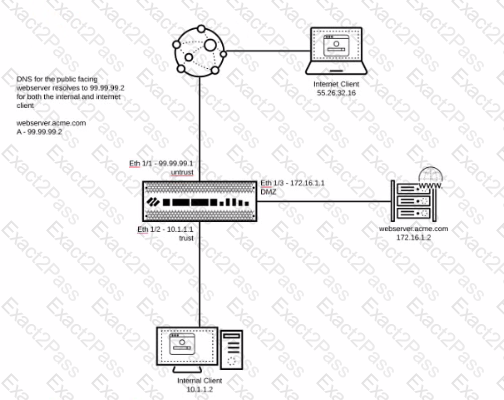
You are hosting a public-facing web server on your DMZ and access to that server is through a Palo Alto Networks firewall Both internal clients and internet clients access this web server using the FQDN public webserver acme com which resolves to the public address of 99.99 99.2
Which combination of NAT policies is necessary to enable access to the web server for both internal and internet clients?
A)

B)

C)

D)

TAC has requested a PCAP on your Panorama lo see why the DNS app is having intermittent issues resolving FODN What is the appropriate CLI command1*
SSL Forward Proxy decryption is enabled on (he firewall When clients use Chrome to browse to HTTPS sites, the firewall returns the Forward Trust certificate, even when accessing websites with invalid certificates The clients need to be presented with a browser warning error with the option to proceed to websites with invalid certificates
Which two options will satisfy this requirement? (Choose two.)
What is the maximum number of virtual systems supported by a Palo Alto Networks VM-300 firewall?
Instead of disabling App-IDs regularly, a security policy rule is going to be configured to temporarily allow new App-IDs. In which two circumstances is it valid to disable App-IDs as part of content update-?
(Choose two)
What is the default port used by the Terminal Services agent to communicate with a firewall?
A customer has a five-year-old firewall in production in the time since the firewall was installed, the IT team deleted unused security policies on a regular basis but they did not remove the address objects and groups that were part of these security policies.
What is the best way to delete all of the unused address objects on the firewall?
Which GlobalProtect feature ensures that only trusted endpoints can connect to the network?

