
Spring Sale Special Limited Time 70% Discount Offer - Ends in 0d 00h 00m 00s - Coupon code: buysanta

Exact2Pass Menu

Google Cloud Certified - Professional Cloud DevOps Engineer Exam

Last Update 1 day ago Total Questions : 201

The Google Cloud Certified - Professional Cloud DevOps Engineer Exam content is now fully updated, with all current exam questions added 1 day ago. Deciding to include Professional-Cloud-DevOps-Engineer practice exam questions in your study plan goes far beyond basic test preparation.

You'll find that our Professional-Cloud-DevOps-Engineer exam questions frequently feature detailed scenarios and practical problem-solving exercises that directly mirror industry challenges. Engaging with these Professional-Cloud-DevOps-Engineer sample sets allows you to effectively manage your time and pace yourself, giving you the ability to finish any Google Cloud Certified - Professional Cloud DevOps Engineer Exam practice test comfortably within the allotted time.

Question # 31

You need to create a Cloud Monitoring SLO for a service that will be published soon. You want to verify that requests to the service will be addressed in fewer than 300 ms at least 90% Of the time per calendar month. You need to identify the metric and evaluation method to use. What should you do?

A.

Select a latency metric for a request-based method of evaluation.

B.

Select a latency metric for a window-based method of evaluation.

C.

Select an availability metric for a request-based method of evaluation.

D.

Select an availability metric for a window-based method Of evaluation.

Question # 32

You support a service that recently had an outage. The outage was caused by a new release that exhausted the service memory resources. You rolled back the release successfully to mitigate the impact on users. You are now in charge of the post-mortem for the outage. You want to follow Site Reliability Engineering practices when developing the post-mortem. What should you do?

A.

Focus on developing new features rather than avoiding the outages from recurring.

B.

Focus on identifying the contributing causes of the incident rather than the individual responsible for the cause.

C.

Plan individual meetings with all the engineers involved. Determine who approved and pushed the new release to production.

D.

Use the Git history to find the related code commit. Prevent the engineer who made that commit from working on production services.

Question # 33

You are configuring a CI pipeline. The build step for your CI pipeline integration testing requires access to APIs inside your private VPC network. Your security team requires that you do not expose API traffic publicly. You need to implement a solution that minimizes management overhead. What should you do?

A.

Use Cloud Build private pools to connect to the private VPC.

B.

Use Cloud Build to create a Compute Engine instance in the private VPC. Run the integration tests on the VM by using a startup script.

C.

Use Cloud Build as a pipeline runner. Configure a cross-region internal Application Load Balancer for API access.

D.

Use Cloud Build as a pipeline runner. Configure a global external Application Load Balancer with a Google Cloud Armor policy for API access.

Question # 34

You built a serverless application by using Cloud Run and deployed the application to your production environment You want to identify the resource utilization of the application for cost optimization What should you do?

A.

Use Cloud Trace with distributed tracing to monitor the resource utilization of the application

B.

Use Cloud Profiler with Ops Agent to monitor the CPU and memory utilization of the application

C.

Use Cloud Monitoring to monitor the container CPU and memory utilization of the application

D.

Use Cloud Ops to create logs-based metrics to monitor the resource utilization of the application

Question # 35

You manage an application that runs in Google Kubernetes Engine (GKE) and uses the blue/green deployment methodology Extracts of the Kubernetes manifests are shown below:
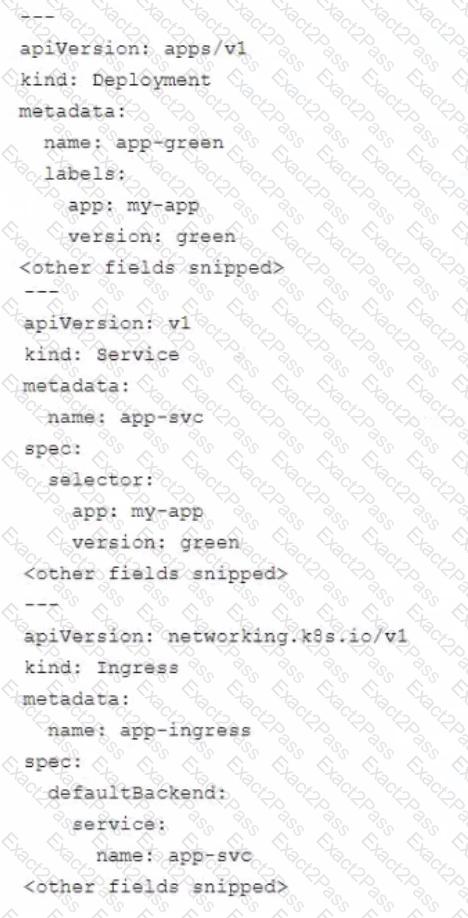
The Deployment app-green was updated to use the new version of the application During post-deployment monitoring you notice that the majority of user requests are failing You did not observe this behavior in the testing environment You need to mitigate the incident impact on users and enable the developers to troubleshoot the issue What should you do?

A.

Update the Deployment app-blue to use the new version of the application

B.

Update the Deployment ape-green to use the previous version of the application

C.

Change the selector on the Service app-2vc to app: my-app.

D.

Change the selector on the Service app-svc to app: my-app, version: blue

Question # 36

You recently deployed your application in Google Kubernetes Engine (GKE) and now need to release a new version of the application You need the ability to instantly roll back to the previous version of the application in case there are issues with the new version Which deployment model should you use?

A.

Perform a rolling deployment and test your new application after the deployment is complete

B.

Perform A. B testing, and test your application periodically after the deployment is complete

C.

Perform a canary deployment, and test your new application periodically after the new version is deployed

D.

Perform a blue/green deployment and test your new application after the deployment is complete

Question # 37

You use Cloud Build to build and deploy your application. You want to securely incorporate database credentials and other application secrets into the build pipeline. You also want to minimize the development effort. What should you do?

A.

Create a Cloud Storage bucket and use the built-in encryption at rest. Store the secrets in the bucket and grant Cloud Build access to the bucket.

B.

Encrypt the secrets and store them in the application repository. Store a decryption key in a separate repository and grant Cloud Build access to the repository.

C.

Use client-side encryption to encrypt the secrets and store them in a Cloud Storage bucket. Store a decryption key in the bucket and grant Cloud Build access to the bucket.

D.

Use Cloud Key Management Service (Cloud KMS) to encrypt the secrets and include them in your Cloud Build deployment configuration. Grant Cloud Build access to the KeyRing.

Question # 38

You deploy a new release of an internal application during a weekend maintenance window when there is minimal user traffic. After the window ends, you learn that one of the new features isn ' t working as expected in the production environment. After an extended outage, you roll back the new release and deploy a fix. You want to modify your release process to reduce the mean time to recovery so you can avoid extended outages in the future. What should you do?

Choose 2 answers

A.

Before merging new code, require 2 different peers to review the code changes.

B.

Adopt the blue/green deployment strategy when releasing new code via a CD server.

C.

Integrate a code linting tool to validate coding standards before any code is accepted into the repository.

D.

Require developers to run automated integration tests on their local development environments before release.

E.

Configure a CI server.Add a suite of unit tests to your code and have your CI server run them on commit and verify any changes.

Question # 39

You support a web application that is hosted on Compute Engine. The application provides a booking service for thousands of users. Shortly after the release of a new feature, your monitoring dashboard shows that all users are experiencing latency at login. You want to mitigate the impact of the incident on the users of your service. What should you do first?

A.

Roll back the recent release.

B.

Review the Stackdriver monitoring.

C.

Upsize the virtual machines running the login services.

D.

Deploy a new release to see whether it fixes the problem.

Question # 40

You have an application running in Google Kubernetes Engine. The application invokes multiple services per request but responds too slowly. You need to identify which downstream service or services are causing the delay. What should you do?


A.

Analyze VPC flow logs along the path of the request.

B.

Investigate the Liveness and Readiness probes for each service.

C.

Create a Dataflow pipeline to analyze service metrics in real time.

D.

Use a distributed tracing framework such as OpenTelemetry or Stackdriver Trace.

Go to page: