
Spring Sale Special Limited Time 70% Discount Offer - Ends in 0d 00h 00m 00s - Coupon code: buysanta

Exact2Pass Menu

Google Cloud Certified - Professional Cloud DevOps Engineer Exam

Last Update 1 day ago Total Questions : 201

The Google Cloud Certified - Professional Cloud DevOps Engineer Exam content is now fully updated, with all current exam questions added 1 day ago. Deciding to include Professional-Cloud-DevOps-Engineer practice exam questions in your study plan goes far beyond basic test preparation.

You'll find that our Professional-Cloud-DevOps-Engineer exam questions frequently feature detailed scenarios and practical problem-solving exercises that directly mirror industry challenges. Engaging with these Professional-Cloud-DevOps-Engineer sample sets allows you to effectively manage your time and pace yourself, giving you the ability to finish any Google Cloud Certified - Professional Cloud DevOps Engineer Exam practice test comfortably within the allotted time.

Question # 21

You are creating a CI/CD pipeline to perform Terraform deployments of Google Cloud resources Your CI/CD tooling is running in Google Kubernetes Engine (GKE) and uses an ephemeral Pod for each pipeline run You must ensure that the pipelines that run in the Pods have the appropriate Identity and Access Management (1AM) permissions to perform the Terraform deployments You want to follow Google-recommended practices for identity management What should you do?

Choose 2 answers

A.

Create a new Kubernetes service account, and assign the service account to the Pods Use Workload Identity to authenticate as the Google service account

B.

Create a new JSON service account key for the Google service account store the key as a Kubernetes secret, inject the key into the Pods, and set the boogle_application_credentials environment variable

C.

Create a new Google service account, and assign the appropriate 1AM permissions

D.

Create a new JSON service account key for the Google service account store the key in the secret management store for the CI/CD tool and configure Terraform to use this key for authentication

E.

Assign the appropriate 1AM permissions to the Google service account associated with the Compute Engine VM instances that run the Pods

Question # 22

You use Google Cloud Managed Service for Prometheus with managed collection to gather metrics from your service running on Google Kubernetes Engine (GKE). After deploying the service, there is no metric data appearing in Cloud Monitoring, and you have not encountered any error messages. You need to troubleshoot this issue. What should you do?

A.

Determine if your service has exceeded its quota for writes to the Cloud Monitoring API.

B.

Check if the Grafana service is installed on your GKE cluster.

C.

Confirm that your service has the monitoring.servicesViewer IAM role.

D.

Verify that your PodMonitoring configuration references a valid port.

Question # 23

You are the on-call Site Reliability Engineer for a microservice that is deployed to a Google Kubernetes Engine (GKE) Autopilot cluster. Your company runs an online store that publishes order messages to Pub/Sub and a microservice receives these messages and updates stock information in the warehousing system. A sales event caused an increase in orders, and the stock information is not being updated quickly enough. This is causing a large number of orders to be accepted for products that are out of stock You check the metrics for the microservice and compare them to typical levels.
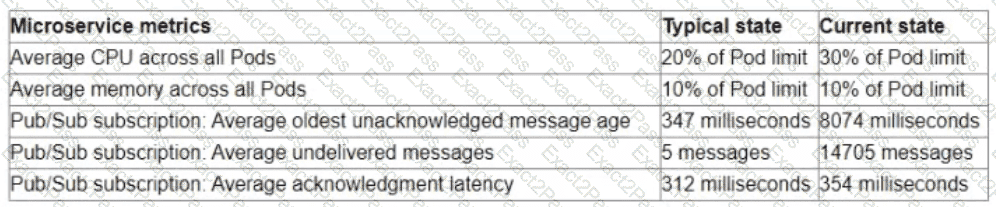
You need to ensure that the warehouse system accurately reflects product inventory at the time orders are placed and minimize the impact on customers What should you do?

A.

Decrease the acknowledgment deadline on the subscription

B.

Add a virtual queue to the online store that allows typical traffic levels

C.

Increase the number of Pod replicas

D.

Increase the Pod CPU and memory limits

Question # 24

You support a large service with a well-defined Service Level Objective (SLO). The development team deploys new releases of the service multiple times a week. If a major incident causes the service to miss its SLO, you want the development team to shift its focus from working on features to improving service reliability. What should you do before a major incident occurs?

A.

Develop an appropriate error budget policy in cooperation with all service stakeholders.

B.

Negotiate with the product team to always prioritize service reliability over releasing new features.

C.

Negotiate with the development team to reduce the release frequency to no more than once a week.

D.

Add a plugin to your Jenkins pipeline that prevents new releases whenever your service is out of SLO.

Question # 25

Your application images are built and pushed to Google Container Registry (GCR). You want to build an automated pipeline that deploys the application when the image is updated while minimizing the development effort. What should you do?

A.

Use Cloud Build to trigger a Spinnaker pipeline.

B.

Use Cloud Pub/Sub to trigger a Spinnaker pipeline.

C.

Use a custom builder in Cloud Build to trigger a Jenkins pipeline.

D.

Use Cloud Pub/Sub to trigger a custom deployment service running in Google Kubernetes Engine (GKE).

Question # 26

You are configuring a Cl pipeline. The build step for your Cl pipeline integration testing requires access to APIs inside your private VPC network. Your security team requires that you do not expose API traffic publicly. You need to implement a solution that minimizes management overhead. What should you do?

A.

Use Cloud Build private pools to connect to the private VPC.

B.

Use Spinnaker for Google Cloud to connect to the private VPC.

C.

Use Cloud Build as a pipeline runner. Configure Internal HTTP(S) Load Balancing for API access.

D.

Use Cloud Build as a pipeline runner. Configure External HTTP(S) Load Balancing with a Google Cloud Armor policy for API access.

Question # 27

Your organization wants to implement Site Reliability Engineering (SRE) culture and principles. Recently, a service that you support had a limited outage. A manager on another team asks you to provide a formal explanation of what happened so they can action remediations. What should you do?

A.

Develop a postmortem that includes the root causes, resolution, lessons learned, and a prioritized list of action items. Share it with the manager only.

B.

Develop a postmortem that includes the root causes, resolution, lessons learned, and a prioritized list of action items. Share it on the engineering organization ' s document portal.

C.

Develop a postmortem that includes the root causes, resolution, lessons learned, the list of people responsible, and a list of action items for each person. Share it with the manager only.

D.

Develop a postmortem that includes the root causes, resolution, lessons learned, the list of people responsible, and a list of action items for each person. Share it on the engineering organization ' s document portal.

Question # 28

Your development team has created a new version of their service’s API. You need to deploy the new versions of the API with the least disruption to third-party developers and end users of third-party installed applications. What should you do?

A.

Introduce the new version of the API.Announce deprecation of the old version of the API.Deprecate the old version of the API.Contact remaining users of the old API.Provide best effort support to users of the old API.Turn down the old version of the API.

B.

Announce deprecation of the old version of the API.Introduce the new version of the API.Contact remaining users on the old API.Deprecate the old version of the API.Turn down the old version of the API.Provide best effort support to users of the old API.

C.

Announce deprecation of the old version of the API.Contact remaining users on the old API.Introduce the new version of the API.Deprecate the old version of the API.Provide best effort support to users of the old API.Turn down the old version of the API.

D.

Introduce the new version of the API.Contact remaining users of the old API.Announce deprecation of the old version of the API.Deprecate the old version of the API.Turn down the old version of the API.Provide best effort support to users of the old API.

Question # 29

You are managing an application that exposes an HTTP endpoint without using a load balancer. The latency of the HTTP responses is important for the user experience. You want to understand what HTTP latencies all of your users are experiencing. You use Stackdriver Monitoring. What should you do?

A.

• In your application, create a metric with a metricKind set to DELTA and a valueType set to DOUBLE.• In Stackdriver ' s Metrics Explorer, use a Slacked Bar graph to visualize the metric.

B.

• In your application, create a metric with a metricKind set to CUMULATIVE and a valueType set to DOUBLE.• In Stackdriver ' s Metrics Explorer, use a Line graph to visualize the metric.

C.

• In your application, create a metric with a metricKind set to gauge and a valueType set to distribution.• In Stackdriver ' s Metrics Explorer, use a Heatmap graph to visualize the metric.

D.

• In your application, create a metric with a metricKind. set toMETRlc_KIND_UNSPECIFIEDanda valueType set to INT64.• In Stackdriver ' s Metrics Explorer, use a Stacked Area graph to visualize the metric.

Question # 30

Your company follows Site Reliability Engineering practices. You are the person in charge of Communications for a large, ongoing incident affecting your customer-facing applications. There is still no estimated time for a resolution of the outage. You are receiving emails from internal stakeholders who want updates on the outage, as well as emails from customers who want to know what is happening. You want to efficiently provide updates to everyone affected by the outage. What should you do?


A.

Focus on responding to internal stakeholders at least every 30 minutes. Commit to " next update " times.

B.

Provide periodic updates to all stakeholders in a timely manner. Commit to a " next update " time in all communications.

C.

Delegate the responding to internal stakeholder emails to another member of the Incident Response Team. Focus on providing responses directly to customers.

D.

Provide all internal stakeholder emails to the Incident Commander, and allow them to manage internal communications. Focus on providing responses directly to customers.

Go to page: