
Spring Sale Special Limited Time 70% Discount Offer - Ends in 0d 00h 00m 00s - Coupon code: buysanta

Exact2Pass Menu

Oracle Database 12c SQL

Last Update 15 hours ago Total Questions : 326

The Oracle Database 12c SQL content is now fully updated, with all current exam questions added 15 hours ago. Deciding to include 1z0-071 practice exam questions in your study plan goes far beyond basic test preparation.

You'll find that our 1z0-071 exam questions frequently feature detailed scenarios and practical problem-solving exercises that directly mirror industry challenges. Engaging with these 1z0-071 sample sets allows you to effectively manage your time and pace yourself, giving you the ability to finish any Oracle Database 12c SQL practice test comfortably within the allotted time.

Question # 91

Which two are true about unused columns?

A.

The DESCRIBE command displays unused columns

B.

A primary key column cannot be set to unused.

C.

A query can return data from unused columns, but no DML is possible on those columns.

D.

Once a column has been set to unused, a new column with the same name can be added to the table.

E.

A foreign key column cannot be set to unused.

F.

Unused columns retain their data until they are dropped

Question # 92

Which four statements are true about constraints on Oracle tables?

A.

A Column can have only one CHECK Constraint.

B.

A NOT NULL Constraint can be defined at the table level.

C.

A UNIQUE constraint permits NULLS.

D.

A PRIMARY KEY Constraint can be added after a table has been created and populated.

E.

A CHECK Constraint can refer to values in other rows.

F.

A UNIQUE Constraint can use a pre-existing index on the constrained column or columns.

G.

A FOREIGN KEY Column can contain NULLS.

Question # 93

Which three are true about subqueries?

A.

A subquery can be used in a WHERE clause.

B.

A subquery can be used in a HAVING clause.

C.

=ANY can only evaluate the argument against a subcjuery if it returns two or more values.

D.

< ANY returns true if the argument is less than the highest value returned by the subquery.

E.

A subquery cannot be used in a FROM clause.

F.

< any returns true if the argument is less than the lowest value returned by the subquery.

G.

A subquery cannot be used in the select list.

Question # 94

You execute these commands successfully:

CREATE GLOBAL TEMPORARY TABLE invoices _ gtt

( customer id INTEGER,

invoice_ total NUMBER (10, 2)

) ON COMMIT PRESERVE ROWS;

INSERT INTO invoices_ gtt VALUES (1 , 100);

COMMIT;

Which two are true?

A.

You can add a foreign key to the table.

B.

When you terminate your session, the row will be deleted.

C.

To drop the table in this session, you must first truncate it.

D.

You can add a column to the table in this session.

E.

Other sessions can view the committed row.

Question # 95

Which three are true about granting object privileges on tables, views, and sequences?

A.

UPDATE can be granted only on tables and views.

B.

DELETE can be granted on tables, views, and sequences.

C.

REFERENCES can be granted only on tables and views.

D.

INSERT can be granted on tables, views, and sequences.

E.

SELECT can be granted only on tables and views.

F.

ALTER can be granted only on tables and sequences.

Question # 96

Which three are true about dropping columns from a table?

A.

A column can be removed only if it contains no data.

B.

A column drop is implicitly committed

C.

A column that is referenced by another column in any other table cannot be dropped.

D.

A column must be set as unused before it is dropped from a table.

E.

A primary key column cannot be dropped.

F.

Multiple columns can be dropped simultaneously using the ALTER TABLE command.

Question # 97

Examine the description of the CUSTOMERS table:
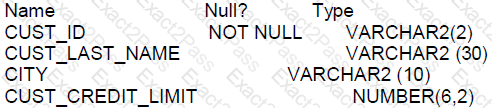
You need to display last names and credit limits of all customers whose last name starts with A or B In lower or upper case, and whose credit limit is below 1000.

Examine this partial query:

SELECT cust_last_nare, cust_credit_limit FROM customers

Which two WHERE conditions give the required result?

A.

WHERE UPPER(cust_last_name) IN ( ' A% ' , ' B% ' ) AND cust_credit_limit < 1000:

B.

WHERE (INITCAP(cust_last_name) LIKE ‘A% ' OR ITITCAP(cust_last_name) LIKE ‘B% ' ) AND cust_credit_limit < 1000

C.

WHERE UPPER(cust_last_name) BETWEEN UPPER( ' A% ' AND ' B%’) AND ROUND(cust_credit_limit) < 1000;

D.

WHERE (UPPER(cust_last_name) LIKE ' A%’ OR UPPER(cust_last_name) LIKE ‘B%’) AND ROUND(cust_credit_limit) < 1000;

E.

WHERE (UPPER(cust_last_name) like INITCAP ( ' A ' ) OR UPPER(cust_last_name) like INITCAP( ' B ' )) AND ROUND(cust_credit_limit) < ROUND(1000) ;

Go to page:
