Spring Sale Special Limited Time 70% Discount Offer - Ends in 0d 00h 00m 00s - Coupon code: buysanta

Exact2Pass Menu

Oracle Database 12c SQL

Last Update 8 hours ago Total Questions : 326

The Oracle Database 12c SQL content is now fully updated, with all current exam questions added 8 hours ago. Deciding to include 1z0-071 practice exam questions in your study plan goes far beyond basic test preparation.

You'll find that our 1z0-071 exam questions frequently feature detailed scenarios and practical problem-solving exercises that directly mirror industry challenges. Engaging with these 1z0-071 sample sets allows you to effectively manage your time and pace yourself, giving you the ability to finish any Oracle Database 12c SQL practice test comfortably within the allotted time.

Question # 81

Which three statements are true about a self join?
A.

It must be an inner join.

B.

It must be an equijoin.

C.

The query must use two different aliases for the table.

D.

The on clause can be used.

E.

The on clause must be used.

F.

It can be an outer join.

Question # 82

For each employee in department 90 you want to display:

1. their last name

2. the number of complete weeks they have been employed

The output must be sorted by the number of weeks, starting with the longest serving employee

first.Which statement will accomplish this?

A.

SELECT last_name, TRUNC( (SYSDATE - hire_ date) 1 7) AS tenure

FROM employees

WHERE department_ id = 90

ORDER BY tenure ;

B.

SELECT last_name, ROUND( (SYSDATE - hire_ date) 1 7) AS tenure

FROM employees

WHERE department_ id = 90

ORDER BY tenure ;

C.

SELECT last_name, ROUND( (SYSDATE - hire_ date) 17) AS tenure

FROM employees

WHERE department_ id = 90

ORDER BY tenure DESC;

D.

SELECT last_name, TRUNC ( (SYSDATE - - hire_ date) 1 7) AS tenure

FROM employees

WHERE department_id = 90

ORDER BY tenure DESC;

Question # 83

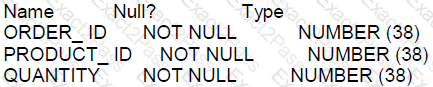
Examine the ORDER _ITEms table:

Which two queries return rows where QUANTITY is a multiple of ten?

A.

SELECT * FROM order_ items WHERE quantity = TRUNC (quantity, -1);

B.

SELECT * FROM order_ items WHERE MOD (quantity, 10) = 0;

C.

SELECT” FROM order_ items WHERE FLOOR (quantity / 10) = TRUNC (quantity / 10);

D.

SELECT FROM order_ items WHERE quantity / 10 = TRUNC (quantity);

E.

SELECT” FROM order_ _items WHERE quantity = ROUND (quantity, 1);

Question # 84

Which three statements are true?

A.

A customer can exist in many countries.

B.

The statement will fail if a row already exists in the SALES table for product 23.

C.

The statement will fail because subquery may not be I contained in a values clause.

D.

The SALES table has five foreign keys.

E.

The statement will execute successfully and a new row will be inserted into the SALES table.

F.

A product can have a different unit price at different times.

Question # 85

Examine this query which executes successfully:

SELECT job, deptno FROM emp

UNION ALL

SELECT job, deptno FROM jobs_ history;

What will be the result?

A.

It will return rows common to both SELECT statements.

B.

It will return rows from both SELECT statements after eliminating duplicate rows.

C.

It will return rows that are not common to both SELECT statements.

D.

It will return rows from both SELECT statements including duplicate rows.

Question # 86

Which two queries only return CUBE?

A.

SELECT shape FROM bricks JOIN boxes ON weight > = min_weight AND weight < max_weight;

B.

SELECT shape FROM bricks JOIN boxes ON weight > min_weight;

C.

SELECT shape FROM bricks JOIN boxes ON weight BETWEEN min_weight AND max_weight;

D.

SELECT shape FROM bricks JOIN boxes ON weight < max_weight;

E.

SELECT shape FROM bricks JOIN boxes ON NOT (weight > max_weight);

Question # 87

Which three statements are true about GLOBAL TEMPORARY TABLES?

A.

GLOBAL TEMPORARY TABLE rows inserted by a session are available to any other session whose user has been granted select on the table.

B.

A TRUNCATE command issued in a session causes all rows In a GLOBAL TEMPORARY TABLE for the issuing session to be deleted.

C.

A DELETE command on a GLOBAL TEMPORARY TABLE cannot be rolled back.

D.

A GLOBAL TEMPORARY TABLE ' s definition is available to multiple sessions.

E.

Any GLOBAL TEMPORARY TABLE rows existing at session termination will be deleted.

F.

GLOBAL TEMPORARY TABLE space allocation occurs at session start.

Question # 88

Which four statements are true regarding primary and foreign key constraints and the effect they can have on table data?

A.

Only the primary key can be defined at the column and table level.

B.

The foreign key columns and parent table primary key columns must have the same names.

C.

It is possible for child rows that have a foreign key to remain in the child table at the time the parent row is deleted.

D.

A table can have only one primary key but multiple foreign keys.

E.

Primary key and foreign key constraints can be defined at both the column and table level.

F.

A table can have only one primary key and one foreign key.

G.

It is possible for child rows that have a foreign key to be deleted automatically from the child table at the time the parent row is deleted

Question # 89

Examine the data in the EMPLOYEES table:

Which statement will compute the total annual compensation for each employee?

A.

SELECT last _ NAME (monthly_ salary + monthly _commission _ pct) * 12 AS annual_ comp FROM employees;

B.

select last _ name, (monthly_ salary * 12) + (monthly_ salary * 12 *monthly_ commission_ pct) AS annual_ camp FROM employees

C.

SELECT last _ name, (monthly_ salary * 12) + (monthly_ salary * 12 * NVL (monthly_ commission _pct, 0)) AS annual _comp

D.

SELECT last _ name, (monthly _ salary * 12) + (monthly_ commission _ pct * 12) AS FROM employees:

Question # 90

Which two statements are true about * TABLES views?

A.

You must have SELECT privileges on a table to view it in ALL TABLES.

B.

You must have SELECT privileges on a table to view it in DBA TABLES.

C.

USER TABLES displays all tables owned by the current user.

D.

All TABLES displays all tables owned by the current user.

E.

You must have SELECT privileges on a table to view it in USER TABLES.

F.

All users can query DBA TABLES successfully.

Go to page: