
Spring Sale Special Limited Time 70% Discount Offer - Ends in 0d 00h 00m 00s - Coupon code: buysanta

Exact2Pass Menu

Oracle Database 12c SQL

Last Update 8 hours ago Total Questions : 326

The Oracle Database 12c SQL content is now fully updated, with all current exam questions added 8 hours ago. Deciding to include 1z0-071 practice exam questions in your study plan goes far beyond basic test preparation.

You'll find that our 1z0-071 exam questions frequently feature detailed scenarios and practical problem-solving exercises that directly mirror industry challenges. Engaging with these 1z0-071 sample sets allows you to effectively manage your time and pace yourself, giving you the ability to finish any Oracle Database 12c SQL practice test comfortably within the allotted time.

Question # 21

Which three are true about the MERGE statement ?

A.

It can merge rows only from tables.

B.

It can use views to produce source rows.

C.

It can combine rows from multiple tables conditionally to insert into a single table.

D.

It can use subqueries to produce source rows.

E.

It can update the same row of the target table multiple times.

F.

It can update, insert, or delete rows conditionally in multiple tables.

Question # 22

Examine this statement:

SELECT1 AS id,‘ John’ AS first_name, NULL AS commission FROM dual

INTERSECT

SELECT 1,’John’ null FROM dual ORDER BY 3;

What is returned upon execution?[

A.

2 rows

B.

0 rows

C.

An error

D.

1 ROW

Question # 23

Which three statements are true about defining relations between tables in a relational database?

A.

Foreign key columns allow null values.

B.

Unique key columns allow null values

C.

Primary key columns allow null values.

D.

Every primary or unique key value must refer to a matching foreign key value.

E.

Every foreign key value must refer to a matching primary or unique key value.

Question # 24

Examine these requirements:

1. Display book titles for books purchased before January 17, 2007 costing less than 500 or more than 1000.

2. Sort the titles by date of purchase, starting with the most recently purchased book.

Which two queries can be used?

A.

SELECT book_title FROM books WHERE (price < 500 OR > 1000) AND (purchase date < ' 17-JAN-2007 ' ) ORDER BY purchase date DESC;

B.

SELECT book_title FROM books WHERE (price IN (500, 1000)) AND (purchase date < ' 17-JAN-2007 ' ) ORDER BY purchase_date ASC;

C.

SELECT book_title FROM books WHERE (price NOT BETWEEN 500 AND 1000) AND (purchase_date < ' 17-JAN-2007 ' ) ORDER BY purchase_date DESC;

D.

SELECT book_title FROM books WHERE (price BETWEEN 500 AND 1000) AND (purchase_date < ' 17-JAN-2007 ' ) ORDER BY purchase_date;

Question # 25

You execute this query:

SELECT TO CHAR (NEXT_DAY(LAST_DAY(SYSDATE),’MON’ ),’ dd“Monday for” fmMonth rrr’) FROM DUAL;

What is the result?

A.

It executes successfully but does not return any result.

B.

It returns the date for the first Monday of the next month.

C.

It generates an error.

D.

It returns the date for the last Monday of the current month.

Question # 26

Which two statements about INVISIBLE indexes are true?

A.

an INVISIBLE Index consumes no storage

B.

You can only create one INVISIBLE index on the same column list

C.

The query optimizer never considers INVISIBLE Indexes when determining execution plans

D.

You use AlTER INDEX to make an INVISIBLE Index VISIBLE

E.

All INSERT, UPDATE, and DELETE statements maintain entries in the index

Question # 27

Examine the description of the BRICKS table;
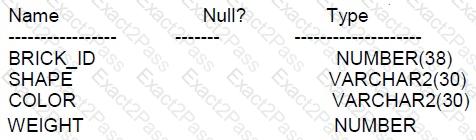
Examine the description of the BRICKS_STAGE table;
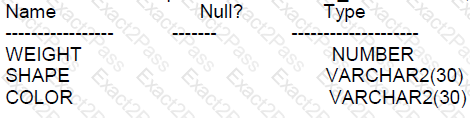
Which two queries execute successfully?

A.

SELECT shape,color,weight from bricks

MINUS

SELECT * FROM bricks_stage;

B.

SELECT shape,color FROM bricks

MINUS

SELECT WEIGHT,color FROM bricks_stage;

C.

select * from bricks

MINUS

select * from bricks_stage;

D.

SELECT shape,color FROM bricks

MINUS

SELECT color,shape FROM bricks_stage;

E.

SELECT brick_id,shape FROM bricks

MINUS

SELECT WEIGHT,COLOR from bricks_stage;

Question # 28

Examine this query:

SELECT INTERVAL ' 100 ' MONTH DURATION FROM DUAL;

What will be the output?

A.

DURATION

+08-04

B.

DUFATION

+100

C.

DURATION

+08

D.

an error

Question # 29

Which two are true about virtual columns?

A.

They can be referenced In the where clause of an update or debete statement.

B.

They can be referenced in the set clause of an update statement as the name of the column To be updated.

C.

They can be indexed.

D.

They cannot have a data type explicitly specified.

E.

They can be referenced in the column expression of another virtxial column.

Question # 30

Which three are true about privileges and roles?

A.

A role is owned by the user who created it.

B.

System privileges always set privileges for an entire database.

C.

All roles are owned by the SYS schema.

D.

A role can contain a combination of several privileges and roles.

E.

A user has all object privileges for every object in their schema by default.

F.

PUBLIC can be revoked from a user.

G.

PUBLIC acts as a default role granted to every user in a database

Go to page:
