
Spring Sale Special Limited Time 70% Discount Offer - Ends in 0d 00h 00m 00s - Coupon code: buysanta

Exact2Pass Menu

Oracle Database 12c SQL

Last Update 8 hours ago Total Questions : 326

The Oracle Database 12c SQL content is now fully updated, with all current exam questions added 8 hours ago. Deciding to include 1z0-071 practice exam questions in your study plan goes far beyond basic test preparation.

You'll find that our 1z0-071 exam questions frequently feature detailed scenarios and practical problem-solving exercises that directly mirror industry challenges. Engaging with these 1z0-071 sample sets allows you to effectively manage your time and pace yourself, giving you the ability to finish any Oracle Database 12c SQL practice test comfortably within the allotted time.

Question # 71

You create a table named 123.

Which statement runs successfully?

A.

SELECT * FROM TABLE (123) ;

B.

SELECT * FROM & apos;123 & apos;;

C.

SELECT * FROM " 123 " ;

D.

SELECT * FROM V & apos;123V & apos;;

Question # 72

Examine the data in the PRODUCTS table:
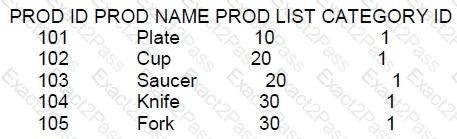
Examine these queries:

1. SELECT prod name, prod list

FROM products

WHERE prod 1ist NOT IN(10 , 20) AND category _id=1;

2. SELECT prod name, | prod _ list

FROM products

WHERE prod list < > ANY (10 , 20) AND category _id= 1;

SELECT prod name, prod _ list

FROM products

WHERE prod_ list < > ALL (10 , 20) AND category _ id= 1;

Which queries generate the same output?

A.

1 and 3

B.

1, 2 and 3

C.

2 and 3

D.

1 and 2

Question # 73

Which statement executes successfully?

A.

SELECT TO_DATE(TO_NUMBER(INTERVATL ' 800 ' SECOND)) FROM DUAL;

B.

SELECT TO_NUMBER(INTERVAL ' 800 ' SECOND, ' HH24:MM ' ) FROM DUAL;

C.

SELECT TO_DATE(INTERVAL ' 800 ' SECOND, ' HH24:MM ' ) FROM DUAL;

D.

SELECT TO_NUWBER(TO_DATE(INTERVAL ' 800 ' SECOND)) FROM DUAL;

E.

SELECT TO_CHAR(INTERVAL ' 800 ' SECOND, ' HH24:MM ' ) FROM DUAL;

Question # 74

Which two true about a sql statement using SET operations such as UNION?

A.

The data type of each column returned by the second query must be implicitly convertible to the data type of the corresponding column returned by the first query

B.

The data type of each column retuned by the second query must exactly match the data type of the corresponding column returned by the first query

C.

The number, but not names, of columns must be identical for all SELECT statements in the query

D.

The data type group of each column returned by the second query must match the data type group of the corresponding column returned by the first query

E.

The names and number of columns must be identical for all SELECT statements in the query.

Question # 75

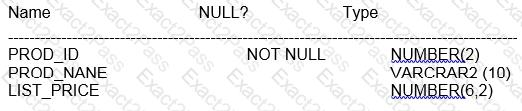
Examine the description of the PRODUCT_INFORMATION table:
A.

SELECT (COUNT(list_price) FROM Product_intormation WHERE list_price=NULL;

B.

SELECT count(nvl( list_price,0)) FROM product_information WHERE list_price is null;

C.

SELECT COUNT(DISTINCT list_price) FROM product_information WHERE list_price is null.

D.

BELECT COUNT(list_price) FROM product_information where list_price is NULL;

Question # 76

Examine the description of the PROMTIONS table:
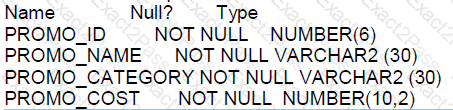
You want to display the unique promotion costs in each promotion category.

Which two queries can be used?

A.

SELECT promo_cost, | pxomo_category FROM promotions ORDER BY 1;

B.

SELECT promo_category, DISTINCT promo_cost PROM promotions ORDER BY 2:

C.

SELECT DISTINCT promo_category || ' has’|| promo_cost AS COSTS FROM promotions ORDER BY 1;

D.

SELECT DISTINCT promo_category, promo_cost FROM promotions ORDER BY 1;

E.

SELECT DISTINCT promo_cost || ' in ' II DISTINCT promo_category FROM promotions ORDER BY 1;

Question # 77

BOOK_SEQ is an existing sequence in your schema.

Which two CREATE TABLE commands are valid?

A.

CREATE TABLE bookings (

bk_id NUMBER(4) NOT NULL PRIMARY KEY,

start_date DATE NOT NULL,

end_date DATE DEFAULT SYSDATE);

B.

CREATE TABLE bookings (

bk_id NUMBER(4) NOT NULL DEFAULT book_seq.CURRVAL,

start_date DATE NOT NULL,

end_date DATE DEFAULT SYSDATE);

C.

CREATE TABLE bookings (

bk_id NUMBER(4) DEFAULT book_seq.CURRVAL,

start_date DATE DEFAULT SYSDATE,

end_date DATE DEFAULT start date);

D.

CREATE TABLE bookings ( bk_id NUMBER(4),

start_date DATE DEFAULT SYSDATE,

end_date DATE DEFAULT (end_date > = start_date));

E.

CREATE TABLE bookings (

bk_id NUMBER(4) DEFAULT book_seq.NEXTVAL PRIMARY KEY,

start_date DATE DEFAULT SYSDATE,

end_date DATE DEFAULT SYSDATE NOT NULL);

Question # 78

Which two statements cause changes to the data dictionary?

A.

DELETE FROM scott. emp;

B.

GRANT UPDATE ON scott. emp TO fin manager;

C.

AITER SESSION set NLs. _DATE FORMAT = ' DD/MM/YYYY ' ;

D.

TRUNCATE TABLE emp:

E.

SELECT * FROM user_ tab._ privs;

Question # 79

Which three statements are true about an ORDER BY clause?

A.

An ORDER BY clause always sorts NULL values last.

B.

An ORDER BY clause can perform a binary sort

C.

An ORDER BY clause can perform a linguistic sort

D.

By default an ORDERBY clause sorts rows in ascending order

E.

An ORDR BY clause will always precede a HAVI NG clause if both are used in the same top-level

Question # 80

Which two statements will return the names of the three employees with the lowest salaries?

A.

SELECT last_ name, salary

FROM employees

FETCH FIRST 3 ROWS ONLY

ORDER BY salary;

B.

SELECT last name, salary

FROM employees

ORDER BY salary

FETCE FIRST 3 RONS ONLY;

C.

SELECT last_ name, salary

FBOM employees

WEERE

ORDER BY SELECT

ROINUM < = 3

salary FROM

employees);

D.

SELECT last_ name, salary

FROM

(SELECT” FROM employees ORDER BY salary)

WHERE ROWNUM < =3

E.

SELECT last_ name, salary

FROM employees

WHERE ROWNUM < =3

ORDER BY salary

Go to page:
