
Spring Sale Special Limited Time 70% Discount Offer - Ends in 0d 00h 00m 00s - Coupon code: buysanta

Exact2Pass Menu

Oracle Database 12c SQL

Last Update 8 hours ago Total Questions : 326

The Oracle Database 12c SQL content is now fully updated, with all current exam questions added 8 hours ago. Deciding to include 1z0-071 practice exam questions in your study plan goes far beyond basic test preparation.

You'll find that our 1z0-071 exam questions frequently feature detailed scenarios and practical problem-solving exercises that directly mirror industry challenges. Engaging with these 1z0-071 sample sets allows you to effectively manage your time and pace yourself, giving you the ability to finish any Oracle Database 12c SQL practice test comfortably within the allotted time.

Question # 61

Examine the description of the EMPLOYEES table:
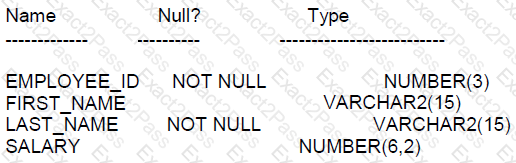
Which two statements will run successfully?

A.

SELECT ' The first_name is ' ' || first_name || ' ' FROM employees ;

B.

SELECT ' The first_name is ' ' ' ||first_name || ' ' ' ' FROM employees ;

C.

SELECT ' The first_name is ' ' ' ||first_name|| ' ' ' FROM employees ;

D.

SELECT ' The first_name is ' || first_name|| ' ' FROM employees;

E.

SELECT ' The first_name is \ ' ' || first_name || ' \ ' ' FROM employees;

Question # 62

Which three are key components of an Entity Relationship Model?

A.

a table

B.

an attribute

C.

a unique identifier

D.

an activity

E.

a relationship

F.

an entity

Question # 63

The PROD_ID column is the foreign key in the SALES table.Which references the PRODUCTS table.

Similarly,the CUST_ID and TIME_ID columns are Also foreign keys in the SALES table referencing the CUSTOMERS and TIMES tables, respectively.

Evaluate the following CREATE TABLE command:

CREATE TABLE new_sales(prod_id, I cust_id, order_date DEFAULT SYSDATE)

AS SELECT I prod_id,cust_id,time_id FROM sales.

Which statement is true regarding the above command?

A.

The NEW_SALES table would not get created because the DEFAULT value cannot be specified in the column definition.

B.

The NEW_SALES table would get created and all the NOT NULL constraints defined on the specified columns would be passed to the new table.

C.

The NEW_SALES table would not get created because the column names in the CREATE TABLE command and the SELECT clause I do not match.

D.

The NEW_SALES table would get created and all the FOREIGN KEY constraints defined on the specified columns would be passed to the new table

Question # 64

Examine this query:

SELECT SUBSTR (SYSDATE,1,5) ‘Result’ FROM DUAL

Which statement is true?

A.

It fails unless the expression is modified to TO-CHAR(SUNBSTR(SYSDATE,1,5)

B.

It fails unless the expression is modified to SUBSTR (TO_ CHAR(SYSDATE),1,5)

C.

It fails unless the expression is modified to SUBSTR (TO_ CHAR(TRUNC(SYSDATE)),1,5)

D.

It executes successfully with an implicit data type conversion

Question # 65

Examine this statement which executes successfully:

Which statement will violate the CHECK constraint?

A.

UPDATE emp80

SET department_id=90

WHERE department_id=80;

B.

DELETE FROM emp80

WHERE department_id=90;

C.

SELECT *

FROM emp80

WHERE department_id=80 ;

D.

SELECT *

FROM emp80

WHERE department_id=90;

Question # 66

Examine the description of the BOOKS_TRANSACTIONS table:
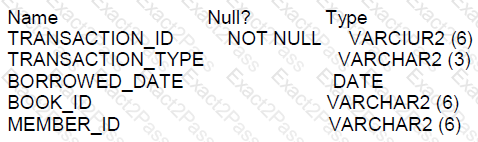
Examine this partial SQL statement:

SELECT * FROM books_transactions

Which two WHERE conditions give the same result?

A.

WHERE (borrowed_date = SYSDATE AND transaction_type = ' RM ' ) OR member_id IN ( ' A101 ' , ' A102 ' );

B.

WHERE borrowed_date = SYSDATE AND transaction_type = ' RM ' OR member_id IN( ' A101 ' , ' A102 ' );

C.

WHERE borrowed_date = SYSDATE AND transaction_type = ' RM ' OR member_id IN( ' A101 ' , ' A102 ' );

D.

WHERE borrowed_date = SYSDATE AND transaction_type = ' RM ' AND (member_id = ' A101 ' OR member_id = ' A102 ' ));

E.

WHERE borrowed_date = SYSDATE AND transaction_type = ' RM ' AND member_id = ' A101 ' OR member_id = ' A102 ' );

Question # 67

Which two statements will return the names of the three employees with the lowest salaries?

A.

SELECT last_name, salary

FROM employees

WHERE ROWNUM < =3

B.

SELECT last_name,salary

FROM employees

ORDER BY salary

FETCH FIRST 3 ROWS ONLY;

C.

SELECT last_name,salary

FROM employees

WHERE ROWNUM < =3

ORDER BY (SELECT salary FROM employees);

D.

SELECT last_name,salary

FROM (SELECT * FROM employees ORDER BY salary)

E.

SELECT last_name,salary

FROM employees

FETCH FIRST 3 ROWS ONLY

ORDER BY salary;

Question # 68

Which three statements are true about built-in data types?

A.

A VARCHAR2 blank-pads column values only if the data stored is non-numeric and contains no special characters.

B.

The default length for a CHAR column is always one character.

C.

A VARCHAR2 column definition does not require the length to be specified.

D.

A BLOB stores unstructured binary data within the database.

E.

A CHAR column definition does not require the length to be specified.

F.

A BFILE stores unstructured binary data in operating system files.

Question # 69

Examine the description of the EMPLOYEES table :
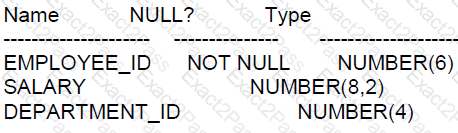
Which two queries return the highest salary in the table?

A.

SELECT department_id, MAX(salary)

FROM employees

GROUP BY department_id;

B.

SELECT MAX (salary)

FROM employees;

C.

SELECT MAX (salary)

FROM employees

GROUP BY department_id;

D.

SELECT MAX (salary)

FROM employees

GROUP BY department_id

HAVING MAX (salary) = MAX (MAX (salary));

E.

SELECT MAX (MAX (salary))

FROM employees

GROUP BY department_id;

Question # 70

Whith three statements are true about built in data types?

A.

A VARCHAR2 blank pads column values only if the data stored is non numeric and contains no special characlers

B.

A BFILE stores unstructured binary data in operating systerm files

C.

A CHAR column definition does not require the length to be specified

D.

The default length for a CHAR column is always one character

E.

A VARCHAR2 column definition does not require the length to be specified

F.

A BLOB stores unstructured binary data within the database

Go to page:
