
Spring Sale Special Limited Time 70% Discount Offer - Ends in 0d 00h 00m 00s - Coupon code: buysanta

Exact2Pass Menu

Oracle Database 12c SQL

Last Update 8 hours ago Total Questions : 326

The Oracle Database 12c SQL content is now fully updated, with all current exam questions added 8 hours ago. Deciding to include 1z0-071 practice exam questions in your study plan goes far beyond basic test preparation.

You'll find that our 1z0-071 exam questions frequently feature detailed scenarios and practical problem-solving exercises that directly mirror industry challenges. Engaging with these 1z0-071 sample sets allows you to effectively manage your time and pace yourself, giving you the ability to finish any Oracle Database 12c SQL practice test comfortably within the allotted time.

Question # 41

Choose two

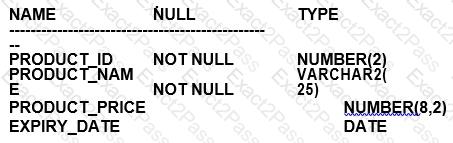
Examine the description of the PRODUCT DETALS table:
A.

PRODUCT_ID can be assigned the PEIMARY KEY constraint.

B.

EXPIRY_DATE cannot be used in arithmetic expressions.

C.

EXPIRY_DATE contains the SYSDATE by default if no date is assigned to it

D.

PRODUCT_PRICE can be used in an arithmetic expression even if it has no value stored in it

E.

PRODUCT_PRICE contains the value zero by default if no value is assigned to it.

F.

PRODUCT_NAME cannot contain duplicate values.

Question # 42

Examine the description of the CUSTONERS table
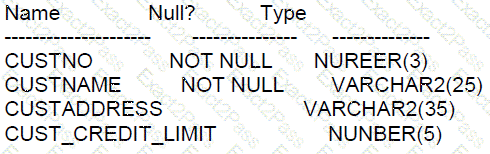
CUSTON is the PRIMARY KEY.

You must derermine if any customers’derails have entered more than once using a different

costno,by listing duplicate name

Which two methode can you use to get the requlred resuit?

A.

RIGHT OUTER JOIN with seif join

B.

FULL OUTER JOIN with seif join

C.

SUBQUERY

D.

seif join

E.

LEFT OUTER JOIN with seif join

Question # 43

Which three statements are true about sequences in a single instance Oracle database?

A.

A sequence ' s unallocated cached values are lost if the instance shuts down.

B.

Two or more tables cannot have keys generated from the same sequence.

C.

A sequence number that was allocated can be rolled back if a transaction fails.

D.

A sequence can issue duplicate values.

E.

Sequences can always have gaps.

F.

A sequence can only be dropped by a DBA.

Question # 44

Which statement falls to execute successfully?

A.

SELECT *

FROM employees e

JOIN department d

WHERE e.department_id=d.department_id

AND d.department_id=90;

B.

SELECT *

FROM employees e

JOIN departments d

ON e.department_id=d.department_id

WHERE d.department_id=90;

C.

SELECT *

FROM employees e

JOIN departments d

ON e.department_id=d.department_id

AND d.department_id=90;

D.

SELECT *

FROM employees e

JOIN departments d

ON d.departments_id=90

WHERE e.department_id=d.department_id;

Question # 45

Which two are true about the precedence of opertors and condtions

A.

+ (addition) has a higher order of precedence than * (mliplpition)

B.

NOT has a higher order of precedence than AND and OR in a condition.

C.

AND and OR have the same order of precedence in a condition

D.

Operators are evaluated before conditions.

E.

|| has a higher order of precedence than +(addition)

Question # 46

Examine these statements and results :

SQL > SELECT COUNT(*) FROM emp

COUNT(*)

---------------------

14

sQL > CREATE GLOBAL TEMPORARY TABLE t emp As SELECT * FROM emp;

Table created

SQL > INSERT INTo temp SELECT * FROM emp;

14 rows created

SQL > COMMIT:

Commit complete*

SQL > INSERT INTo temp SELECT * EROM emp;

14. rows created

SQL > SELECT COUNT(*) FROM t emp

How many rows are retrieved by the last query?

A.

28

B.

0

C.

14

D.

42

Question # 47

Examine the description of the SALES1 table:
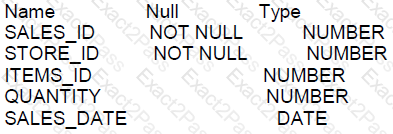
SALES2 is a table with the same description as SALES1,

Some sales data is duplicated In both tables.

You want to display the rows from the SALES1 table which are not present in the SALIES2 table.

Which set operator generates the required output?

A.

SUBTRACT

B.

INTERSECT

C.

UNION ALL

D.

MINUS

E.

UNION

Question # 48

SELECT *

FROM bricks,colors;

Which two statements are true?

A.

You can add an ON clause with a join condition.

B.

You can add a WHERE clause with filtering criteria.

C.

It returns the number of rows in BRICKS plus the number of rows in COLORS.

D.

You can add a USING clause with a join condition.

E.

It returnsthe same rows as SELECT * FROM bricks CROSS JOIN colors.

Question # 49

Which two are true about the USING clause when joining tables?

A.

All column names in a USING clause must be qualified with a table name or table alias.

B.

It can never be used with onatural join.

C.

It is used to specify an equijoin of columns that have the same name in both tables.

D.

It can never be used with a full outer join.

E.

It is used to specify an explicit join condition involving operators.

Question # 50

In which three situations does a new transaction always start?

A.

When issuing a SELECT FOR UPDATE statement after a CREATE TABLE AS SELECT statement was issued in the same session

B.

When issuing a CREATE INDEX statement after a CREATE TABLE statement completed unsuccessfully in the same session

C.

When issuing a TRUNCATE statement after a SELECT statement was issued in the same session

D.

When issuing a CREATE TABLE statement after a SELECT statement was issued in the same session

E.

When issuing the first Data Manipulation Language (OML) statement after a COMMIT or ROLLBACK statement was issued in the same session

F.

When issuing a DML statement after a DML statement filed in the same session.

Go to page:
