Spring Sale Special Limited Time 70% Discount Offer - Ends in 0d 00h 00m 00s - Coupon code: buysanta

Exact2Pass Menu

Implementing Cisco Service Provider VPN Services (300-515 SPVI)

Last Update 4 hours ago Total Questions : 71

The Implementing Cisco Service Provider VPN Services (300-515 SPVI) content is now fully updated, with all current exam questions added 4 hours ago. Deciding to include 300-515 practice exam questions in your study plan goes far beyond basic test preparation.

You'll find that our 300-515 exam questions frequently feature detailed scenarios and practical problem-solving exercises that directly mirror industry challenges. Engaging with these 300-515 sample sets allows you to effectively manage your time and pace yourself, giving you the ability to finish any Implementing Cisco Service Provider VPN Services (300-515 SPVI) practice test comfortably within the allotted time.

Question # 1

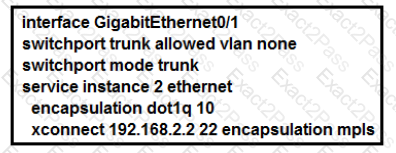
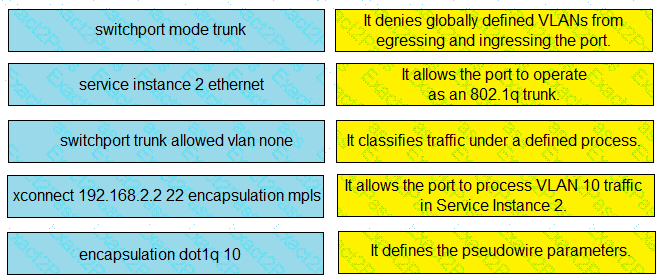
Refer to the exhibit.

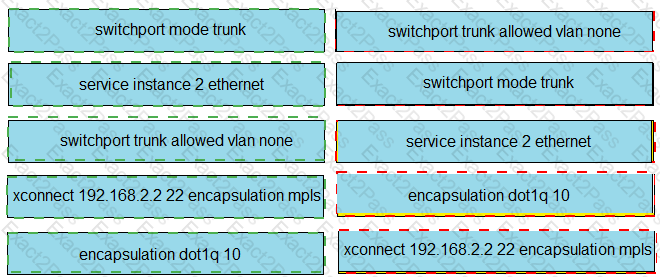
Drag and drop the EVC configuration items from the left onto the correct descriptions on the right.
Question # 2

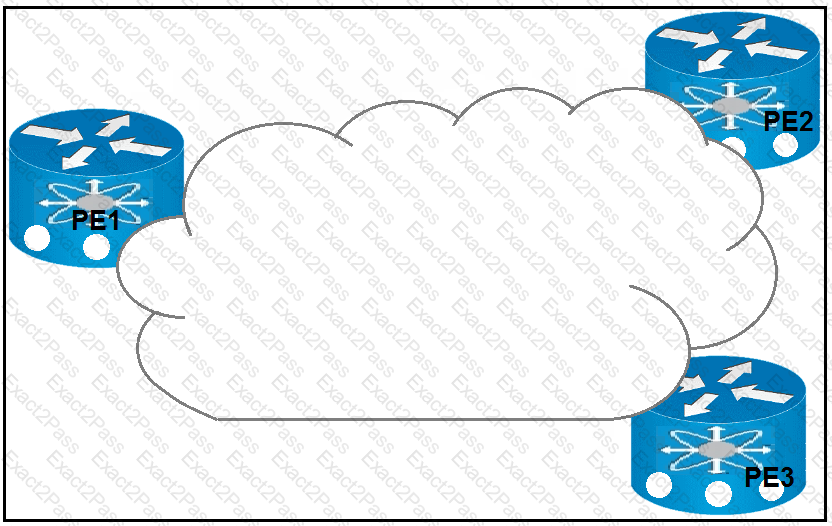
Refer to the exhibit.

Which result occurs when PE1 learns a new MAC address and all three PEs are enabled with EVPN native?

A.

A system notification is sent to the network administrator that triggers the manual configuration of the new MAC address on PE2 and PE3.

B.

The new MAC address is sent by BGP to PE2 and PE3 as a Type 2 BGP route.

C.

The MAC address is entered into the CAM table and is classified for use on the native VLAN

D.

The MAC address is entered into the CAM table only if it is learned on the native VLAN.

Question # 3

What must match in the EVPN and L2VPN configuration mode when configuring EVPN native in a router?

A.

interface

B.

address family

C.

bridge domain

D.

EVI

Question # 4

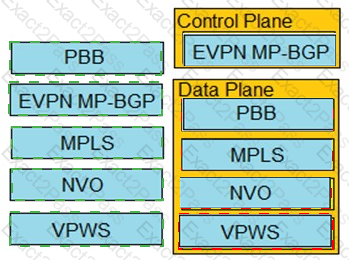
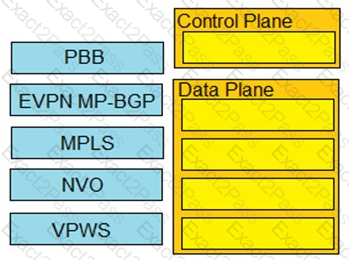
Drag and drop the EVPN components from the left onto the correct planes on the right.
Question # 5

An engineer is troubleshooting an EoMPLS circuit on a Cisco IOS XR router interface that removes a VLAN

A.

interface GigabitEthernet 0/10.l2transport

encapsulation dot1q 10

rewrite ingress tag pop 1 symmetric

l2vpn

xconnect group 103588

p2p 103588

interface GigabitEthernet 0/10.10

neighbor ipv4 10.10.10.2 pw-id 103588

B.

interface GigabitEthernet 0/10.10

encapsulation dot1q 10

rewrite ingress tag pop 1 symmetric

l2vpn

xconnect group 103588

p2p 103588

interface GigabitEthernet 0/10.10

neighbor ipv4 10.10.10.2 pw-id 103588

C.

interface GigabitEthernet 0/10.10 l2transport

encapsulation dot1q 10

l2vpn

xconnect group 103588

p2p 103588

interface GigabitEthernet 2/10.10

neighbor ipv4 10.10.10.2 pw-id 103588

D.

interface GigabitEthernet 0/10.10 l2transport

encapsulation dot1q 10

rewrite ingress tag translate 1-to-1 dot1ad 10

symmetric

l2vpn

xconnect group 103588

p2p 103588

interface GigabitEthernet 0/10.10

neighbor ipv4 10.10.10.2 pw-id 103588

Question # 6

Which two statements about MPLS L3 VPN RDs are true? (Choose two.)

A.

They enable EIGRP to use address families to separate traffic between IPv4 and VPNv4.

B.

They are represented as 32-bit values

C.

They are represented as 64-bit values.

D.

They enable OSPF to import and export routes into the global routing table of a router.

E.

E . They allow BGP to uniquely identify duplicate routes.

Question # 7

Which is the primary function of a MPLS L3 VPN route target?
A.

It imports and exports identified routes into selected VRFs.

B.

It uniquely identifies NLRIs that have the same numeric value.

C.

It imports the external routes it identifies into VRFs that support Internet traffic

D.

It supports QoS by classifying traffic by file type when it applies MPLS EXP bits to each packet.

Question # 8

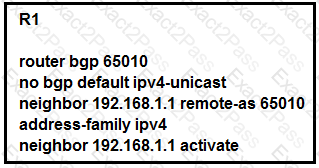
Which statement describes the result of this BGP configuration?

A.

R1 operates using IPv4 and VPNv4 address families.

B.

R1 operates on IPv6 only because the bgp default ipv4-unicast command is missing.

C.

R1 establishes a VPNv4 eBGP relationship with neighbor 192.168.1.1.

D.

R1 establishes an iBGP relationship with peer 192.168.1.1.

Question # 9

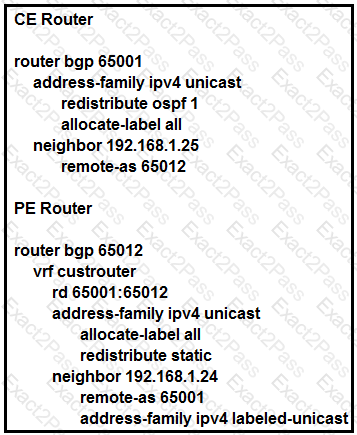
Refer to the exhibit.

The CE router has established a BGP peering with the PE router, and the CE will use the core infrastructure of the PE as a backbone carrier to support CSC. Which additional task can you perform to complete the configuration?

A.

Configure static routing on the CE router.

B.

Configure the address-family ipv4 labeled-unicast command under the neighbor configuration of the CE router for the PE.

C.

Change the rd value to 65001:65001 under the VRF section of the PE router.

D.

Configure OSPF on the PE router.

Question # 10

A network engineer is implementing Layer 3 MPLS VPNs on Cisco IOS/IOS XE PE routers. Which PE-to-CE routing protocol requires a separate routing process to be created for each VRF?


A.

RIPv2

B.

OSPF

C.

BGP

D.

EIGRP

Go to page: