Exact2Pass

Last Update 10 hours ago Total Questions : 201
The EC-Council Certified Security Analyst (ECSA) V10 content is now fully updated, with all current exam questions added 10 hours ago. Deciding to include 412-79v10 practice exam questions in your study plan goes far beyond basic test preparation.
You'll find that our 412-79v10 exam questions frequently feature detailed scenarios and practical problem-solving exercises that directly mirror industry challenges. Engaging with these 412-79v10 sample sets allows you to effectively manage your time and pace yourself, giving you the ability to finish any EC-Council Certified Security Analyst (ECSA) V10 practice test comfortably within the allotted time.
How many bits is Source Port Number in TCP Header packet?
You setup SNMP in multiple offices of your company. Your SNMP software manager is not receiving data from other offices like it is for your main office. You suspect that firewall changes are to blame.
What ports should you open for SNMP to work through Firewalls.
(Select 2)
ARP spoofing is a technique whereby an attacker sends fake ( " spoofed " ) Address Resolution Protocol (ARP) messages onto a Local Area Network. Generally, the aim is to associate the attacker ' s MAC address with the IP address of another host (such as the default gateway), causing any traffic meant for that IP address to be sent to the attacker instead.
ARP spoofing attack is used as an opening for other attacks.

What type of attack would you launch after successfully deploying ARP spoofing?
Black-box testing is a method of software testing that examines the functionality of an application (e.g. what the software does) without peering into its internal structures or workings. Black-box testing is used to detect issues in SQL statements and to detect SQL injection vulnerabilities.
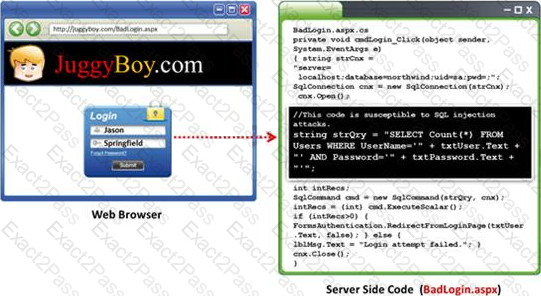
Most commonly, SQL injection vulnerabilities are a result of coding vulnerabilities during the Implementation/Development phase and will likely require code changes. Pen testers need to perform this testing during the development phase to find and fix the SQL injection vulnerability.
What can a pen tester do to detect input sanitization issues?
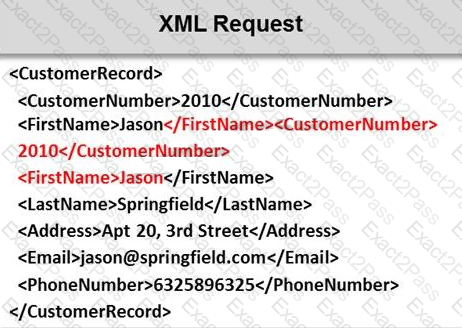
Identify the injection attack represented in the diagram below:
Which one of the following is a useful formatting token that takes an int * as an argument, and writes the number of bytes already written, to that location?
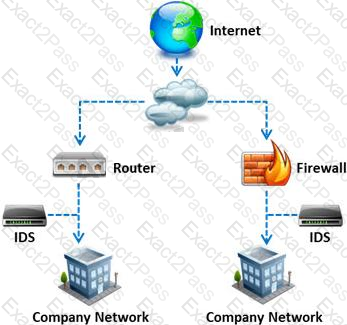
What is a difference between host-based intrusion detection systems (HIDS) and network-based intrusion detection systems (NIDS)?
An attacker injects malicious query strings in user input fields to bypass web service authentication mechanisms and to access back-end databases. Which of the following attacks is this?
SQL injection attacks are becoming significantly more popular amongst hackers and there has been an estimated 69 percent increase of this attack type.
This exploit is used to great effect by the hacking community since it is the primary way to steal sensitive data from web applications. It takes advantage of non-validated input vulnerabilities to pass SQL commands through a web application for execution by a back-end database.
The below diagram shows how attackers launched SQL injection attacks on web applications.

Which of the following can the attacker use to launch an SQL injection attack?
Kyle is performing the final testing of an application he developed for the accounting department. His last round of testing is to ensure that the program is as secure as possible. Kyle runs the following command. What is he testing at this point?
include < stdio.h >
#include < string.h >
int main(int argc, char *argv[])
{
char buffer[10];
if (argc < 2)
{
fprintf(stderr, " USAGE: %s string\n " , argv[0]);
return 1;
}
strcpy(buffer, argv[1]);
return 0;
}

