
Spring Sale Special Limited Time 70% Discount Offer - Ends in 0d 00h 00m 00s - Coupon code: buysanta

Exact2Pass Menu

AE Adult Echocardiography Examination

Last Update 15 hours ago Total Questions : 137

The AE Adult Echocardiography Examination content is now fully updated, with all current exam questions added 15 hours ago. Deciding to include AE-Adult-Echocardiography practice exam questions in your study plan goes far beyond basic test preparation.

You'll find that our AE-Adult-Echocardiography exam questions frequently feature detailed scenarios and practical problem-solving exercises that directly mirror industry challenges. Engaging with these AE-Adult-Echocardiography sample sets allows you to effectively manage your time and pace yourself, giving you the ability to finish any AE Adult Echocardiography Examination practice test comfortably within the allotted time.

Question # 11

What is the significance of a mitral B-bump seen on M-mode?

A.

Elevated left atrial systolic pressure

B.

Elevated left ventricular end-diastolic pressure

C.

Hypertrophic obstructive cardiomyopathy

D.

Mitral stenosis

Question # 12

Where would a Swan-Ganz catheter be best visualized?

A.

Left ventricular outflow tract

B.

Pulmonary veins

C.

Descending aorta

D.

Right ventricular outflow tract

Question # 13

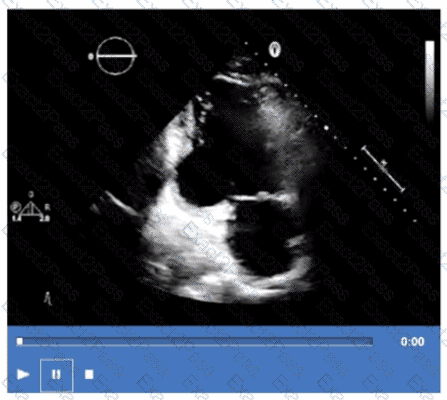
What is the regional wall motion assessment of the two-chamber view displayed in this video?
A.

Aneurysmal basal inferior wall

B.

Hypokinetic basal inferior wall

C.

Aneurysmal basal inferolateral wall

D.

Hypokinetic basal inferolateral wall

Question # 14

How must the sonographer angle the transducer from the apical four-chamber view in order to visualize the aortic valve in the apical five-chamber view?

A.

Anteriorly

B.

Posteriorly

C.

Medially

D.

Laterally

Question # 15

Which method is appropriate for measuring the left atrial diameter in parasternal long axis?

A.

Inner edge to inner edge, perpendicular to the aortic root, at end-diastole

B.

Inner edge to inner edge, parallel to the aortic root, at end-diastole

C.

Inner edge to inner edge, perpendicular to the aortic root, at end-systole

D.

Outer edge to outer edge, perpendicular to the aortic root, at end-systole

Question # 16

Which unit of measurement is used to quantify tricuspid annular plane systolic excursion?

A.

Centimeters

B.

Centimeters/second

C.

MiHiliters/minute

D.

Millimeters of mercury

Question # 17

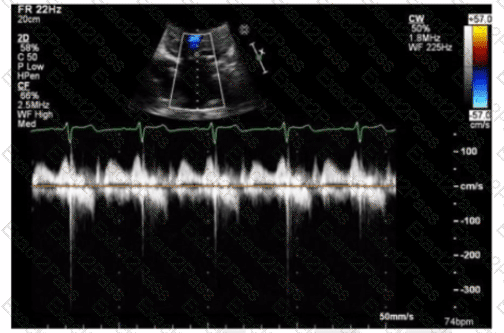
Which next step is appropriate after obtaining the Doppler signal in this image?
A.

Pulsed wave at various levels of the left ventricle to localize intracavitary gradient.

B.

Pulsed wave at the level of the mitral valve leaflet tips to assess for mitral stenosis

C.

Continuous wave through the left ventricle to localize intracavitary gradient

D.

Continuous wave through the mitral valve to assess for mitral stenosis

Question # 18

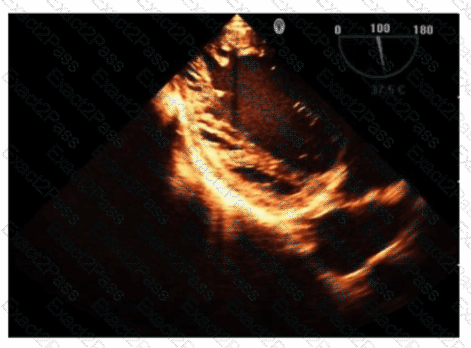
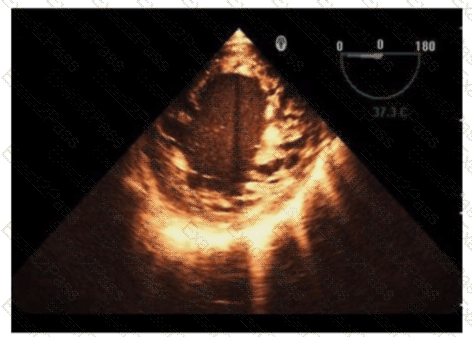
Which is the most likely abnormality represented in these images from a 48-year-old man with shortness of breath?
A.

Loeffler syndrome

B.

Hypertrophic cardiomyopathy

C.

Left ventricular noncompaction

D.

Ischemic cardiomyopathy

Question # 19

Which flow abnormality produces a continuous murmur?

A.

Aortic regurgitation

B.

Mitral stenosis

C.

Muscular ventricular septal defect

D.

Ruptured sinus of Valsalva aneurysm

Question # 20

Which finding is demonstrated in this video?
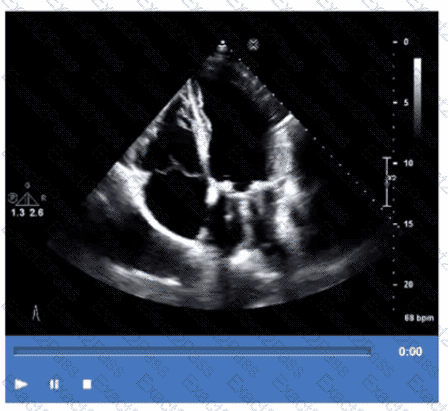
A.

Bioprosthetic valve replacement

B.

Mechanical valve replacement

C.

Annuloplasty ring repair

D.

Native valve with extensive calcification

Go to page:

