Exact2Pass

Last Update 17 hours ago Total Questions : 572
The MEDICAL LABORATORY TECHNICIAN - MLT(ASCP) content is now fully updated, with all current exam questions added 17 hours ago. Deciding to include ASCP-MLT practice exam questions in your study plan goes far beyond basic test preparation.
You'll find that our ASCP-MLT exam questions frequently feature detailed scenarios and practical problem-solving exercises that directly mirror industry challenges. Engaging with these ASCP-MLT sample sets allows you to effectively manage your time and pace yourself, giving you the ability to finish any MEDICAL LABORATORY TECHNICIAN - MLT(ASCP) practice test comfortably within the allotted time.
The MCV is indicative of microcytosis with MCV= < 80fL. The RDW is within normal limits and indicative of a homogenous cell population.
If the MCV was > 100 fL, this would be indicative of macrocytosis. An RDW that was outside of normal limits would be indicative of a heterogenous cell population.
An 18 year old female has a CBC as part of a routine physical exam. The following results were obtained and the physician determines she is anemic. After reviewing her CBC results shown below, which of the following would be an appropriate description of the anemia?
White blood cells (WBC): 5.6 x 10^9/L (RR:4.0-10.0 x 10^9/L)
Red blood cells (RBC): 3.7 x 10^12/L (RR: 4.2-5.9 x 10^12/L)
Hemoglobin: 9.9 g/dL (RR:12-16 g/dL)
Hematocrit: 28% (RR: 37-48%)
MCV: 75 fL (80-100 fL)
RDW-CV: 14% (RR: 11.0-15.0%)
Laboratories performing which of the following types of tests need to be enrolled in a CLIA-approved proficiency testing program?
The part of the microscope that control the amount of light entering the specimen much like the iris of your eye controls light is called the iris _______________.
Overcentrifugation may cause either a false negative result (if too much agitation is required for resuspension), or a false positive, (if centrifuged clumps cannot be completely dispersed). High concentration of IgG paraprotein, and failure to adequately wash cells can leave unbound IgG which will neutralize antiglobulin reagent. Delay of addition of antiglobulin reagent may allow previously bound IgG antibody to dissociate from red cells.
Blood bank
Which of the following might cause a false positive indirect antiglobulin test:
The dematiaceous molds can be broadly separated into two major groups: the agents of chromomycosis that grow more slowly, maturing only after 7 days or more of incubation, and the more rapidly growing species that most commonly are clinically insignificant commensals or contaminants when recovered from clinical specimens, but in rare situations may cause opportunistic infections called phaeohyphomycosis.
Dematiaceous molds can be broadly separated into two major groups; the agents of chromomycosis and clinically insignificant commensals or contaminants. The agents of chromomycosis grow: more slowly than; more rapidly than; or generally at the same rate as the clinically insignificant commensals or contaminants?
The cell depicted with the arrow in this image is an atypical (reactive) lymphocyte. These cells are common found in certain viral infections, especially infectious mononucleosis. Notice the larger size and abundant cytoplasm present in this lymphocyte. There is also apparent vacuoliation which is a key feature of atypical lymphocytes. The chromatin pattern of this cell as well as the overall shape, color and size rules out the monocyte, macrophage, and mesothelial cell choices.
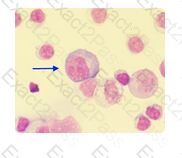
A patient with an infectious mononucleosis infection presents in the emergency room. Physicians order a spinal tap which is immediately sent to the laboratory for review. Please identify the cell in the image below from this patient ' s cerebrospinal fluid sample.
The beta hemoglobin chain loci are found on which chromosome?
All of the following have been an inspection deficiency for CLIA-approved laboratories except:
The red blood cell distribution width (RDW) increases as the severity of alpha thalassemia increases because of changing MCV as the bone marrow produces smaller cells. In addition, if Hemoglobin H bodies are present, they result in the formation of schiztocytes (RBC fragments) that can have an effect on the MCV and RDW.
The Red cell Distribution Width (RDW) in alpha thalassemia is
A positive RPR test and a negative FTA-ABS test is most likely the result of:
The agency within Department of Health and Human Services (DHHS) responsible for implementing CLIA ' 88 is:
The personal protective equipment (PPE) that is used in the laboratory to protect the personnel when performing tests on patient blood samples is which of the following:
Enterococcus spp. are bile esculin positive and grow in 6.5% NaCl. If they grow on the 6 µg/mL vancomycin screen agar as this isolate does, it is vancomycin resistant. If there is no growth on the 6 µg/mL vancomycin screen agar, the isolate is susceptible to vancomycin. Streptococcus Group D, not Enterococcus will not grow in the 6.5% NaCl and should not be tested for vancomycin resistance. Staphylococcus epidermidis is catalase positive.

The images below represent a gram-positive, catalase-negative, non-motile coccus inoculated to bile esculin agar, 6.5% NaCl broth and to 6 µg/mL of vancomycin in Mueller Hinton agar. It should be reported as:
Rapid vascular constriction, not dilation, immediately occurs when there is vascular injury in order to constrict the amount of blood that escapes the vessels; ultimately preventing massive loss of blood.
Primary hemostatic processes resulting from vascular damage include all of the following EXCEPT:
Listeria are non-capsulated, non-acid-fast, ß-hemolytic, gram-positive bacilli that have a characteristic tumbling motility. They are found primarily in the environment and in the human GI tract. Since L. monocytogenes multiplies intracellularly, control of listeriosis requires cell-mediated immunity; thus, immunocompromised patients (such as newborns) are at high risk.
Which bacterial species is a common agent of neonatal bacteremia?

