Exact2Pass

Last Update 20 hours ago Total Questions : 228
The Certified Tester Advanced Level Test Management (CTAL-TM) v3.0 content is now fully updated, with all current exam questions added 20 hours ago. Deciding to include CTAL-TM practice exam questions in your study plan goes far beyond basic test preparation.
You'll find that our CTAL-TM exam questions frequently feature detailed scenarios and practical problem-solving exercises that directly mirror industry challenges. Engaging with these CTAL-TM sample sets allows you to effectively manage your time and pace yourself, giving you the ability to finish any Certified Tester Advanced Level Test Management (CTAL-TM) v3.0 practice test comfortably within the allotted time.
Which of the following is required to apply an experience-based testing approach''
Which test process improvement model consists of five maturity levels?
You are a new lest manager in an organization You have been asked to assess the defect process to determine if there are any efficiency improvements that could be made that would reduce the cost of quality You have started digging through the defect Information What information would be most helpful for this investigation?
You are managing the test team that is testing a new mobile application that provides a "step-by-step' hiking guide Your risk assessment resulted in the following table:
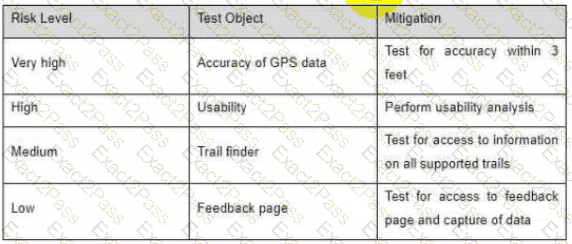
Your team has clone the depth and breadth testing for the GPS accuracy and usability features but when the product was given to beta testers there were some issues Despite the users reporting the app was easy to use at least one user walked off the edge of a cliff and another one ended up in a river. Your team has confirmed that the functionality is working correctly. and the GPS information is accurate.
What other area of testing should you now prioritize?
Which of the following is a generic good practice when evaluating and selecting a test tool?
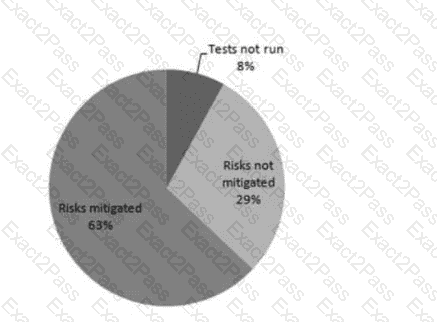
You are the Test Manager of a risk-based testing effort. You develop the following graph to show residual risk. Assume that "Risks mitigated" represents passed tests and "Risks not mitigated"
represents failed tests and other discovered failures.
Which of the following answers best represents what the graph shows? [3]
Which of the following metrics would be most beneficial to collect to determine the effectiveness of a review process? [2]
Which one of the following will allow phase containment to be assessed within a testing project? SELECT ONE OPTION
Refer to SCENARIO 3
You are the Test Manager for a software house called "MakeMyApp" that specialise in mobile phone applications, agile techniques are used for all software development projects.
A new project is underway to develop enhancements to a 'photo sharing' application, known as 'PictureFriend'. There are two types of user account available -Premium Users and Guest Users. Guest users only have limited functionality available. The enhanced features to PictureFriend are:
• Feature 1: Guest Users can share photos with other Guest Users and Premium Users;
• Feature 2: Premium Users can edit pictures before posting to their account;
• Feature 3: Premium Users can create '3D-effect' photographs
The requirements for each feature will be broken down into a number of User Stories with acceptance criteria created for each of them. User Stories are planned and delivered in 2-week 'Sprints'. The project will have 3 sprints.
Which of the following are test planning activities that would be MOST appropriate for Sprint 1?
a) Analyse the risk for each of the user stories in sprint 1
b) Publish lest progress reports throughout the sprint
c) Arrange informal reviews of the user stories by the test team
d) Plan an automated system test suite for the user stories.
e) Specify system test conditions at a detailed level for all user stories Chose one of the following options:
SELECT ONE OPTION
You are the Test Manager of a four-person test team working for a small distribution company with a single warehouse. Your team has been working with a third party development team on a new
inventory management system. The company expects this system to generate approximately one million dollars per annum in profits for the company. Early in the project, various risks were
identified, and steps taken to mitigate those risks.
For example, you sent your test team for training on the new system, and upgraded the test environment. There are still some lingering risks that have not been addressed, but they have been
determined to have a low chance of occurring, with minimal impact if they do occur.
What would be the best option to mitigate these remaining risks? [3]

