Summer Sale Special Limited Time 70% Discount Offer - Ends in 0d 00h 00m 00s - Coupon code: buysanta

Exact2Pass Menu

Enterprise Routing and Switching, Specialist (JNCIS-ENT)

Last Update 12 hours ago Total Questions : 65

The Enterprise Routing and Switching, Specialist (JNCIS-ENT) content is now fully updated, with all current exam questions added 12 hours ago. Deciding to include JN0-352 practice exam questions in your study plan goes far beyond basic test preparation.

You'll find that our JN0-352 exam questions frequently feature detailed scenarios and practical problem-solving exercises that directly mirror industry challenges. Engaging with these JN0-352 sample sets allows you to effectively manage your time and pace yourself, giving you the ability to finish any Enterprise Routing and Switching, Specialist (JNCIS-ENT) practice test comfortably within the allotted time.

Question # 11

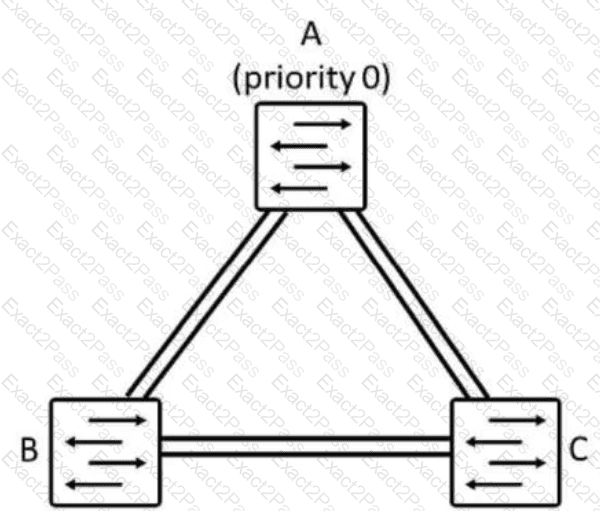
[Exhibit]

Click the Exhibit button.

Devices on VLAN 5 and VLAN 7 need to communicate with each other.

Referring to the exhibit, what will satisfy this requirement?

A.

Configure a family inet interface connecting the two VLANs and assign both subnet IPs to it using secondary addressing.

B.

Enable spanning tree on both VLANs and set the EX Series Switch as the root bridge.

C.

Add both VLANs to a single trunk port and enable the Multiple VLAN Registration Protocol.

D.

Create an integrated routing and bridging (IRB) interface for each VLAN, assign the gateway IP to each IRB, and enable static routing.

Question # 12

Which statement describes how a generated route determines its next hop?

A.

It uses the next hop of the first contributing route.

B.

It uses a static next hop configured under the aggregate route hierarchy.

C.

It uses the next hop of the least-specific contributing route.

D.

It uses the next hop of the primary contributing route.

Question # 13

What determines the preferred route to a destination in an IS-IS network?

A.

the path that passes through a Level 2 router closest to the destination

B.

the path that has the lowest accumulated metric value

C.

the path that has the most recently originated LSP

D.

the path that has the highest accumulated metric value

Question # 14

A switch uses the factory-default storm control configuration. A sudden unknown-unicast burst causes packet loss for only 4-5 seconds before stabilizing.

Which statement describes why normal operation resumes automatically?

A.

Storm control applies only to multicast traffic by default.

B.

Storm control triggers GRES recovery.

C.

Storm control shuts down the interface and re-enables it after 5 seconds.

D.

Storm control drops only excess packets until traffic falls below the threshold.

Question # 15

Which two statements are correct about BGP local preference? (Choose two.)

A.

A local preference of 100 is the Junos default.

B.

Local preference is advertised to EBGP peers.

C.

Local preference is used to direct outbound traffic within an AS to a specific peer.

D.

A local preference of 0 means to drop the route.

Question # 16

What are three valid OSPF adjacency states? (Choose three.)

A.

reject

B.

loading

C.

down

D.

established

E.

init

Question # 17

Which statement describes the additional overhead added when a packet is encapsulated in a GRE tunnel?

A.

GRE adds 12 bytes of overhead to each packet.

B.

GRE adds 32 bytes of overhead to each packet.

C.

GRE adds 24 bytes of overhead to each packet.

D.

GRE adds 20 bytes of overhead to each packet.

Question # 18

You are establishing a new BGP session to an EBGP peer using loopback addresses.

In addition to your general EBGP settings, which BGP feature must be enabled for this session to establish?

A.

multihop

B.

multipath

C.

damping

D.

passive

Question # 19

A GRE tunnel is experiencing fragmentation issues. You confirm that the tunnel is up and is functioning correctly. You confirm that hosts are sending 1500-byte packets.

In this scenario, which statement is correct?

A.

You should use the clear-dont-fragment parameter to allow fragmentation.

B.

You should lower the physical interface's MTU to 1476 bytes to avoid fragmentation.

C.

You should enable BFD to more rapidly identify tunnel link failures.

D.

You should use ToS copying to reduce header size.

Go to page: