Exact2Pass

Last Update 57 minutes ago Total Questions : 395
The Commercial Negotiation content is now fully updated, with all current exam questions added 57 minutes ago. Deciding to include L4M5 practice exam questions in your study plan goes far beyond basic test preparation.
You'll find that our L4M5 exam questions frequently feature detailed scenarios and practical problem-solving exercises that directly mirror industry challenges. Engaging with these L4M5 sample sets allows you to effectively manage your time and pace yourself, giving you the ability to finish any Commercial Negotiation practice test comfortably within the allotted time.
A supplier can produce a product for $160. The supplier sells the product to their client for $240, making a profit before tax of $80 on the transaction. What is the mark-up profit percentage earned by the supplier on this transaction?
Jasmine and the IHL sales team have a negotiation scheduled with one of AB’s lead buyers, Samuel, at AB’s premises. This is one of the biggest negotiations that Jasmine has been involved in and is eager not to make any mistakes. Jasmine has heard from a colleague that Samuel tends to adopt an integrative negotiation style. IHL senior management decides to send a team of three members to the negotiation. Jasmine is among the team and she is assigned to check body language, reactions, feeds insight to her leader and to record important comments and information from the meeting for minutes. Which of the following are roles of Jasmine in the forthcoming negotiation? Select TWO that apply.
“BATNA is a concept that should be considered at the start of negotiations.” Is this statement correct?
Which negotiation approach is focused on a win–win outcome?
A breakeven analysis uses which of the following aspects as part of the analysis?
Which of the following are most likely to be fundamentals of Fisher & Ury ' s principled negotiation?
1. Depersonalise the argument
2. Focus on positions
3. Generate creative options
4. Using subjective criteria
A procurement manager withholds important information to strengthen negotiating power. Is this appropriate when using an integrative negotiation style?
Which of the following are stages within the negotiation process?
Planning and preparation
Arguing and persuasion
Accepting hospitality
Testing and proposing
Champion Toys (CT) is negotiating a large order of luxury toys with its supplier. CT has identified that lead times, order quantities, and delivery locations are tradeables that could be used in this negotiation. At which negotiation stage should CT introduce these tradeables?
John Browne, a junior buyer for a corporation, is analyzing the global supply market before undertaking negotiations and is wondering whether foreign exchange rates are important to factor into his research. Should John consider the foreign exchange rates?


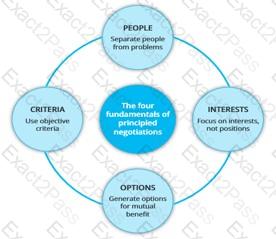 Diagram Description automatically generated