Exact2Pass

Last Update 14 hours ago Total Questions : 45
The Palo Alto Networks Network Security Architect content is now fully updated, with all current exam questions added 14 hours ago. Deciding to include NetSec-Architect practice exam questions in your study plan goes far beyond basic test preparation.
You'll find that our NetSec-Architect exam questions frequently feature detailed scenarios and practical problem-solving exercises that directly mirror industry challenges. Engaging with these NetSec-Architect sample sets allows you to effectively manage your time and pace yourself, giving you the ability to finish any Palo Alto Networks Network Security Architect practice test comfortably within the allotted time.
A technology company is deploying its own AI applications on a Google Kubernetes Engine (GKE) cluster. The development team is concerned with protecting the complex, microservices-based AI stack from both internal and external threats, including data poisoning and lateral movement between containerized components.
Which solution should be proposed to address these concerns?
Which custom component can reduce the risk of an organization’s sales staff completing a customer-intake PDF form that includes corporate confidential information?
An architect is evaluating a use case with these requirements:
Visibility into the health of an end user’s path for the five most critical applications
Metrics showing the effect of endpoint health on an application
Centralized call-quality analytics from the Zoom video-conferencing solution
Insights into supporting protocols, such as DNS
Support for 600 users on Windows desktops in one sales office
Which solution should be recommended to satisfy these requirements?
A global manufacturing organization with 50,000 employees across 35 countries designs advanced industrial equipment and owns substantial intellectual property. It operates in a highly competitive market where safeguarding trade secrets is essential to preserving market advantage.
Over the last 18 months, the CISO has found that employees throughout the organization have adopted hundreds of GenAI applications to improve productivity. Engineers use AI coding assistants to speed product development, sales teams use AI tools to create proposals, and customer service representatives use chatbots to draft responses. Although this adoption has fueled innovation, it has also introduced substantial security risks.
A security audit finds sensitive CAD files uploaded to image-generation services, proprietary source code shared with public coding assistants, and confidential customer information included in prompts. The audit identifies more than 300 different GenAI applications in use, most of which were not formally reviewed or approved.
The customer service department is also developing internal AI applications, including a customer service copilot built on a cloud large language model (LLM) platform, an internal knowledge management assistant, and a code review tool. These internal applications access sensitive databases, customer records, and internal APIs—creating further security concerns about exploitation or misuse.
The organization has a distributed workforce, with 60% of employees working remotely or in hybrid arrangements and accessing corporate resources and AI applications from different locations using managed and unmanaged devices. Its existing network security infrastructure has no AI-specific security capabilities.
Organization leadership wants to enable AI-driven innovation while deploying comprehensive security controls. The CISO has been assigned to develop an organization-wide GenAI governance program that safeguards sensitive assets without impeding productivity. The program must address both external AI applications employees use and internal AI applications IT develops.
Which architectural approach most closely aligns with the organization’s strategic objectives of enabling AI innovation and protecting sensitive assets?
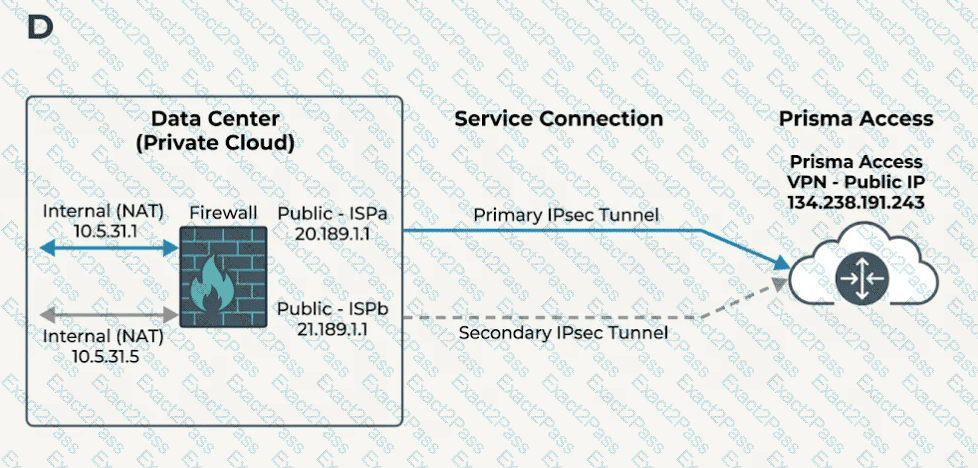
An organization is building a cloud-first network infrastructure. The updated architecture includes Prisma Access, as shown in the diagram. The organization selected Strata Cloud Manager (SCM) to manage Prisma Access and NGFWs deployed in the data center and public-cloud environments. It has 150 NGFWs that terminate service connections, segment networks, and secure data-center and public-cloud resources.
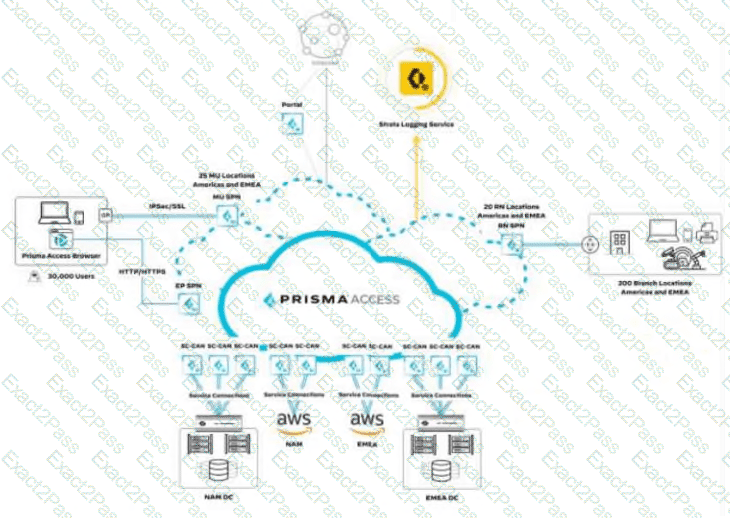
A resilience requirement is to provide highly available directory services and authentication for the NGFW and Prisma Access deployment.
Which traffic flow is valid for administrators connecting over SSH to network equipment hosted in the data center?
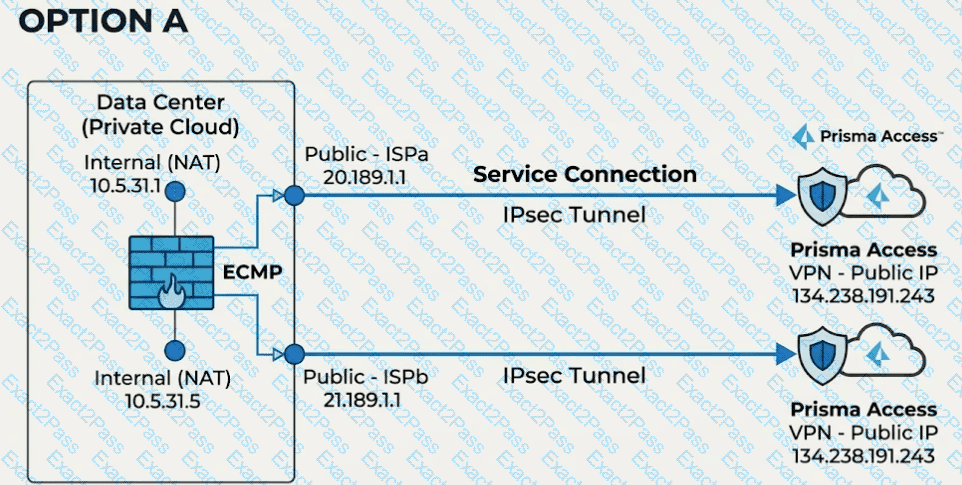
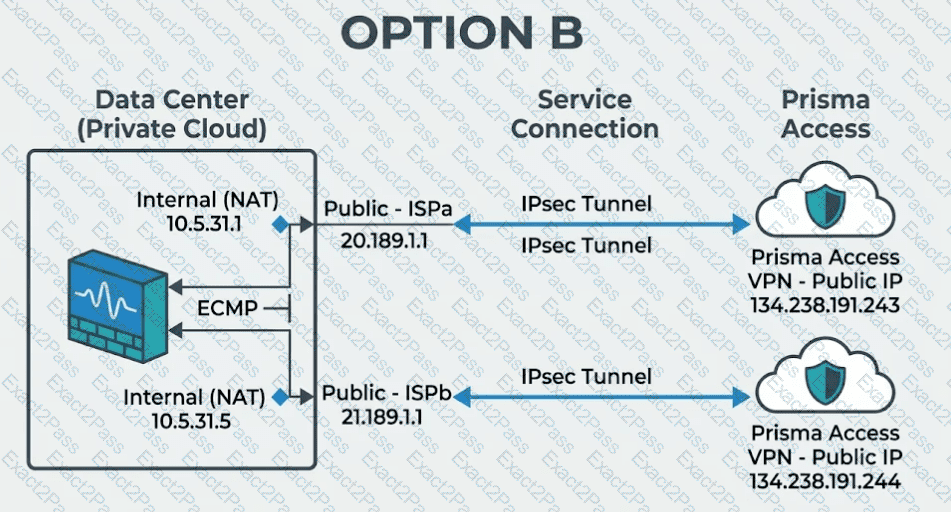
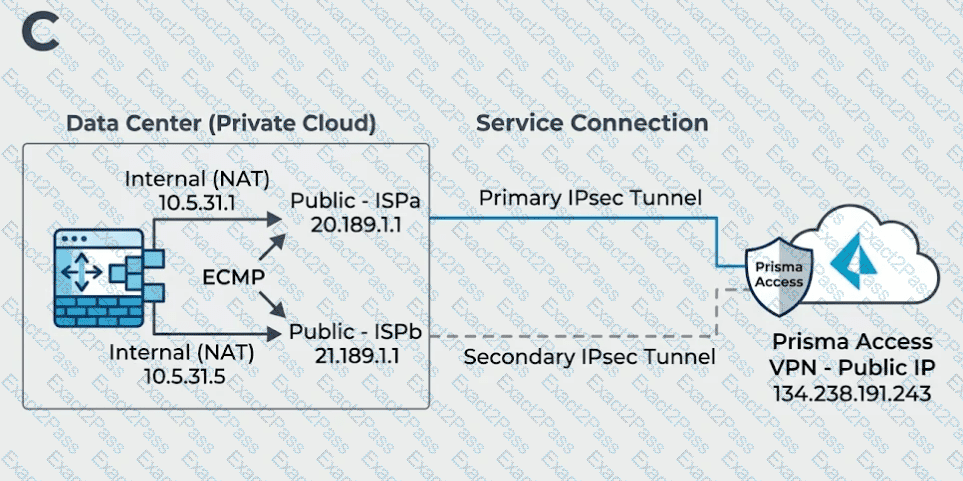
An organization is designing Prisma Access service connections for its data centers. Each data center has redundant 10 Gb internet links and must support at least 1.5 Gbps of throughput for Prisma Access-connected users and branches.
Which diagram shows a solution that satisfies these use-case requirements?
A retail organization wants to approve the use of a specific third-party SaaS-based AI application for inventory management. The application requires network-layer data access to the organization’s internal supply-chain database, which contains confidential information and is highly secured in its own DMZ. Implementation has been delayed because the CISO is concerned that the approved third-party AI application could be compromised and then used to exfiltrate customer PII from the internal database.
Which solution will address the CISO’s concern?
A multinational organization has a large, global population of remote users. This population includes several persona types with distinct requirements and concerns about adopting a Zero Trust Network Access (ZTNA) solution.
Developers need to temporarily bypass security controls for business reasons, but the security team considers this a potential risk. Developers commonly access development servers on premises in private data centers and in the public cloud. These development applications use web (HTTP/HTTPS), API, RPC, and SMB-based applications.
Sales staff travel frequently and connect to the network through many different connection types, but they are generally limited to SaaS-based web applications. They often report performance issues whenever an agent is installed and want the ability to temporarily disable those agents. Data exfiltration and insider risk have been identified as the primary threats for this user class.
Executives are concerned about being high-value targets. Security must be consistent across multiple endpoint types, including mobile and desktop devices. Executive team members have stated that their primary objective is for the solution to be responsive and easy to troubleshoot.
Which two solutions will help mitigate risk to the sales staff? (Choose two.)
A global manufacturing organization has a strategic plan for rapid growth through mergers and acquisitions. Several components that the organization purchased are considered large deployments with existing IP address schemas and allocations that conflict with the parent organization. The manufacturing organization requires access to the resources before a re-IP initiative can be completed.
All deployments contain a variety of IoT devices. Leadership requires protection of vulnerable assets and identification of any known CVEs associated with the IoT devices. The governance, risk, and compliance (GRC) team requires comprehensive, non-repudiable logs to identify all IoT devices reporting “Critical (9.0+) CVE scores” for mandatory remediation.
Throughput must exceed the current 1 Gbps trending rate and, with anticipated growth, will soon scale to 5 Gbps.
Segmentation is mandatory, with enclaves based on region, device type, and function.
Which architectural component ensures IoT storage, integrity, and non-repudiation of this granular risk data for auditing purposes?
A global organization is securing critical applications during a cloud-based migration to a cloud-first design. It is currently performing a brownfield migration of its most critical applications—such as CRM and product intellectual property / design systems—into Azure Cloud. The organization already has an active/passive high-availability (HA) NGFW deployed at its data center with multiple zones, and it has replicated that design in its existing Azure HA deployment.
The organization recognizes the need to modernize its security posture as critical workloads move out of the data center and users connect from anywhere. Its security model follows a traditional “hard shell, soft center” approach:
Zero Trust Gaps -
Current network segmentation is perimeter-based. The organization wants to extend Zero Trust principles across cloud and on-premises environments.
The network depends heavily on VLANs and IP address-based Access Control Lists (ACLs), segmented primarily by office location and broad departmental groups.
Once employees are on the corporate network (that is, inside the “perimeter”), they have relatively broad access.
If attackers compromise one endpoint (for example, through a phishing email), they can readily move laterally and scan for high-value targets.
Cloud Blind Spots -
The organization uses Azure for its production environments and hosts applications containing sensitive customer data.
Cloud security controls are often managed independently from the on-premises network. Access is frequently granted through overly permissive identity and access management (IAM) roles and keys based on the resource instead of the user’s real-time context or application health.
Remote User Access -
Many remote users still hairpin through the corporate data center merely to access internet or SaaS resources, causing latency and inefficiency.
Traditional VPN is used for remote employees.
The VPN grants access to the entire internal network segment, making the remote endpoint the new, weaker perimeter. There is no continuous check of the user’s device health after the initial connection.
Visibility and Logging -
Logs are mainly stored on-premises and then forwarded to a local Security Information and Event Management (SIEM) solution. As applications move to Azure, visibility into cloud traffic and user behavior becomes fragmented.
Data Security Concern -
Sensitive data, including product design files, will now reside in SaaS and cloud environments. The organization requires data security to prevent leakage and enforce compliance.
Ingress Security -
Third-party partners and suppliers need access into the data center and cloud applications, creating risk at ingress points.
The current Microsoft Azure NGFW architecture will not support the increased traffic from the newly migrated applications.
Which architectural solution will provide scalable inspection?