Exact2Pass

Last Update 13 hours ago Total Questions : 189
The Certified Cost Professional (CCP) Exam content is now fully updated, with all current exam questions added 13 hours ago. Deciding to include CCP practice exam questions in your study plan goes far beyond basic test preparation.
You'll find that our CCP exam questions frequently feature detailed scenarios and practical problem-solving exercises that directly mirror industry challenges. Engaging with these CCP sample sets allows you to effectively manage your time and pace yourself, giving you the ability to finish any Certified Cost Professional (CCP) Exam practice test comfortably within the allotted time.
A major theme park is expanding the existing facility over a five-year period. The design phase will be completed one year after the contract is awarded. Major engineering drawings will be finalized two years after the design contract is awarded and construction will begin three years after the award of the design contract. New, unique ride technology will be used and an estimate will need to be developed to identify these costs that have no historical data.
The recognition of loss of value of a natural resource used in the production process is referred to as:
A major theme park is expanding the existing facility over a five-year period. The design phase will be completed one year after the contract is awarded. Major engineering drawings will be finalized two years after the design contract is awarded and construction will begin three years after the award of the design contract. New, unique ride technology will be used and an estimate will need to be developed to identify these costs that have no historical data.
The following is NOT an advantage of the critical path method:
An American company plans to acquire a new press machine from a Dutch manufacturer under the following conditions. One question remaining to be answered is the expected amount of capital recovery when salvage is accounted for.
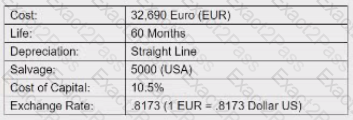
The following question requires your selection of Scenario 1.4.15Q from the right side of your split screen. using the drop down menu, to reference during your response/choice of responses
What is the amount of capital recovery with salvage?
An agricultural corporation that paid 53% in income tax wanted to build a grain elevator designed to last twenty-five (25) years at a cost of $80,000 with no salvage value. Annual income generated would be $22,500 and annual expenditures were to be $12,000.
Answer the question using a straight line depreciation and a 10% interest rate.
How many years will it take to earn $400 in interest on $800 at 4% compounded annually?
A work breakdown structure (WBS) is developed because:
When using a fixed-price./lump-sum contract, which of the following; situations can a payment be made for the adjustment of fluctuations in the cost of of construction resources?

