
Pre-Winter Sale Special Limited Time 70% Discount Offer - Ends in 0d 00h 00m 00s - Coupon code: buysanta

Exact2Pass Menu

HCIP-Datacom-Core Technology V1.0

Last Update 16 hours ago Total Questions : 394

The HCIP-Datacom-Core Technology V1.0 content is now fully updated, with all current exam questions added 16 hours ago. Deciding to include H12-821_V1.0 practice exam questions in your study plan goes far beyond basic test preparation.

You'll find that our H12-821_V1.0 exam questions frequently feature detailed scenarios and practical problem-solving exercises that directly mirror industry challenges. Engaging with these H12-821_V1.0 sample sets allows you to effectively manage your time and pace yourself, giving you the ability to finish any HCIP-Datacom-Core Technology V1.0 practice test comfortably within the allotted time.

Question # 11

After the election is complete, VRRP sends Advertisement packets to check whether a device is faulty. What is the default interval for sending VRRP Advertisement packets?

A.

1 second

B.

5 seconds

C.

10 seconds

D.

3 seconds

Question # 12

A switch runs MSTP. The configuration is shown in the figure. What is the role of this switch in MSTI 1?

A.

Uncertain

B.

Root switch

C.

Non-root switch

D.

Secondary root switch

Question # 13

Access control lists can be classified into which types as follows?

A.

Basic ACL

B.

User-defined ACL

C.

Advanced ACL

D.

Layer 2 ACL

Question # 14

Which of the following statements regarding IGMPv1 and IGMPv2 are true?

A.

1GMPv2 supports only general query.

B.

1GMPv2 defines the Leave message type.

C.

IGMPv1 does not define the IGMP Leave message type.

D.

IGMPv1 supports general query.

Question # 15

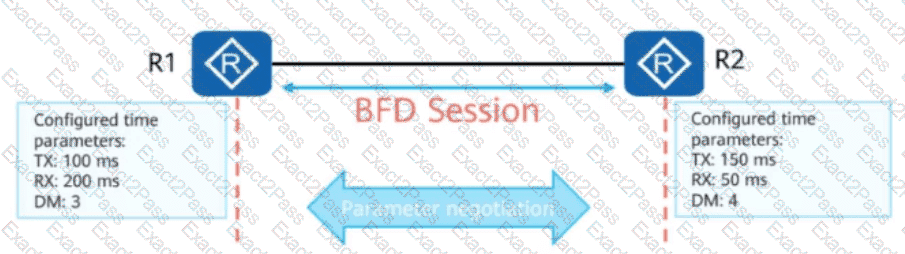
When configuring BFD to detect link faults on devices at both ends, an enterprise administrator incorrectly sets parameters to different values on the two devices, as shown in the figure. Which of the following is the interval for sending packets on R1 after negotiation?
A.

150 ms

B.

100 ms

C.

The negotiation fails and the interval changes to 0.

D.

200 ms

Question # 16

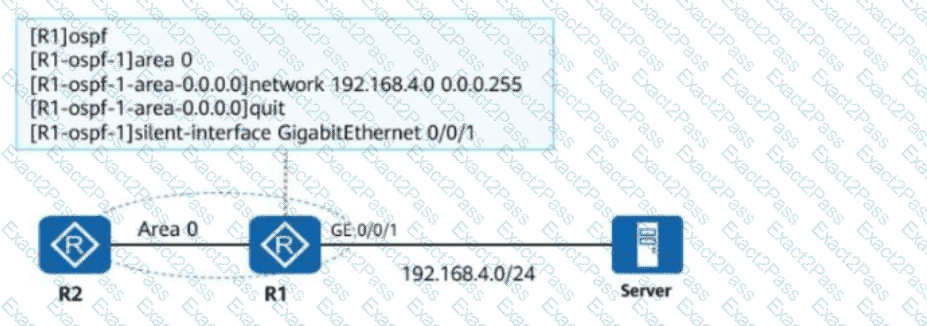
The following figure shows the OSPF network of an enterprise and the OSPF configurations of R1. Which of the following statements is false about the network?
A.

R2 can access the server.

B.

GE 0/0/1 of R1 cannot send OSPF packets.

C.

The network segment to which GE 0/0/1 of R1 belongs cannot be advertised.

D.

GE 0/0/1 of R1 cannot accept OSPF packets.

Question # 17

On an IS-IS network, all routers generate LSPs. Which of the following types of information is not contained in the LSPs generated by pseudonodes?

A.

Interface information

B.

Information about supported network protocols

C.

Route information

D.

Neighbor information

Question # 18

Which of the following statements regarding OSPF route summarization commands are true?

A.

The asbr-summary command is executed in the OSPF view.

B.

The abr-summary command is executed in the OSPF area view.

C.

Advertise is the default parameter of the abr-summary command. That is, if not-advertise is not specified in the abr-summary command, the advertise parameter takes effect by default.

D.

Not-advertise is the default parameter of the abr-summary command. That is, if advertise is not specified in the abr-summary command, the not-advertise parameter takes effect by default.

Question # 19

Compared with STP, RSTP defines the different port states. Which of the following statements regarding discarding and learning states are true?

A.

The port In discarding or learning state does not forward data frames.

B.

The port in discarding state does not learn MAC addresses table.

C.

The port in discarding or learning state does not learn MAC addresses

D.

The port In learning stole docs not learn MAC addresses table.

Question # 20

The filter-policy 2000 export command is run in an ISIS process. Which of the following statements about the functions of a filter policy is false?


A.

Is used together with the route import function to advertise some imported external routes to neighbors.

B.

If this command is not run, the device by default advertises all routes that ISIS Imports form external routing protocols.

C.

Controls the advertisement of routes generated by the device.

D.

Filters LSPs to be advertised.

Go to page: