Exact2Pass

Last Update 16 hours ago Total Questions : 394
The HCIP-Datacom-Core Technology V1.0 content is now fully updated, with all current exam questions added 16 hours ago. Deciding to include H12-821_V1.0 practice exam questions in your study plan goes far beyond basic test preparation.
You'll find that our H12-821_V1.0 exam questions frequently feature detailed scenarios and practical problem-solving exercises that directly mirror industry challenges. Engaging with these H12-821_V1.0 sample sets allows you to effectively manage your time and pace yourself, giving you the ability to finish any HCIP-Datacom-Core Technology V1.0 practice test comfortably within the allotted time.
IGMPV3 not only supports IGMPv1 General Query and IGMPv2 Group-Specific Query, and also IGMPv3 Source/Group-Specific Query.
The Next_Hop attribute in BGP records the next hop of a route. Similar to the next hop in an IGP, the Next_Hop attribute in BGP must be the IP address of a peer interface.
ICMPv6 messages are classified as error or informational messages.
As shown in the figure, data traffic is forwarded in tunnel mode along the path of STA - > HAP - > HAC - > upper-layer network before roaming. What is the flow direction of data traffic after Layer 3 roaming?
In an IPv4 address space, Class D addresses are used for multicast. Among Class D addresses, which of the following is the permanent group address range reserved for routing protocols?
On an STP network, parameters used for role election, such as the root bridge ID, root path cost, and bridge ID, are all fields in BPDUs.
BGP is generally applied to complex networks where routes change frequently. Frequent route flapping consumes a large number of bandwidth and CPU resources, and even affects the normal operation of the network. This is an unavoidable problem that cannot be solved in BGP.
On a large-scale network, the BGP routing table of each device is extremely large, which overloads devices. To address this problem, route summarization can be configured. Which of the following statements is false about BGP route summarization?
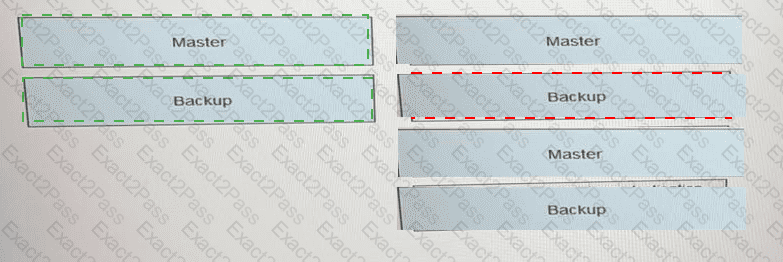
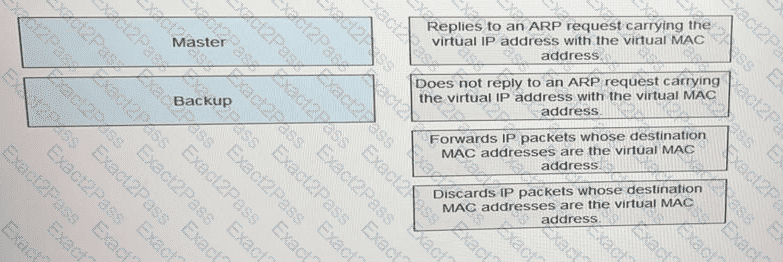
Drag the following VRRP states to the corresponding working mechanisms.
When receiving a packet that does not match any session table entry, the firewall discards the packet to prevent external attacks and ensure internal information security.