Exact2Pass

Last Update 18 hours ago Total Questions : 244
The HCIP-Datacom-Advanced Routing & Switching Technology V1.0 content is now fully updated, with all current exam questions added 18 hours ago. Deciding to include H12-831_V1.0 practice exam questions in your study plan goes far beyond basic test preparation.
You'll find that our H12-831_V1.0 exam questions frequently feature detailed scenarios and practical problem-solving exercises that directly mirror industry challenges. Engaging with these H12-831_V1.0 sample sets allows you to effectively manage your time and pace yourself, giving you the ability to finish any HCIP-Datacom-Advanced Routing & Switching Technology V1.0 practice test comfortably within the allotted time.
A network engineer enters dir on the device to obtain the following file names. Which is most likely to be the version file of the device?
OSPFv3 packets are encapsulated in IPv6 packets and can be sent in unicast, multicast, or broadcast mode.
VLAN aggregation is configured on a switched network. Sub-VLAN 2 and Sub-VLAN 3 are added to Super-VLAN 10.
To enable hosts in different Sub-VLANs to communicate with each other, run the _____ inter-sub-vlan-proxy enable command in the view of VLANIF 10, corresponding to the Super-VLAN.
(Enter the answer in lowercase letters only.)
After basic QinQ is configured on an interface of a switch, the switch adds the default VLAN tag of the interface to packets only when the interface receives tagged packets. In this way, the VLAN space is expanded.
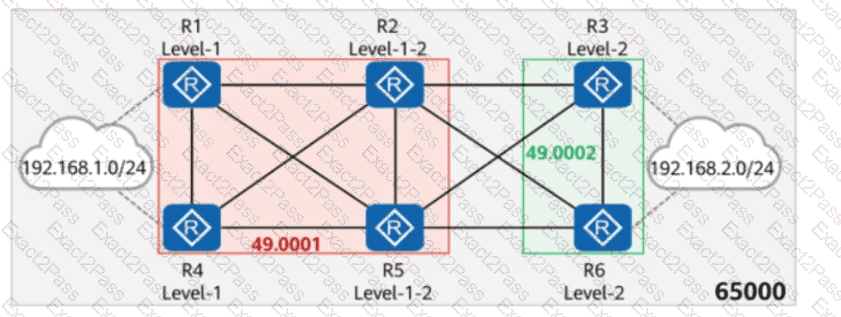
On the network shown in the figure, IS-IS runs on R1, R2, R4, and R5, and the area ID is 49.0001. IS-IS runs on R3 and R6, and the area ID is 49.0002. The import-route isis level-2 into level-1 command is configured on R2 and R5. In AS 65000, R1, R3, R4, and R6 each establish iBGP peer relationships with R2 and R5. R2 and R5 are RR (Route Reflectors), and R1, R4, R3, and R6 are the iBGP peer relationship clients. The iBGP peer relationship ID is 10.0.0.X/32, where X is the number of the iBGP router. R1 and R4 import the external route 192.168.1.0/24 to BGP through the import-route command, and R3 and R6 import the external route 192.168.2.0/24 to BGP through the import-route command. Which of the following statements are true?
If the migration preparation is insufficient, which of the following problems may occur?
Options (Multiple Choice):
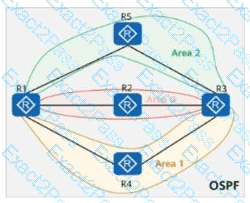
On the OSPF network shown in the figure, area 1 is a totally NSSA, area 2 is a common area, and R4 imports an external route 10.0.4.4/32. The router ID of each router is 10.0.X.X, where X is the number of the router. The asbr-summary 10.0.4.0 255.255.255.0 command is configured in the OSPF processes of R1 and R3. Which of the following statements is true?
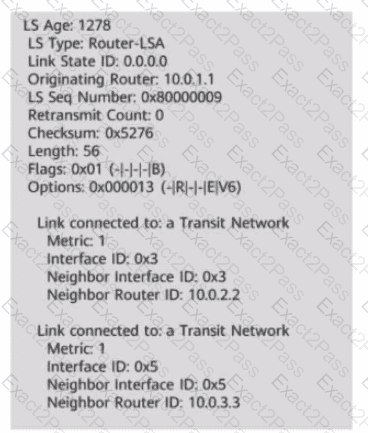
The figure shows the Router-LSA generated by a router. Which of the following statements are true based on the LSA?
On the OSPFv3 network shown in the figure:
OSPFv3 is enabled on the interfaces connecting R1, R2, and R3.
The router ID of each router is 10.0.X.X, where X is the number of the router.
When checking detailed information about an LSA on R3, the command output shows that the LSA is generated by R2 and describes the IPv6 prefix address associated with the Network-LSA.
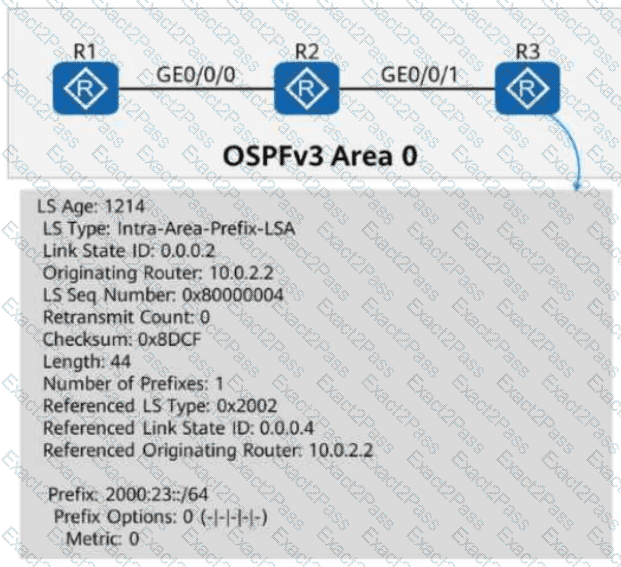
Based on this information, which of the following statements is correct?
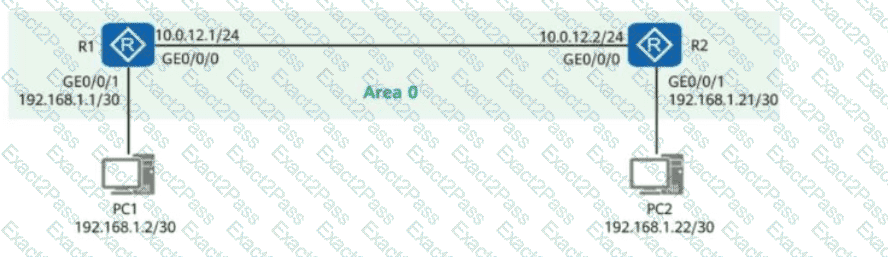
A network engineer provides a troubleshooting report after rectifying a fault. The actual network is simplified into the one shown in the figure, where:
R1 and R2 both have OSPF enabled.
R1 and R2 function as the gateways for PC1 and PC2, respectively.
Given this, which of the following statements are true?
Options: