Exact2Pass

Last Update 20 hours ago Total Questions : 418
The PECB Certified ISO/IEC 27001 2022 Lead Auditor exam content is now fully updated, with all current exam questions added 20 hours ago. Deciding to include ISO-IEC-27001-Lead-Auditor practice exam questions in your study plan goes far beyond basic test preparation.
You'll find that our ISO-IEC-27001-Lead-Auditor exam questions frequently feature detailed scenarios and practical problem-solving exercises that directly mirror industry challenges. Engaging with these ISO-IEC-27001-Lead-Auditor sample sets allows you to effectively manage your time and pace yourself, giving you the ability to finish any PECB Certified ISO/IEC 27001 2022 Lead Auditor exam practice test comfortably within the allotted time.
You are performing an ISMS audit at a residential nursing home that provides healthcare services. The next step in your audit plan is to verify the information security incident management process. The IT Security Manager presents the information security incident management procedure and explains that the process is based on ISO/IEC 27035-1:2016.
You review the document and notice a statement " any information security weakness, event, and incident should be reported to the Point of Contact (PoC) within 1 hour after identification " . When interviewing staff, you found that there were differences in the understanding of the meaning of " weakness, event, and incident " .
You sample incident report records from the event tracking system for the last 6 months with summarized results in the following table.
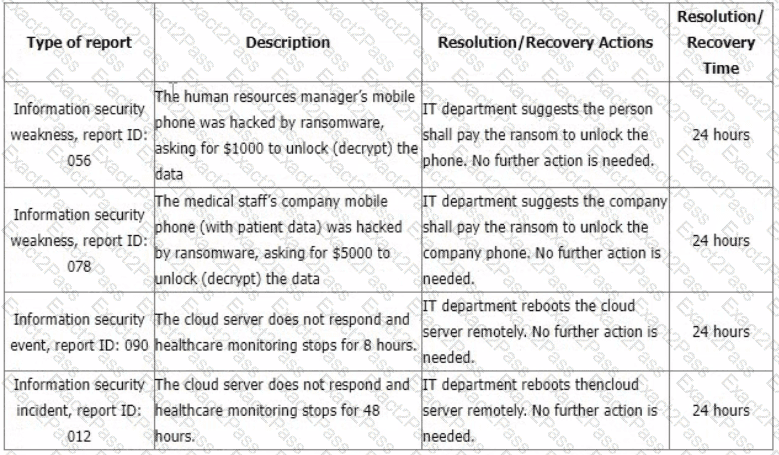
You would like to further investigate other areas to collect more audit evidence. Select two options that will not be in your audit trail.
AppFolk, a software development company, is seeking certification against ISO/IEC 27001. In the initial phases of the external audit, the certification body in discussion with the company excluded the marketing division from the audit scope, although they stated in their ISMS scope that the whole company is included. Is this acceptable?
During discussions with the individual(s) managing the audit programme of a certification body, the Management System Representative of the client organisation asks for a specific auditor for the certification audit. Select two of the following options for how the individual(s) managing the audit programme should respond.
Scenario 5: Cobt. an insurance company in London, offers various commercial, industrial, and life insurance solutions. In recent years, the number of Cobt ' s clients has increased enormously. Having a huge amount of data to process, the company decided that certifying against ISO/IEC 27001 would bring many benefits to securing information and show its commitment to continual improvement. While the company was well-versed in conducting regular risk assessments, implementing an ISMS brought major changes to its daily operations. During the risk assessment process, a risk was identified where significant defects occurred without being detected or prevented by the organizations internal control mechanisms.
The company followed a methodology to implement the ISMS and had an operational ISMS in place after only a few months After successfully implementing the ISMS, Cobt applied for ISO/IEC 27001 certification Sarah, an experienced auditor, was assigned to the audit Upon thoroughly analyzing the audit offer, Sarah accepted her responsibilities as an audit team leader and immediately started to obtain general information about Cobt She established the audit criteria and objective, planned the audit, and assigned the audit team members ' responsibilities.
Sarah acknowledged that although Cobt has expanded significantly by offering diverse commercial and insurance solutions, it still relies on some manual processes Therefore, her initial focus was to gather information on how the company manages its information security risks Sarah contacted Cobt ' s representatives to request access to information related to risk management for the off-site review, as initially agreed upon for part of the audit However, Cobt later refused, claiming that such information is too sensitive to be accessed outside of the company This refusal raised concerns about the audit ' s feasibility, particularly regarding the availability and cooperation of the auditee and access to evidence Moreover, Cobt raised concerns about the audit schedule, stating that it does not properly reflect the recent changes the company made It pointed out that the actions to be performed during the audit apply only to the initial scope and do not encompass the latest changes made in the audit scope
Sarah also evaluated the materiality of the situation, considering the significance of the information denied for the audit objectives. In this case, the refusal by Cobt raised questions about the completeness of the audit and its ability to provide reasonable assurance. Following these situations, Sarah decided to withdraw from the audit before a certification agreement was signed and communicated her decision to Cobt and the certification body. This decision was made to ensure adherence to audit principles and maintain transparency, highlighting her commitment to consistently upholding these principles.
Based on the scenario above, answer the following question:
Question:
What type of risk did Cobt identify during the last risk assessment?
Question:
What is the purpose of using a combination of audit test plans?
During a third-party certification audit you are presented with a list of issues by an auditee. Which four of the following constitute ' external ' issues in the context of a management system to ISO/IEC 27001:2022?
Scenario 8: Tessa. Malik, and Michael are an audit team of independent and qualified experts in the field of security, compliance, and business planning and strategies. They are assigned to conduct a certification audit in Clastus, a large web design company. They have previously shown excellent work ethics, including impartiality and objectiveness, while conducting audits. This time, Clastus is positive that they will be one step ahead if they get certified against ISO/IEC 27001.
Tessa, the audit team leader, has expertise in auditing and a very successful background in IT-related issues, compliance, and governance. Malik has an organizational planning and risk management background. His expertise relies on the level of synthesis and analysis of an organization ' s security controls and its risk tolerance in accurately characterizing the risk level within an organization On the other hand, Michael is an expert in the practical security of controls assessment by following rigorous standardized programs.
After performing the required auditing activities, Tessa initiated an audit team meeting They analyzed one of Michael s findings to decide on the issue objectively and accurately. The issue Michael had encountered was a minor nonconformity in the organization ' s daily operations, which he believed was caused by one of the organization ' s IT technicians As such, Tessa met with the top management and told them who was responsible for the nonconformity after they inquired about the names of the persons responsible
To facilitate clarity and understanding, Tessa conducted the closing meeting on the last day of the audit. During this meeting, she presented the identified nonconformities to the Clastus management. However, Tessa received advice to avoid providing unnecessary evidence in the audit report for the Clastus certification audit, ensuring that the report remains concise and focused on the critical findings.
Based on the evidence examined, the audit team drafted the audit conclusions and decided that two areas of the organization must be audited before the certification can be granted. These decisions were later presented to the auditee, who did not accept the findings and proposed to provide additional information. Despite the auditee ' s comments, the auditors, having already decided on the certification recommendation, did not accept the additional information. The auditee ' s top management insisted that the audit conclusions did not represent reality, but the audit team remained firm in their decision.
Based on the scenario above, answer the following question:
Question:
After analyzing the audit conclusions, Company X accepted the risk related to a detected nonconformity and decided not to take corrective action. However, their decision was not documented. Is this acceptable?
In the context of a third-party certification audit, confidentiality is an issue in an audit programme. Select two options which correctly state the function of confidentiality in an audit
The following are purposes of Information Security, except:
Question:
How does predictive analytics help auditors in identifying potential risks?

