Exact2Pass

Last Update 20 hours ago Total Questions : 418
The PECB Certified ISO/IEC 27001 2022 Lead Auditor exam content is now fully updated, with all current exam questions added 20 hours ago. Deciding to include ISO-IEC-27001-Lead-Auditor practice exam questions in your study plan goes far beyond basic test preparation.
You'll find that our ISO-IEC-27001-Lead-Auditor exam questions frequently feature detailed scenarios and practical problem-solving exercises that directly mirror industry challenges. Engaging with these ISO-IEC-27001-Lead-Auditor sample sets allows you to effectively manage your time and pace yourself, giving you the ability to finish any PECB Certified ISO/IEC 27001 2022 Lead Auditor exam practice test comfortably within the allotted time.
You are conducting a third-party surveillance audit when another member of the audit team approaches you seeking clarification. They have been asked to assess the organisation ' s application of control 5.7 - Threat Intelligence. They are aware that this is one of the new controls introduced in the 2022 edition of ISO/IEC 27001, and they want to make sure they audit the control correctly.
They have prepared a checklist to assist them with their audit and want you to confirm that their planned activities are aligned with the control ' s requirements.
Which three of the following options represent valid audit trails?
You are an ISMS audit team leader tasked with conducting a follow-up audit at a client ' s data centre. Following two days on-site you conclude that of the original 12 minor and 1 major nonconformities that prompted the follow-up audit, only 1 minor nonconformity still remains outstanding.
Select four options for the actions you could take.
The data centre at which you work is currently seeking ISO/IEC27001:2022 certification. In preparation for your initial certification visit, several internal audits have been carried out by a colleague working at another data centre within your Group. They secured their own ISO/IEC 27001:2022 certificate earlier in the year.
You have just qualified as an Internal ISMS auditor and your manager has asked you to review the audit process and audit findings as a final check before the external Certification Body arrives.
Which four of the following would cause you concern in respect of conformity to ISO/IEC 27001:2022 requirements?
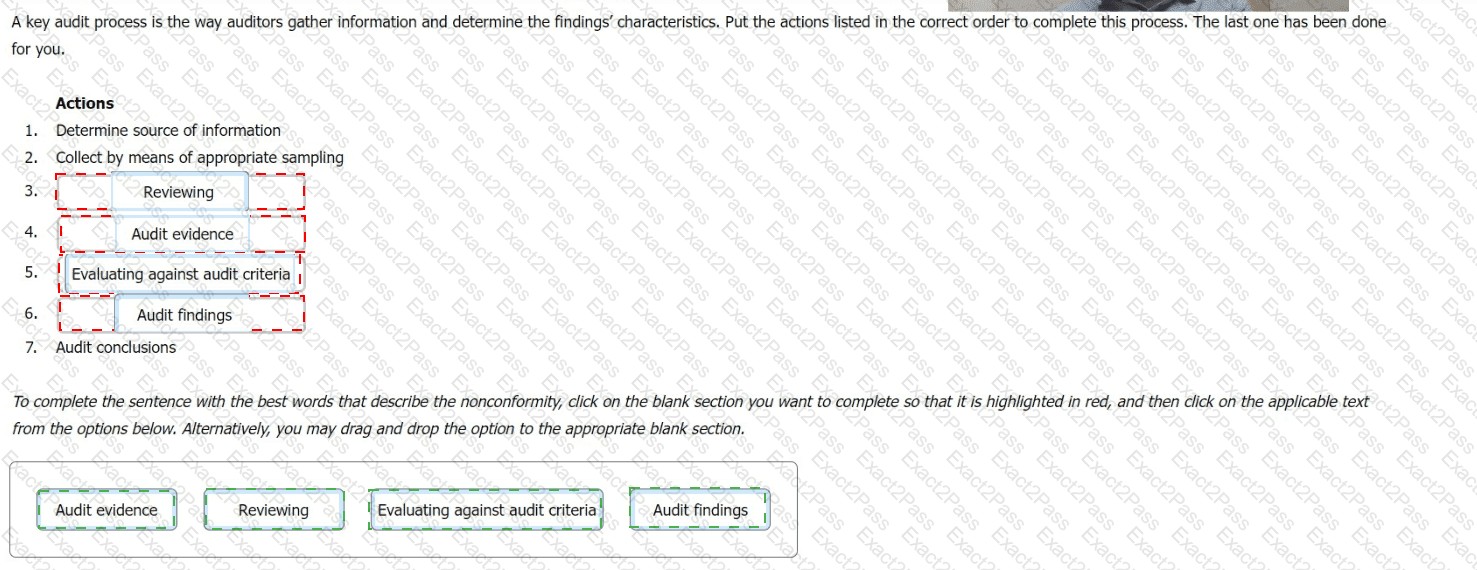
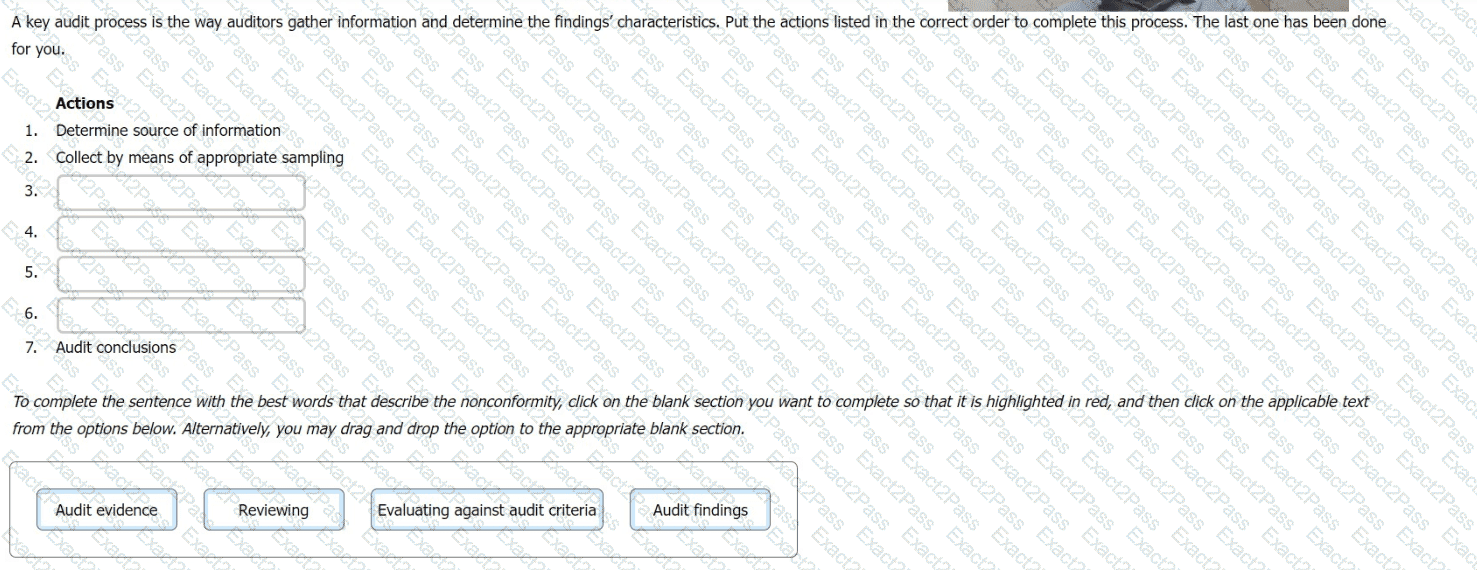
A key audit process is the way auditors gather information and determine the findings ' characteristics. Put the actions listed in the correct order to complete this process. The last one has been done for you.
Scenario 5
CyberShielding Systems Inc. provides security services spanning the entire information technology infrastructure. It provides cybersecurity software, including endpoint security, firewalls, and antivirus software. CyberShielding Systems Inc. has helped various companies secure their networks for two decades through advanced products and services. Having achieved a reputation in the information and network security sector, CyberShielding Systems Inc. decided to implement a security information management system (ISMS) based on ISO/IEC 27001 and obtain a certification to better secure its internal and customer assets and gain a competitive advantage.
The certification body initiated the process by selecting the audit team for CyberShielding Systems Inc. ' s ISO/IEC 27001 certification. They provided the company with the name and background information of each audit member. However, upon review, CyberShielding Systems Inc. discovered that one of the auditors did not hold the security clearance required by them. Consequently, the company objected to the appointment of this auditor. Upon review, the certification body replaced the auditor in response to CyberShielding Systems Inc. ' s objection.
As part of the audit process, CyberShielding Systems Inc. ' s approach to risk and opportunity determination was assessed as a standalone activity. This involved examining the organization’s methods for identifying and managing risks and opportunities. The audit team’s core objectives encompassed providing assurance on the effectiveness of CyberShielding Systems Inc. ' s risk and opportunity identification mechanisms and reviewing the organization ' s strategies for addressing these determined risks and opportunities. During this, the audit team also identified a risk due to a lack of oversight in the firewall configuration review process, where changes were implemented without proper approval, potentially exposing the company to vulnerabilities. This finding highlighted the need for stronger internal controls to prevent such issues.
The audit team accessed process descriptions and organizational charts to understand the main business processes and controls. They performed a limited analysis of the IT risks and controls because their access to the IT infrastructure and applications was limited by third-party service provider restrictions. However, the audit team stated that the risk of a significant defect occurring in CyberShielding’s ISMS was low since most of the company ' s processes were automated. They therefore evaluated that the ISMS, as a whole, conforms to the standard requirements by questioning CyberShielding representatives on IT responsibilities, control effectiveness, and anti-malware measures. CyberShielding’s representatives provided sufficient and appropriate evidence to address all these questions.
Despite the agreement signed before the audit, which outlined the audit scope, criteria, and objectives, the audit was primarily focused on assessing conformity with established criteria and ensuring compliance with statutory and regulatory requirements.
Question
Did the certification body have a valid reason to accept CyberShielding Systems Inc.’s objection to the appointed auditor for their ISO/IEC 27001 certification audit?
Scenario 3
NightCore, a multinational technology enterprise headquartered in the United States, specializes in e-commerce, cloud computing, digital streaming, and artificial intelligence (AI). After having an information security management system (ISMS) implemented for over a year, NightCore contracted a certification body to perform an audit for ISO/IEC 27001 certification.
The certification body formed a team of five auditors, with Jack as a team leader. Jack is renowned for his extensive auditing experience in risk management, information security controls, and incident management. His skill set aligns well with the requirements of auditing principles and processes, enabling him to effectively comprehend the audit scope and apply relevant criteria effectively. Jack also demonstrates a solid understanding of NightCore’s organizational structure, purpose, and management practices and the statutory and regulatory requirements applicable to its activities.
The audit carried out by the audit team followed a rational method to reach reliable and reproducible conclusions systematically. The audit team recognized that only information capable of being verified to some extent should be considered valid evidence. In some rare instances during the audit where the verification of certain information posed challenges and where its degree of verifiability was low, the auditors exercised their professional judgment to assess the reliability and determine the level of reliance that could be placed on such evidence.
During the audit, the auditors documented their observations and inspection notes regarding the operational planning and control of NightCore’s ISMS operations. They also recorded observations of NightCore’s inventory of information and associated assets. Additionally, the auditors reviewed the configuration of firewalls implemented to secure connections to network services.
As the audit approached its final stages, NightCore’s commitment to upholding the highest levels of information security became evident. With ISO/IEC 27001 certification within reach, NightCore is well-positioned to achieve ISO/IEC 27001 certification, enhancing its reputation in the technology sector.
Question
Based on Scenario 3, what approach or method did the audit team employ to reach conclusions in NightCore’s audit process?
Which option below is NOT a role of the audit team leader?
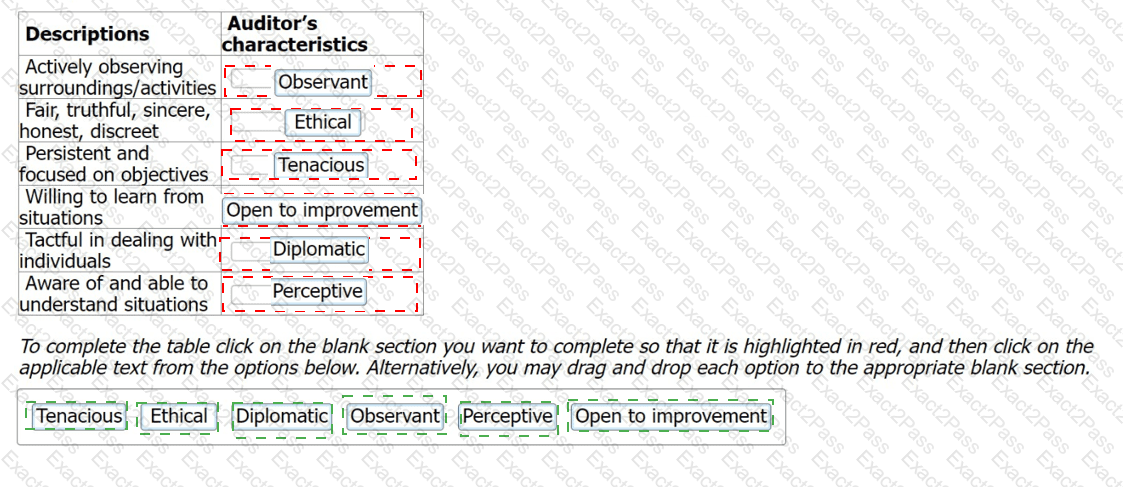
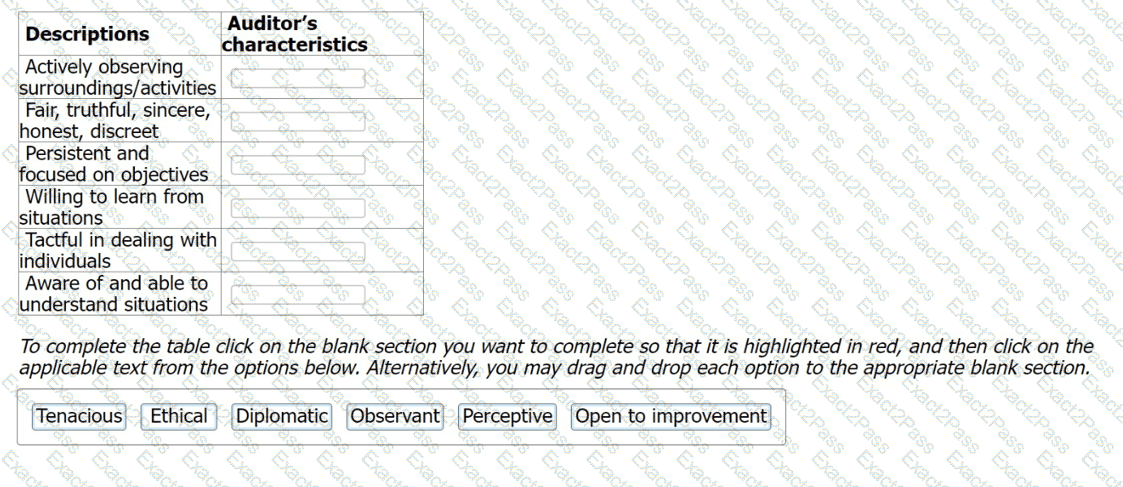
Auditors need to communicate effectively with auditees. Therefore, their personal behaviour is a key characteristic needed to ensure a successful audit. Below there are the characteristics and a brief related description. Match the characteristics to the descriptions.
Implement plan on a test basis - this comes under which section of PDCA
Scenario:
Northstorm is an online retail shop offering unique vintage and modern accessories. It initially entered a small market but gradually grew thanks to the development of the overall e-commerce landscape. Northstorm works exclusively online and ensures efficient payment processing, inventory management, marketing tools, and shipment orders. It uses prioritized ordering to receive, restock, and ship its most popular products.
Northstorm has traditionally managed its IT operations by hosting its website and maintaining full control over its infrastructure, including hardware, software, and data administration. However, this approach hindered its growth due to the lack of responsive infrastructure. Seeking to enhance its e-commerce and payment systems, Northstorm opted to expand its in-house data centers, completing the expansion in two phases over three months. Initially, the company upgraded its core servers, point-of-sale, ordering, billing, database, and backup systems. The second phase involved improving mail, payment, and network functionalities. Additionally, during this phase, Northstorm adopted an international standard for personally identifiable information (PII) controllers and PII processors regarding PII processing to ensure its data handling practices were secure and compliant with global regulations.
Despite the expansion, Northstorm ' s upgraded data centers failed to meet its evolving business demands. This inadequacy led to several new challenges, including issues with order prioritization. Customers reported not receiving priority orders, and the company struggled with responsiveness. This was largely due to the main server ' s inability to process orders from YouDecide, an application designed to prioritize orders and simulate customer interactions. The application, reliant on advanced algorithms, was incompatible with the new operating system (OS) installed during the upgrade.
Faced with urgent compatibility issues, Northstorm quickly patched the application without proper validation, leading to the installation of a compromised version. This security lapse resulted in the main server being affected and the company ' s website going offline for a week. Recognizing the need for a more reliable solution, the company decided to outsource its website hosting to an e-commerce provider. The company signed a confidentiality agreement concerning product ownership and conducted a thorough review of user access rights to enhance security before transitioning.
Question:
Based on Scenario 1, which international standard did Northstorm adopt during the second phase of expansion?