Exact2Pass

Last Update 20 hours ago Total Questions : 418
The PECB Certified ISO/IEC 27001 2022 Lead Auditor exam content is now fully updated, with all current exam questions added 20 hours ago. Deciding to include ISO-IEC-27001-Lead-Auditor practice exam questions in your study plan goes far beyond basic test preparation.
You'll find that our ISO-IEC-27001-Lead-Auditor exam questions frequently feature detailed scenarios and practical problem-solving exercises that directly mirror industry challenges. Engaging with these ISO-IEC-27001-Lead-Auditor sample sets allows you to effectively manage your time and pace yourself, giving you the ability to finish any PECB Certified ISO/IEC 27001 2022 Lead Auditor exam practice test comfortably within the allotted time.
You are an experienced ISMS audit team leader conducting a third-party surveillance audit of an internet services provider. You are reviewing the organization ' s risk assessment processes for conformity with ISO/IEC 27001:2022.
Which three of the following audit findings would prompt you to raise a nonconformity report?
Scenario 9: Techmanic is a Belgian company founded in 1995 and currently operating in Brussels. It provides IT consultancy, software design, and hardware/software services, including deployment and maintenance. The company serves sectors like public services, finance, telecom, energy, healthcare, and education. As a customer-centered company, it prioritizes strong client relationships and leading security practices.
Techmanic has been ISO/IEC 27001 certified for a year and regards this certification with pride. During the certification audit, the auditor found some inconsistencies in its ISMS implementation. Since the observed situations did not affect the capability of its ISMS to achieve the intended results, Techmanic was certified after auditors followed up on the root cause analysis and corrective actions remotely During that year, the company added hosting to its list of services and requested to expand its certification scope to include that area The auditor in charge approved the request and notified Techmanic that the extension audit would be conducted during the surveillance audit
Techmanic underwent a surveillance audit to verify its iSMS ' s continued effectiveness and compliance with ISO/IEC 27001. The surveillance audit aimed to ensure that Techmanic’s security practices, including the recent addition of hosting services, aligned seamlessly with the rigorous requirements of the certification
The auditor strategically utilized the findings from previous surveillance audit reports in the recertification activity with the purpose of replacing the need for additional recertification audits, specifically in the IT consultancy sector. Recognizing the value of continual improvement and learning from past assessments. Techmanic implemented a practice of reviewing previous surveillance audit reports. This proactive approach not only facilitated identifying and resolving potential nonconformities but also aimed to streamline the recertification process in the IT consultancy sector.
During the surveillance audit, several nonconformities were found. The ISMS continued to fulfill the ISO/IEC 27001*s requirements, but Techmanic failed to resolve the nonconformities related to the hosting services, as reported by its internal auditor. In addition, the internal audit report had several inconsistencies, which questioned the independence of the internal auditor during the audit of hosting services. Based on this, the extension certification was not granted. As a result. Techmanic requested a transfer to another certification body. In the meantime, the company released a statement to its clients stating that the ISO/IEC 27001 certification covers the IT services, as well as the hosting services.
Based on the scenario above, answer the following question:
Question:
What action should be taken regarding Techmanic’s certification?
Question
An organization requires all employees to undergo security awareness training every six months. The training covers topics such as recognizing phishing attacks, handling sensitive data, and reporting security incidents. After completing the training, employees must pass a short quiz to demonstrate their understanding.
What type of control does this activity represent?
Scenario 1: Fintive is a distinguished security provider for online payments and protection solutions. Founded in 1999 by Thomas Fin in San Jose, California, Fintive
offers services to companies that operate online and want to improve their information security, prevent fraud, and protect user information such as PII. Fintive centers
its decision-making and operating process based on previous cases. They gather customer data, classify them depending on the case, and analyze them. The company
needed a large number of employees to be able to conduct such complex analyses. After some years, however, the technology that assists in conducting such analyses
advanced as well. Now, Fintive is planning on using a modern tool, a chatbot, to achieve pattern analyses toward preventing fraud in real-time. This tool would also be
used to assist in improving customer service.
This initial idea was communicated to the software development team, who supported it and were assigned to work on this project. They began integrating the chatbot
on their existing system. In addition, the team set an objective regarding the chatbot which was to answer 85% of all chat queries.
After the successful integration of the chatbot, the company immediately released it to their customers for use. The chatbot, however, appeared to have some issues.
Due to insufficient testing and lack of samples provided to the chatbot during the training phase, in which it was supposed " to learn " the queries pattern, the chatbot
failed to address user queries and provide the right answers. Furthermore, the chatbot sent random files to users when it received invalid inputs such as odd patterns
of dots and special characters. Therefore, the chatbot was unable to properly answer customer queries and the traditional customer support was overwhelmed with
chat queries and thus was unable to help customers with their requests.
Consequently, Fintive established a software development policy. This policy specified that whether the software is developed in-house or outsourced, it will undergo a
black box testing prior to its implementation on operational systems.
According to scenario 1, the chatbot sent random files to users when it received invalid inputs. What impact might that lead to?
You are conducting an ISMS audit in the despatch department of an international logistics organisation that provides shipping services to large organisations including local hospitals and government offices. Parcels typically contain pharmaceutical products, biological samples, and documents such as passports and driving licences. You note that the company records show a very large number of returned items with causes including mis-addressed labels and, in 15% of company cases, two or more labels for different addresses for the one package. You are interviewing the Shipping Manager (SM).
You: Are items checked before being dispatched?
SH: Any obviously damaged items are removed by the duty staff before being dispatched, but the small profit margin makes it uneconomic to implement a formal checking process.
You: What action is taken when items are returned?
SM: Most of these contracts are relatively low value, therefore it has been decided that it is easier and more convenient to simply reprint the label and re-send individual parcels than it is to implement an investigation.
You raise a nonconformity. Referencing the scenario, which six of the following Appendix A controls would you expect the auditee to have implemented when you conduct the follow-up audit?
You are performing an ISMS audit at a residential nursing home called ABC that provides healthcare services.
The next step in your audit plan is to verify the information security of ABC ' s healthcare mobile app development, support, and lifecycle process. During the audit, you learned the organisation outsourced the mobile app development to a professional software development organisation with CMMI Level 5, ITSM
(ISO/IEC 20000-1), BCMS (ISO 22301) and ISMS (ISO/IEC 27001) certified.
The IT Manager presents the software security management procedure and summarises the process as follows:
The mobile app development shall adopt " security-by-design " and " security-by-default " principles, as a minimum. The following security functions for personal data protection shall be available:
Access control.
Personal data encryption, i.e., Advanced Encryption Standard (AES) algorithm, key lengths: 256 bits; and
Personal data pseudonymization.
Vulnerability checked and no security backdoor
You sample the latest Mobile App Test report - Reference ID: 0098, details as follows:
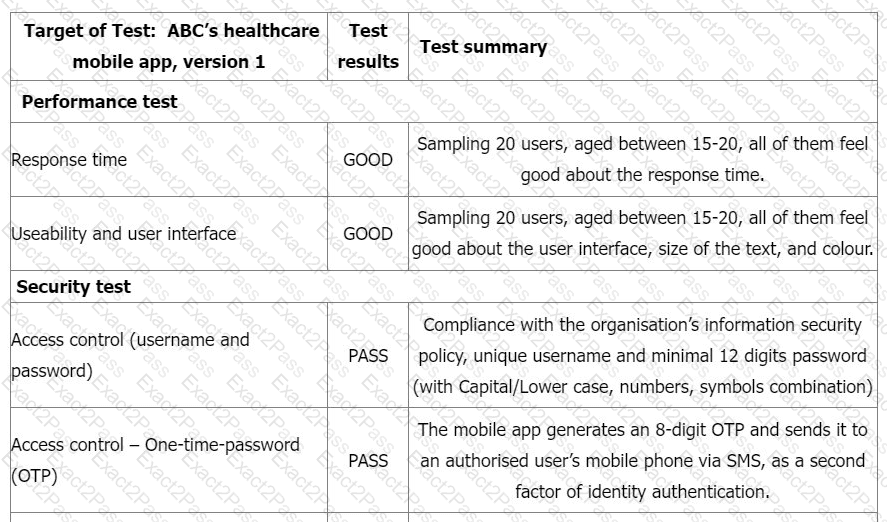
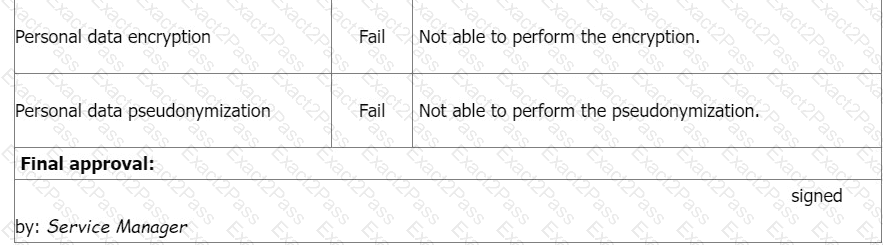
You would like to investigate other areas further to collect more audit evidence. Select three options that will not be in your audit trail.
You are an experienced audit team leader conducting a third-party surveillance audit of an organisation that designs websites for its clients. You are currently reviewing the organisation ' s Statement of Applicability.
Based on the requirements of ISO/IEC 27001, which two of the following observations about the Statement of Applicability are true?
Which one of the following options is the definition of the context of an organisation?
To verify conformity to control 8.15 Logging of ISO/IEC 27001 Annex A, the audit team verified a sample of server logs to determine if they can be edited or deleted. Which audit procedure was used?
You are the person responsible for managing the audit programme and deciding the size and composition of the audit team for a specific audit. Select the two factors that should be considered.
The audit scope and criteria

