Exact2Pass

Last Update 20 hours ago Total Questions : 418
The PECB Certified ISO/IEC 27001 2022 Lead Auditor exam content is now fully updated, with all current exam questions added 20 hours ago. Deciding to include ISO-IEC-27001-Lead-Auditor practice exam questions in your study plan goes far beyond basic test preparation.
You'll find that our ISO-IEC-27001-Lead-Auditor exam questions frequently feature detailed scenarios and practical problem-solving exercises that directly mirror industry challenges. Engaging with these ISO-IEC-27001-Lead-Auditor sample sets allows you to effectively manage your time and pace yourself, giving you the ability to finish any PECB Certified ISO/IEC 27001 2022 Lead Auditor exam practice test comfortably within the allotted time.
Scenario:
Northstorm is an online retail shop offering unique vintage and modern accessories. It initially entered a small market but gradually grew thanks to the development of the overall e-commerce landscape. Northstorm works exclusively online and ensures efficient payment processing, inventory management, marketing tools, and shipment orders. It uses prioritized ordering to receive, restock, and ship its most popular products.
Northstorm has traditionally managed its IT operations by hosting its website and maintaining full control over its infrastructure, including hardware, software, and data administration. However, this approach hindered its growth due to the lack of responsive infrastructure. Seeking to enhance its e-commerce and payment systems, Northstorm opted to expand its in-house data centers, completing the expansion in two phases over three months. Initially, the company upgraded its core servers, point-of-sale, ordering, billing, database, and backup systems. The second phase involved improving mail, payment, and network functionalities. Additionally, during this phase, Northstorm adopted an international standard for personally identifiable information (PII) controllers and PII processors regarding PII processing to ensure its data handling practices were secure and compliant with global regulations.
Despite the expansion, Northstorm ' s upgraded data centers failed to meet its evolving business demands. This inadequacy led to several new challenges, including issues with order prioritization. Customers reported not receiving priority orders, and the company struggled with responsiveness. This was largely due to the main server ' s inability to process orders from YouDecide, an application designed to prioritize orders and simulate customer interactions. The application, reliant on advanced algorithms, was incompatible with the new operating system (OS) installed during the upgrade.
Faced with urgent compatibility issues, Northstorm quickly patched the application without proper validation, leading to the installation of a compromised version. This security lapse resulted in the main server being affected and the company ' s website going offline for a week. Recognizing the need for a more reliable solution, the company decided to outsource its website hosting to an e-commerce provider. The company signed a confidentiality agreement concerning product ownership and conducted a thorough review of user access rights to enhance security before transitioning.
Question:
Which of the following situations represents a vulnerability in Northstorm’s systems?
You are an experienced ISMS audit team leader providing guidance to an auditor in training.
The auditor in training appears to be confused about the interpretation of competence in ISO 27001:2022 and is seeking clarification from you that his understanding is correct. He sets out a series of mini scenarios and asks you which of these you would attribute to a lack of competence. Select four correct options.
Which is not a requirement of HR prior to hiring?
Scenario 9
CloudFort, a small networking company, provides network security, cloud computing, and virtualization solutions. The company has recently been certified in an information security management system (ISMS) based on the ISO/IEC 27001 standard, which has resulted in a spike in its recognition, confirming the maturity of CloudFort’s operations.
CloudFort continually reviewed and enhanced its security controls and the overall effectiveness and efficiency of the ISMS by conducting internal audits. Due to its size and desire for greater objectivity, top management decided to outsource the internal audit function to ensure the internal audit is independent of the audited activities and holds an advisory role in the continual improvement of the ISMS.
After the initial certification audit, the company created a new department specializing in data storage solutions. It offered routers and switches optimized for data centers and software-based networking devices, such as network virtualization and network security appliances. Because of the new department, CloudFort initiated a risk assessment process and an internal audit. Following the internal audit results, the company confirmed the effectiveness and efficiency of the new processes and controls.
After determining that the new department fully complies with ISO/IEC 27001 requirements, top management decided to include it in the certification scope. They submitted a request to the certification body for an extension of the certification scope to ensure that the department’s processes and security measures fully align with the overall ISMS.
One year after the initial certification audit, the certification body conducted another audit of CloudFort ' s ISMS. This audit aimed to determine CloudFort’s ISMS fulfillment of specified ISO/IEC 27001 requirements and ensure continual improvement. The audit team confirmed that the certified ISMS fulfills the standard requirements. Nonetheless, the new department introduced changes that significantly affected how the overall management system was governed, requiring updates to existing processes and controls.
Moreover, although CloudFort requested an extension of the certification scope, they failed to provide timely updates on the impact of the new department on the ISMS to the certification body. Thus, CloudFort’s certification was suspended.
Question
Based on Scenario 9, why was CloudFort’s certification suspended?
Select the words that best complete the sentence to describe an audit finding.

Which two of the following standards are used as ISMS third-party certification audit criteria?
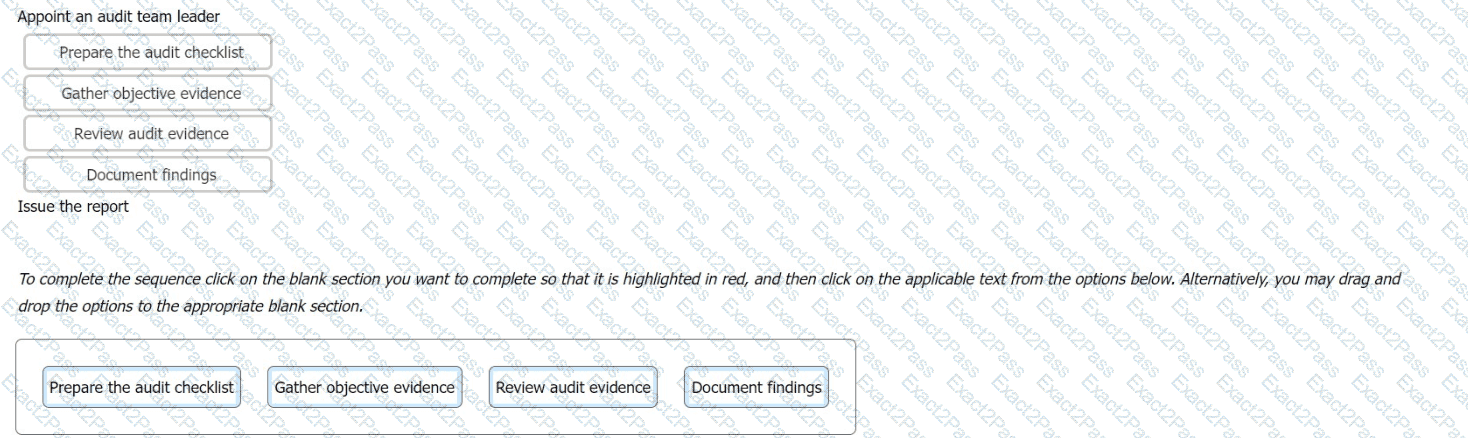
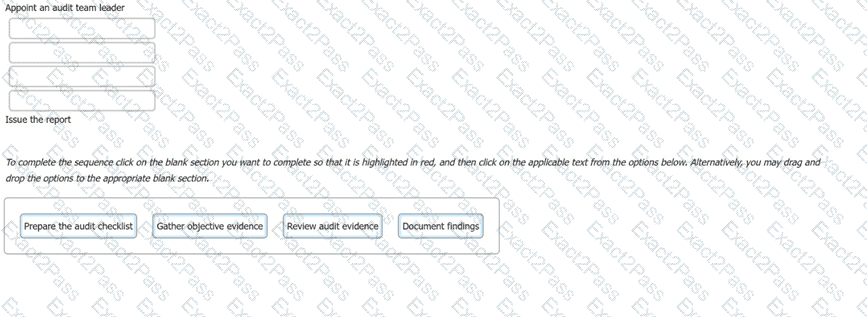
The following options are key actions involved in a first-party audit. Order the stages to show the sequence in which the actions should take place.
Scenario 7: Lawsy is a leading law firm with offices in New Jersey and New York City. It has over 50 attorneys offering sophisticated legal services to clients in business and commercial law, intellectual property, banking, and financial services. They believe they have a comfortable position in the market thanks to their commitment to implement information security best practices and remain up to date with technological developments.
Lawsy has implemented, evaluated, and conducted internal audits for an ISMS rigorously for two years now. Now, they have applied for ISO/IEC 27001 certification to ISMA, a well-known and trusted certification body.
During stage 1 audit, the audit team reviewed all the ISMS documents created during the implementation. They also reviewed and evaluated the records from management reviews and internal audits.
Lawsy submitted records of evidence that corrective actions on nonconformities were performed when necessary, so the audit team interviewed the internal auditor. The interview validated the adequacy and frequency of the internal audits by providing detailed insight into the internal audit plan and procedures.
The audit team continued with the verification of strategic documents, including the information security policy and risk evaluation criteria. During the information security policy review, the team noticed inconsistencies between the documented information describing governance framework (i.e., the information security policy) and the procedures.
Although the employees were allowed to take the laptops outside the workplace, Lawsy did not have procedures in place regarding the use of laptops in such cases. The policy only provided general information about the use of laptops. The company relied on employees ' common knowledge to protect the confidentiality and integrity of information stored in the laptops. This issue was documented in the stage 1 audit report.
Upon completing stage 1 audit, the audit team leader prepared the audit plan, which addressed the audit objectives, scope, criteria, and procedures.
During stage 2 audit, the audit team interviewed the information security manager, who drafted the information security policy. He justified the Issue identified in stage 1 by stating that Lawsy conducts mandatory information security training and awareness sessions every three months.
Following the interview, the audit team examined 15 employee training records (out of 50) and concluded that Lawsy meets requirements of ISO/IEC 27001 related to training and awareness. To support this conclusion, they photocopied the examined employee training records.
Based on the scenario above, answer the following question:
Lawsy lacks a procedure regarding the use of laptops outside the workplace and it relies on employees ' common knowledge to protect the confidentiality of information stored in the laptops. This presents:
Which two of the following phrases would apply to " audit objectives " ?
You are conducting a third-party surveillance audit when another member of the audit team approaches you seeking clarification. They have been asked to assess the organisation ' s application of control 5.7 - Threat Intelligence. They are aware that this is one of the new controls introduced in the 2022 edition of ISO/IEC 27001, and they want to make sure they audit the control correctly.
They have prepared a checklist to assist them with their audit and want you to confirm that their planned activities are aligned with the control ' s requirements.
Which three of the following options represent valid audit trails?