Summer Sale Special Limited Time 70% Discount Offer - Ends in 0d 00h 00m 00s - Coupon code: buysanta

Exact2Pass Menu

Security, Specialist (JNCIS-SEC)

Last Update 15 hours ago Total Questions : 98

The Security, Specialist (JNCIS-SEC) content is now fully updated, with all current exam questions added 15 hours ago. Deciding to include JN0-335 practice exam questions in your study plan goes far beyond basic test preparation.

You'll find that our JN0-335 exam questions frequently feature detailed scenarios and practical problem-solving exercises that directly mirror industry challenges. Engaging with these JN0-335 sample sets allows you to effectively manage your time and pace yourself, giving you the ability to finish any Security, Specialist (JNCIS-SEC) practice test comfortably within the allotted time.

Question # 1

After JSA receives external events and flows, which two steps occur? (Choose two.)

A.

After formatting the data, the data is stored in an asset database.

B.

Before formatting the data, the data is analyzed for relevant information.

C.

Before the information is filtered, the information is formatted

D.

After the information is filtered, JSA responds with active measures

Question # 2

Which two statements about SRX chassis clustering are correct? (Choose two.)

A.

SRX chassis clustering supports active/passive and active/active for the data plane.

B.

SRX chassis clustering only supports active/passive for the data plane.

C.

SRX chassis clustering supports active/passive for the control plane.

D.

SRX chassis clustering supports active/active for the control plane.

Question # 3

Which statement defines the function of an Application Layer Gateway (ALG)?

A.

The ALG uses software processes for permitting or disallowing specific IP address ranges.

B.

The ALG uses software that is used by a single TCP session using the same port numbers as the application.

C.

The ALG contains protocols that use one application session for each TCP session.

D.

The ALG uses software processes for managing specific protocols.

Question # 4

You are asked to create an IPS-exempt rule base to eliminate false positives from happening.

Which two configuration parameters are available to exclude traffic from being examined? (Choose two.)

A.

source port

B.

source IP address

C.

destination IP address

D.

destination port

Question # 5

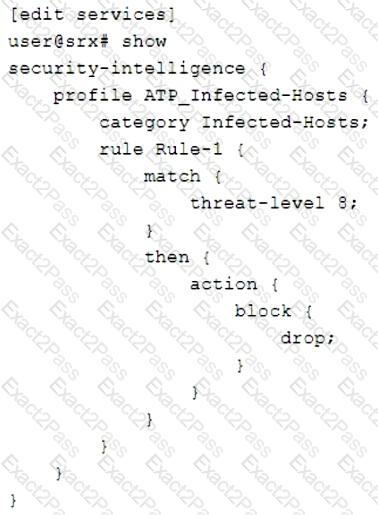
Click the Exhibit button.

Referring to the exhibit, what will the SRX Series device do in this configuration?

A.

Packets from the infected hosts with a threat level of 8 will be dropped and a log message will be generated.

B.

Packets from the infected hosts with a threat level of 8 or above will be dropped and a log message will be generated.

C.

Packets from the infected hosts with a threat level of 8 or above will be dropped and no log message will be generated.

D.

Packets from the infected hosts with a threat level of 8 will be dropped and no log message will be generated.

Question # 6

You administer a JSA host and want to include a rule that sets a threshold for excessive firewall denies and sends an SNMP trap after receiving related syslog messages from an SRX Series firewall.

Which JSA rule type satisfies this requirement?

A.

common

B.

offense

C.

flow

D.

event

Question # 7
A.

IPS is integrated as a security service on SRX Series devices.

B.

IPS uses sandboxinQ to detect unknown attacks.

C.

IPS is a standalone platform running on dedicated hardware or as a virtual device.

D.

IPS uses protocol anomaly rules to detect unknown attacks.

Question # 8

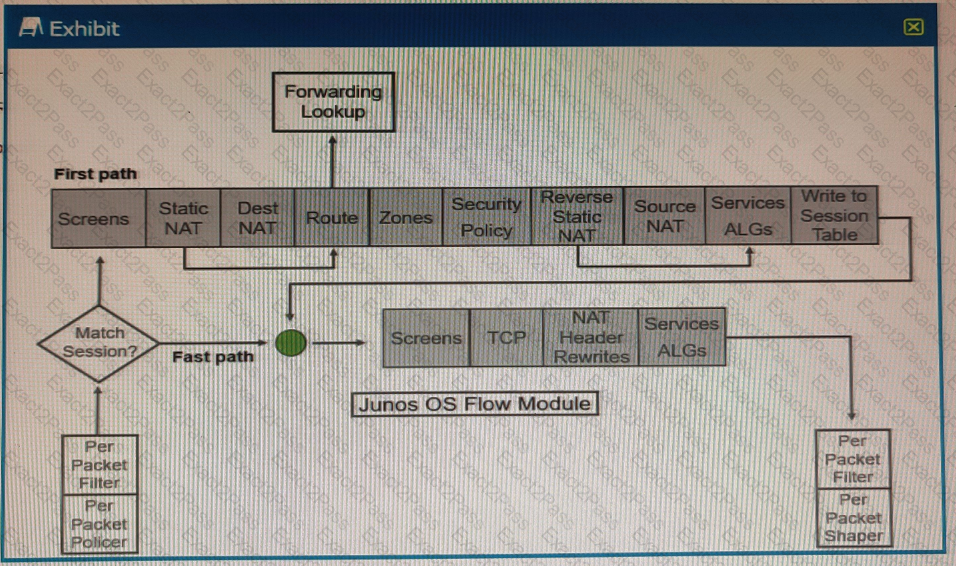
Exhibit

Referring to the SRX Series flow module diagram shown in the exhibit, where is application security processed?

A.

Forwarding Lookup

B.

Services ALGs

C.

Security Policy

D.

Screens

Question # 9

You are experiencing excessive packet loss on one of your two WAN links route traffic from the degraded link to the working link

Which AppSecure component would you use to accomplish this task?

A.

AppFW

B.

AppQoE

C.

AppQoS

D.

APBR

Question # 10

Which two statements are true about Juniper ATP Cloud? (Choose two.)

A.

Dynamic analysis is always performed to determine if a file contains malware.

B.

If the cache lookup determines that a file contains malware, performed to verify the results.

C.

Dynamic analysis is not always necessary to determine if a file contains malware.

D.

If the cache lookup determines that a file contains malware, static analysis is not performed to verify the results.

Go to page: