Spring Sale Special Limited Time 70% Discount Offer - Ends in 0d 00h 00m 00s - Coupon code: buysanta

Exact2Pass Menu

Security, Professional (JNCIP-SEC)

Last Update 12 hours ago Total Questions : 115

The Security, Professional (JNCIP-SEC) content is now fully updated, with all current exam questions added 12 hours ago. Deciding to include JN0-637 practice exam questions in your study plan goes far beyond basic test preparation.

You'll find that our JN0-637 exam questions frequently feature detailed scenarios and practical problem-solving exercises that directly mirror industry challenges. Engaging with these JN0-637 sample sets allows you to effectively manage your time and pace yourself, giving you the ability to finish any Security, Professional (JNCIP-SEC) practice test comfortably within the allotted time.

Question # 11

You have configured the backup signal route IP for your multinode HA deployment, and the ICL link fails.

Which two statements are correct in this scenario? (Choose two.)

A.

The current active node retains the active role.

B.

The active node removes the active signal route.

C.

The backup node changes the routing preference to the other node at its medium priority.

D.

The active node keeps the active signal route.

Question # 12

You are asked to see if your persistent NAT binding table is exhausted.

Which show command would you use to accomplish this task?

A.

show security nat source persistent-nat-table summary

B.

show security nat source summary

C.

show security nat source pool all

D.

show security nat source persistent-nat-table all

Question # 13

Which two elements are necessary to configure a rule under an APBR profile? (Choose Two)

A.

instance type

B.

match condition

C.

then action

D.

RIB group

Question # 14

Which two statements are correct about automated threat mitigation with Security Director? (Choose two.)

A.

It works with third-party switches.

B.

It provides endpoint protection by running a Juniper ATP Cloud agent on the servers.

C.

It provides endpoint protection by running a Juniper ATP Cloud agent on EX Series devices.

D.

It works with SRX Series devices.

Question # 15

You configured two SRX series devices in an active/passive multimode HA setup.

In this scenario, which statement is correct?

A.

Both devices are in the passive state until the activeness determination process is completed.

B.

Both devices start in a hold state until the activeness determination process is completed.

C.

Both devices start in the undiscovered state until the activeness determination process is completed.

D.

Both devices are in the active state until the activeness determine determination process is completed.

Question # 16

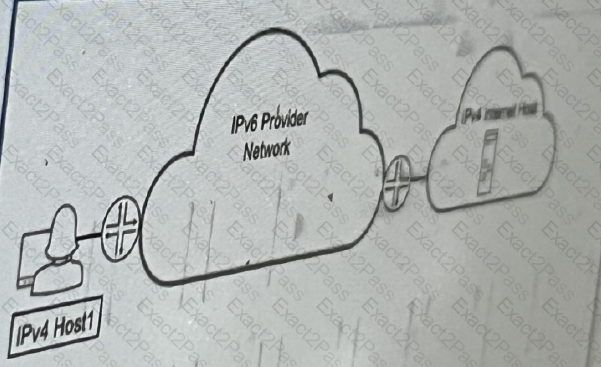
Exhibit:

Referring to the exhibit, which technology would you use to provide communication between

IPv4 host1 and ipv4 internal host

A.

DS-Lite

B.

NAT444

C.

NAT46

D.

full cone NAT

Question # 17

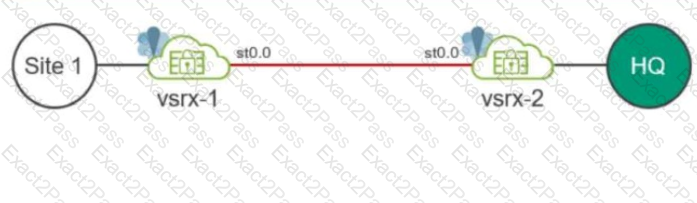
Exhibit:

Your company uses SRX Series devices to establish an IPsec VPN that connects Site-1 and the HQ networks. You want VoIP traffic to receive priority over data traffic when it is forwarded across the VPN.

Which three actions should you perform in this scenario? (Choose three.)

A.

Enable next-hop tunnel binding.

B.

Create a firewall filter that identifies VoIP traffic and associates it with the correct forwarding class.

C.

Configure CoS forwarding classes and scheduling parameters.

D.

Enable the copy-outer-dscp parameter so that DSCP header values are copied to the tunneled packets.

E.

Enable the multi-sa parameter to enable two separate IPsec SAs for the VoIP and data traffic.

Question # 18

What are three configurable monitor components for a service redundancy group? (Choose two)

A.

Interface

B.

BFD

C.

hardware alarm

D.

IP

E.

ARP

Question # 19

You are asked to establish a hub-and-spoke IPsec VPN using an SRX Series device as the hub. All of the spoke devices are third-party devices.

Which statement is correct in this scenario?

A.

You must ensure that you are using aggressive mode when incorporating third-party devices as your spokes.

B.

You must statically configure the next-hop tunnel binding table entries for each of the third-party spoke devices.

C.

You must create a policy-based VPN on the hub device when peering with third-party devices.

D.

You must always peer using loopback addresses when using non-Junos devices as your spokes.

Question # 20

A customer wants to be able to initiate a return connection to an internal host from a specific

Server.

Which NAT feature would you use in this scenario?

A.

target-host

B.

any-remote-host

C.

port-overloading

D.

target-server

Go to page: